
Whatever Happened to Baby Jane? [Movie Review]

It all started with a friend’s recommendation to watch Will and Grace. The hit sitcom was released in 1998, when I was a few months shy of being four years old. I didn’t get many of the references, but one caught my attention.

Will was harshly handling his mother while she was on a wheelchair, and Karen said “Careful, Baby Jane.”

I searched for the reference online and found a 1962 black-and-white film whose screengrabs looked very disturbing.

Source: Letterboxd

I wasn’t in a place where I should be watching upsetting films. (We were just told that we should be working entirely from home, and I was having a hard time adjusting again to a life of seclusion in a tiny room amidst a bustling city.)

But I was intrigued enough.

And I did not regret my decision.

Baby Jane’s Descent Into Madness

The movie is an adaptation of Henry Farrell’s novel, which was published just two years before the film.

It starts off with a young Jane (Julie Allred) performing for an adoring crowd. She was a spoiled child star who went by the name Baby Jane Hudson, and she drinks up the success provided by an early fame while her sister Blanche (Gina Gillespie) watches enviously from the sidelines.

Years later, however, Blanche (Joan Crawford) earns a name for herself, one that will become more well-known than her sister’s. Her career flourishes while Baby Jane (Bette Davis) is slowly forgotten.

Blanche continued making successful films until one night, she was run over by her drunk sister and could no longer walk. She spends the majority of the film on her wheelchair under the reluctant care of an embittered, older Jane.

Jane resents her sister for having a better career and does the bare minimum to keep her alive.

Despite her flaws, I couldn’t help but feel bad for the titular character, especially because Davis has done a great job in playing her. During close shots, you can see not only the hate but also the pain in her eyes, mixed with a determination to take back what was once hers.

I’ve watched many old films before, but this was the first time that I stopped and thought “Now that’s an actress!”

Baby Jane didn’t have a normal childhood, exposed as she was to show business at a young age. Her father controlled her activities and was keen on making sure that the crowd believes she was this sweet, darling girl who could do no wrong. And having to lose the fame slowly—to her sister, no less—must have been hard to bear.

She spirals into alcoholism and lying.

While Blanche sits helplessly in an upstairs room, Jane tries to give her now-dead career a rebirth. This endeavor will prove deadly as she continues to believe in her sister’s contribution to her misery.

Jane stands beside an original Baby Jane Hudson doll, a souvenir from her days in the sun.

An Unnecessary Tragedy

Madness, murder, and mourning—this movie has it all.

The suspenseful parts gave it a touch of brilliance, one that I used to feel only when watching an Alfred Hitchcock film. Director Robert Aldrich did a wonderful job with this work, earning him nominations to the Palme d’Or and the DGA Award.

Throughout the film, Jane’s madness grows more intense. But while she is emotionally unstable, she remains calculating, a characteristic that made her more dangerous and the viewers more uneasy.

Slowly, Jane’s madness is cemented as she acts more and more like a helpless child. In an attempt to regain her early fame, she found herself in a series of unfortunate events that she justifies with that very endeavor.

During the last few minutes of the movie, while you’d think that everything is over, the film turns on its head.

A short disclosure makes viewers question the necessity of the struggles of each character and emphasizes the dangers of fame, especially the yearning that comes after its loss.

Conclusion

I wouldn’t recommend this movie if you’re struggling with depression. It will drag you deeper into the abyss. However, if you’re looking for a great psychological thriller that will pull at your heartstrings, this is worth checking out. 

If you haven’t seen it yet, go ahead and rent it.

Afterwards, ask yourself this question: Who is the real villain in the story?
The Shawshank Redemption: A Reflective Movie Review

A young banker sits in his car. He parks in front of the house of his wife’s lover. His revolver is on his lap as he downs another gulp of liquor. Later, he was sentenced to two back-to-back life sentences for murder.

He was innocent. But that’s not important.

The Shawshank Redemption is not about Andy Dufresne’s guilt or innocence. It’s a window into the lives of those who are doomed into an eternity deprived of freedom and how they make sense of every day.

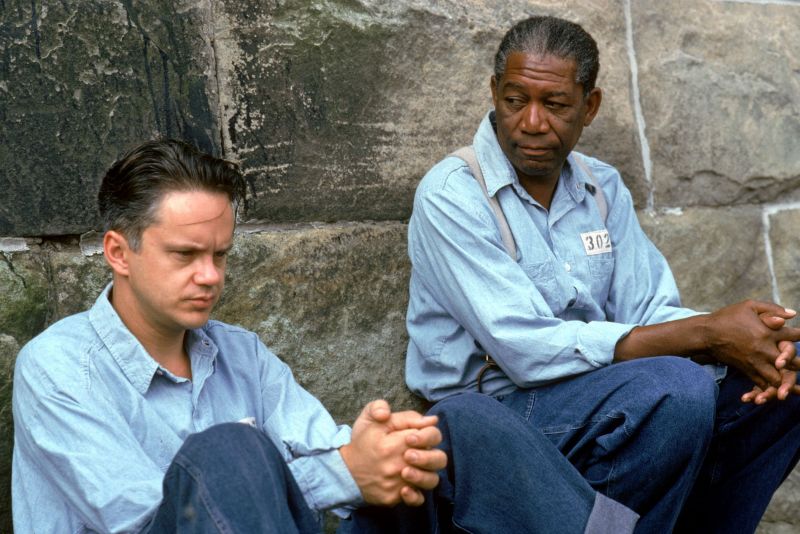
Tim Robbins had the physique and talent to portray Dufresne in this 1994 classic. His apathetic gaze and tall stature made him stand out from the many prisoners of Shawshank. He was wearing the same numbered suit, but he walked about like he didn’t belong there.

Dufresne stayed in Shawshank for almost two decades for a crime he did not commit. But anyone who is paying attention to the movie would not, for even a second, think that his stay there was for naught.

Despite his educational background, he was reduced to nothing but a lowly prisoner when that bus entered the thresholds of the prison grounds. He could have easily succumbed to his new reality and lost all hope.

Instead, he made connections with the people in power, his persistence made stronger every day, and built a library to help his fellow inmates. Some of his antics earned him time in the hole, but he always came out a better man—either happier or with a well-thought-out plan.

Watching Dufresne’s character makes it easier to deal with life’s difficulties. The audience is introduced to an innocent man who pursued worthy endeavors despite being in a situation that was neither pleasant nor warranted.

He made a lot of friends in Shawshank, the best of which was Ellis “Red” Redding (Morgan Freeman). Although already a reformed man, Red would spend a little more time behind bars until he finally gets parole. That was the day he figured he was no longer “institutionalized” as he later explained to the board who held his destiny in their hands.

He would continue his friendship with Dufresne even outside the prison walls, starting with an odd rock under an old tree and the memory of a hard-to-pronounce city in Mexico.

The story alone is poignant and impactful as it is. Couple this with Morgan Freeman’s voice as narrator, and you’re in for a memorable 2 hours and 22 minutes that you’ll treasure forever.

There’s plenty of lessons to be learned from The Shawshank Redemption.

Warden Samuel Norton (Bob Gunton) shows us that not all men who read the Bible are good.

Tommy Williams (Gil Bellows) proved that there’s plenty of hope left if you just find the right mentor and ask for help.

From Brooks Hatlen (James Whitmore), I learned that freedom does not always mean not being behind bars. Humans have the skill to make their own prisons. Some choose to stay there even after being given the choice to step out.

The Shawshank Redemption makes you think about the true meaning of freedom. In a way, it inspires hope even in the bleakest of times.

If there’s one thing I learned from the movie, it’s this: We don’t always control what happens to us. But whatever circumstances we’re in and wherever we may be, we can always find purpose. . . and a home.

Character in Focus: Nightcrawler’s Lou Bloom

Photo Source: https://www.npr.org/2014/10/30/360114076/nightcrawler-jake-gyllenhaal-were-all-complicit-in-if-it-bleeds-it-leads

How far would you go to be the best in the industry?

Jake Gyllenhaal wonderfully portrays Nightcrawler’s protagonist, the overachieving stinger (freelance photojournalist) in this 2014 Dan Gilroy film. He was the perfect man for the job because throughout the movie, he was able to maintain a look made up almost equally of determination and borderline insanity.

Bloom’s job is to capture exclusive footage of news stories which he then sells to the highest bidder. The gorier, the better.

He learned of the business by accident, after witnessing a car crash. He started acquiring his equipment by stealing, and grew his business through hard work.

But when your job depends heavily on people’s misfortunes, morality will slowly be pushed to the sidelines.

It’s hard to judge Bloom’s character during the first part of the movie. He is introduced to the audience as a thief, i.e., someone you couldn’t trust. But as his character develops, it gets easier to root for him.

He has all the qualities of a successful businessman–focus, persistence, and attention to detail. This is what makes his character so much more interesting. Viewers will be having a hard time deciding between admiration and disgust when looking at Bloom.

After beating the police to a major crime scene and filming the murderers, Bloom decides to withhold information from the authorities. At this point, he went from a lowly thief to someone who had the power to control who lives and who dies. His next decisions make his character’s motives and priorities clearer.

The movie had a lot of jaw-dropping moments. I’m not exaggerating when I say I had to hold my head and pause the video just to take in what was happening. I was trying to understand his actions while having an internal debate about whether or not to discount his decisions as legitimate business choices.

Nightcrawler is one of those movies that make you think. It makes you realize the presence of the everyday battle between morality and the desire to succeed.

It makes you ask an important question—how low are you willing to go to climb the ladder of success?

Legal Education During Lockdown: What It’s Really Like

It’s been months since we last walked through the hallowed halls of our law school. When the Philippines had (finally) decided that proper measures must be taken to prevent the further spread of COVID-19, all classes had to be held online.

It was a week before midterms when this news about staying at home was announced. And to be honest, it was like a breath of fresh air, considering that I was far from ready to take my midterm exams.

While we continued seeing the number of positive cases rise up, more and more law schools were announcing that they would give their students a passing mark for the semester. Meanwhile, students from my school are clamoring to put together petitions, asking the school administrators to do the same.

It’s more than a month since the supposed end of the semester, and we’re still having classes and exams. USC thought it best not to give us an easy way out. Say whatever you want about this decision, but I can feel that our teachers have our best interest in mind when they made it. Sure, we will end the semester about two months longer than usual, but at least we had something to do during the quarantine.

However, despite the conduct of online classes and exams, there is still a huge difference in our study schedule when left on our own. Gone is the pressure of preparing for class. You can just join the meeting and do whatever you want. I had attended classes while washing the dishes, cleaning my room, and doing the laundry. Ideally, I would be on my desk, taking copious notes about the class I haven’t prepared for, but knowing that the lectures would be recorded to accommodate those whose internet connections are not that stable, it’s easy to brush it off for later.

We’ve had more time in our hands since the lockdown. This should have been used to catch up on readings or to even study in advance. However, the restrictions that come with the quarantine made it hard to do this. Even people who used to be very productive had succumbed to the mental anguish brought about by not being able to go out.

I personally found myself getting more and more depressed every day. I am generally a homebody, but being in the same small room for too long can take its toll on a person. I had a lot to do and a lot of time to do them, but I found myself procrastinating for weeks on most tasks.

The motivation was no longer there. My life had been a constant cycle of watching random videos online and sleeping in.

Our teachers try their best to conduct classes as much as they can. But we see the number of attendees decrease every meeting. During our last administrative law class, for example, the number of students who attended the live lecture was down by almost half.

There is an upside to the quarantine, however. More organizations have offered free online lectures. A lot of them are taught by authorities in their respective legal fields. The bar topnotcher, Atty. Azores, even shared her tips on how to prepare for the bar exams.

Legal education has evolved significantly these past few months. We may be under quarantine longer, and law schools should put up measures and systems to effectively conduct classes online to avoid face-to-face interactions.

In adjusting to our new normal, we hope that our school administrators will also consider our mental health and the availability of resources when deciding how to proceed with the next semester.

The Lessons We Forget

During one of our classes, our professor posed a question regarding a subject that we had taken just a semester ago. She looked at us to search for a face willing to answer, but everyone just gave hesitant looks.

I could tell she looked disappointed. Deep inside, I was disappointed in myself.

“You already know this. There should be no hesitation,” she told us.

But that’s just the thing, isn’t it? We learn important doctrines of law every day in law school, yet we end up forgetting them either because we didn’t pay much attention or we were cramming our way towards a passing grade.

I did both. I still am doing both.

I took up law because it was fun for me. I don’t really know if I want to be a practicing lawyer someday. I took it up just because I wanted to know my rights so I could be more sure of my next moves. I’ve already been in law school for almost two years, but I still don’t see myself as someone who would make her living representing clients.

Somewhere along the road, legal education became more of a task. I used to be so energetic after classes. “I learned a lot!” I would say to my sister before I give her a lengthy lecture about our lesson for the day.

But as the months went by, it became more about the grades. It didn’t matter if I learned the concepts last-minute. I passed the tests, anyway. With my background in engineering, I have the confidence of walking into an exam room with only 4 to 6 hours of serious studying. As a result, I’d forget everything that I learned as easily as I had acquired them.

I know this is not enough.

Every day is a mental battle to sit down and do the readings. The fun has been completely sucked out of it. I no longer read a case and enjoy its juicy contents. It had all become about whether this will be asked during recitations or if it will appear in the exam.

This makes it easy to forget.

How USC Law Is Handling Law Classes Despite COVID-19

After the end of the class, one of our professors said, “See you when I see you.”

That was before the announcement of the class suspension by the Legal Education Board and before Cebu City mayor Labella was pressured into action by netizens.

The University of San Carlos School of Law and Governance was quick to heed the mandates of the government to suspend classes. However, having a faculty of dedicated lawyers who are seldom affected by our “I wish attorney will be absent today” prayers means that even COVID-19 is no excuse for total class suspension.

Regular classes will resume albeit being online.

USC Law Dean Joan Largo has met with the rest of the faculty to discuss and set up the virtual classrooms that are going to be utilized for the next two weeks. We’ve used the same applications before but mostly just for submitting projects.

USC has made use of Google applications, mainly Google classroom, to keep students busy during the suspension.

We don’t know what will happen in the next few weeks because the number of confirmed COVID cases in the Philippines is still rising. While there’s more time to catch up on readings (and TV series), our professors are giving us a reason to close our Netflix tab to get some studying done.

Ventura v. Spouses Paulino and Abuda

Facts:

  • Socorro Torres was married to Esteban Abletes in 1980.
  • The two did not have common children, but they had children from previous marriages.
    • Esteban had a daughter named Evangeline Abuda.
    • Socorro had a son who is the father of Edilberto Ventura, Jr., the petitioner in this case.
  • Socorro had a subsisting marriage with Crispin Roxas during the time she contracted marriage with Esteban.
  • Esteban’s first marriage, on the other hand, was dissolved because of the death of his previous spouse.
  • Edilberto’s claims
    • Sometime in 1968, Esteban purchased a portion of the Vitas Property, located at Tondo, Manila.
    • The remaining portion was purchased by Evangeline Abuda on her father’s behalf in 1970.
      • Note: The Vitas property is covered by a TCT issued to “Esteban Abeletes, of legal age, Filipino, married to Socorro Torres.”
    • Starting 1978, Evangeline and Esteban operated small business establishments in the Delpan Property.
  • In 1997, Esteban sold the Vitas and Delpan properties to Evangeline and her husband, Paulino Abuda.
    • It was Evangeline who continued to pay the amortizations.
  • In 2000, the mother of Edilberto Jr., Leonora Urquila, discovered the sale.
    • She filed a petition for annulment of deeds of sale.
  • Edilberto’s allegation
    • The signature on the Deed of Sale was forged.
    • Esteban’s actual contribution to the purchase of the Delpan property was not sufficiently proven since Evangeline shouldered some of the amortizations.
  • Abuda’s allegation
    • Because Socorro’s marriage to Esteban is void, neither Socorro nor her heirs can claim any right or interest over the properties of Esteban.
  • RTC ruled that the marriage between Socorro and Esteban was void from the beginning by virtue of Article 83 of the Civil Code.
  • Edilberto offered the testimony of Socorro’s daughter-in-law Conchita Ventura.
    • Conchita claimed that Crispin, who was a seaman, had been missing and unheard from for 35 years.
  • The TCT to the properties were issued during the marriage of Socorro and Esteban, but it was applied for before such marriage. The ownership had transferred to Esteban before his marriage to Socorro despite the title being issued later.
  • During trial, the Abuda spouses presented receipts evidencing payments of the amortizations for the Delpan property.
    • Edilberto failed to show any evidence showing Socorro s alleged monetary contributions.
  • RTC Ruling:
    • the Vitas and Delpan properties are not conjugal. It held that what governs is Articles 144 and 485 of the Civil Code:
      • Art. 144. When a man and a woman live together as husband and wife, but they are not married, or their marriage is void from the beginning, the property acquired by either or both of them through their work or industry or their wages and salaries shall be governed by the rules on co-ownership.
      • Art. 485. The share of the co-owners, in the benefits as well as in the charges, shall be proportional to their respective interests. Any stipulation in a contract to the contrary shall be void.
    • Socorro did not contribute any funds for the acquisition of the properties.
  • CA’s ruling:
    • Sustained RTC decision but made some notes:
    • The RTC should have applied Article 148 of the Family Code and not 144 and 485 of the Civil Code.
      • only the properties acquired by both of the parties through their actual joint contribution of money, property, or industry shall be owned by them in common in proportion to their respective contributions. In the absence of proof to the contrary, their contributions and corresponding shares are presumed to be equal. The same rule and presumption shall apply to joint deposits of money and evidences of credit.
      • If one of the parties is validly married to another, his or her share in the co-ownership shall accrue to the absolute community or conjugal partnership existing in such valid marriage. If the party who acted in bad faith is not validly married to another, his or her share shall be forfeited in the manner provided in the last paragraph of the preceding Article.

Issue:

Was the CA correct in upholding the decision of the RTC that the properties are not conjugal?

Ruling:

Yes.

Applying the foregoing provision, the Vitas and Delpan properties can be considered common property if:

  1. these were acquired during the cohabitation of Esteban and Socorro; and
  2. there is evidence that the properties were acquired through the parties’ actual joint contribution of money, property, or industry.

The title itself shows that the Vitas property is owned by Esteban alone. The phrase “married to Socorro Torres” is merely descriptive of his civil status, and does not show that Socorro co-owned the property.

The evidence on record also shows that Esteban acquired ownership over the Vitas property prior to his marriage to Socorro, even if the certificate of title was issued after the celebration of the marriage. Registration under the Torrens title system merely confirms, and does not vest title.

As to the amortizations paid by Evangeline

Even if payment was made by Evangeline, such was maid on behalf of her father.

Art. 1238 of the Civil Code provides

“Payment made by a third person who does not intend to be reimbursed by the debtor is deemed to be a donation, which requires the debtor s consent. But the payment is in any case valid as to the creditor who has accepted it.”

It is clear that Evangeline paid on behalf of her father, and the parties intended that the Delpan property would be owned by and registered under the name of Esteban.

The Little Things

There are the little things. The ones that bring back the most vivid memories.

Cal Cheese. The one snack my sister introduced me to when she was living with me in Cebu. She was on her way to become an accountant, and I was hurdling my first semester in law school. Those days when we were cramped up in a tiny room with so much on our minds.

TV Patrol. The peaceful nights at the dinner table where my father sat silently for minutes, eyes on his food, intently listening to the news. I would dread the pile of fish bones around his plate, knowing I’d have to wash the dishes after.

Sliding windows. The kind I had to close as I settled into my first college dormitory after seeing my father and brother drive away.

The top of a bunk bed. Where our youngest sister has made a home in. Underneath the worn mattress was the notebook filled with her thoughts, where I read about the things she could never say out loud.

Plastic drawers. The kind my mom grew up with and continues to buy. Where non-fitting clothes of yesteryear dwell, forgotten, but taking up space.

An empty air conditioner space. Just like the one I saw during my college enrollment. The day I swore I would do well. A reminder of broken promises and lost time.

A dark room during a hot afternoon. Where my brother hugged me, saying how he missed me. I was gone for only four hours.

Safari. The chocolate I asked my mom to buy for me that afternoon when we were waiting for our pictures to develop. She loved taking photos. There were so many memories worthy of remembrance. I especially love those involving her.

Bananas. The small kind. The ones I once told my father I liked. The ones he bought when I went home. Because he listened. He remembered. He cared.

It’s the little things. The triggers. And the memories that come with them.

Parulan v. Garcia Case Digest

G.R. No. 184148 

June 9, 2014

Facts:

  • Pedro Calalang was married to Encarnacion Silverio. Encarnacion, however, died in 1942.
    • Pedro and Encarnacion had children, who are the respondents in this case.
  • Pedro contracted another marriage with Elvira Berba.
  • During his marriage to Encarnacion, they obtained a parcel of land allegedly from a sale from Encarnacion’s parents. This was not registered under the spouses’ names.
    • There was, however, no documents presented to prove the sale. There were only testimonies presented for this.
  • 30 years after the death of Encarnacion and after the dissolution of the conjugal partnership of gains
    • It was only then that Pedro was able to obtain a patent over the land.
    • On February 17, 1984, Pedro sold the property to Nora Calalang-Parulan, his daughter from the second marriage.
    • Pedro’s children from the first marriage allege that the application for the free patent of the land was attended with fraud because he claimed sole ownership over it despite having 3 children with Encarnacion.
    • The children from the first marriage also said that the sale was absolutely simulated because at that time, Nora had no means to pay for the land.
      • However, it was found out later that Nora was gainfully employed in Spain at the time of the sale.
  • The children from the second marriage, on the other hand, contend that the land belongs to both their parents because it was issued in the name of “Pedro Calalang, married to Elvira Berba.”

Issue:

Was Pedro Calalang the exclusive owner of the property prior to its transfer to Nora, his daughter?

Ruling:

Yes.

The SC reviewed the finding of facts in this case because as an exception, it can do this because the RTC and CA have conflicting findings.

There was no proof that the property indeed belonged to the respondents’ maternal grandparents. Only testimonial evidence was presented here.

The patent was also issued more than 30 years after the death of Encarnacion and after the dissolution of the conjugal partnership of gains of the first marriage.

These facts lead to the fact that the property was not owned by both Encarnacion and Pedro.

As to the statement “Pedro Calalang, married to Elvira Berba,” this merely describes that civil status and identifies the spouse of the registered owner. This does not mean that the property is conjugal.

Section 45 of Presidential Decree No. 1529

SEC. 45. Statement of personal circumstances in the certificate. – Every certificate of title shall set forth the full names of all persons whose interests make up the full ownership in the whole land, including their civil status, and the names of their respective spouses, if married, as well as their citizenship, residence and postal address. If the property covered belongs to the conjugal partnership, it shall be issued in the names of both spouses.

In his application for the free patent, Pedro averred that he was the first occupant of the land and had cultivated it since 1935. He applied for the patent before his marriage to Elvira but was only granted it during the subsistence of the marriage.

This means that the property becomes the exclusive property of Pedro Calalang.

And because he is the exclusive owner thereof, he has the right to convey the property to Nora.

As to fraud

Fraud must be proven by clear and convincing evidence. There was no sufficient evidence in this case that would lead to the conclusion that fraud was present.

Supapo v. De Jesus Case Digest

G.R. No. 198356

April 20, 2015

Facts:

  • Spouses Supapo owned a parcel of land in Quezon City valued at Php39,980 (according to the Declaration of Real Property Value or tax declaration).
  • The spouses do not reside in the lot, but they visit it at least twice a year.
  • In 1992, they discovered that there were 2 houses built therein. It was without their consent or knowledge.
  • They filed a criminal case against the Spouses de Jesus and Macario, who were the owners of the houses.
    • They filed this under PD 772 or the Anti-Squatting Law.
  • While the case was pending, however, Congress enacted RA 8368 “An Act Repealing PD 772”.
    • Thus, the criminal case was dismissed.
    • The dismissal became final in 1999.
  • Even though the dismissal became final, the Spouses Supapo moved for the execution of the respondents’ civil liability.
    • The RTC granted the motion.
    • But the CA reversed the RTC, saying that with the repeal of the Anti-Squatting Law, the respondents’ criminal and civil liabilities were extinguished.
  • Thereafter, the Spouses Supapo filed a complaint for accion publiciana.
    • Respondents contended they could not do this because
      • There is another action pending between the same parties
      • The complaint for accion publiciana is barred by the statute of limitations and
      • The Spouses Supapo’s cause of action is barred by prior judgment
  • MeTC ruled against respondents.
  • The RTC agreed with respondents on two grounds:
    • The action has prescribed
    • Accion publiciana falls within the exclusive jurisdiction of the RTC
      • It held that in an action where the only issue is possession, the MeTC has jurisdiction is the action for forcible entry or unlawful detainer is filed within 1 year from the time to demand to vacate was made. Otherwise, it should be filed before the RTC.
      • It held that the action was filed beyond the 10-year prescriptive period under Art 555 of the Civil Code.

Issues:

  1. Has the action prescribed?
  2. Is the complaint for accion publiciana barred by res judicata?

Ruling:

  1. No.

In a long line of cases, we have consistently ruled that lands covered by a title cannot be acquired by prescription or adverse possession. We have also held that a claim of acquisitive prescription is baseless when the land involved is a registered land because of Article 1126 of the Civil Code in relation to Act 496 [now, Section 47 of Presidential Decree (PD) No. 152950].

The Spouses Supapo (as holders of the TCT) enjoy a panoply of benefits under the Torrens system. The most essential insofar as the present case is concerned is Section 47 of PD No. 1529 which states:

Section 47. Registered land not subject to prescriptions. No title to registered land in derogation of the title of the registered owner shall be acquired by prescription or adverse possession.

In addition to the imprescriptibility, the person who holds a Torrens Title over a land is also entitled to the possession thereof.

With respect to laches

The ground on laches is evidentiary in nature and cannot be established by mere allegations in the pleadings.60 In other words, the party alleging laches must adduce in court evidence proving such allegation. This Court not being a trier of facts cannot rule on this issue; especially so since the lower courts did not pass upon the same.

  • No.

Res judicata embraces two concepts:

A. bar by prior judgment

  • Rule 39, Section 47(b) of the Rules of Civil Procedure
  • means that when a right or fact had already been judicially tried on the merits and determined by a court of competent jurisdiction, the final judgment or order shall be conclusive upon the parties and those in privity with them and constitutes an absolute bar to subsequent actions involving the same claim, demand or cause of action.

B.conclusiveness of judgment

  • Rule 39, Section 47(c)

Elements of Res Judicata (Bar by Prior Judgment)

  1. The former judgment or order must be final.
  2. It must be a judgment on the merits.
  3. It must have been rendered by a court having jurisdiction over the subject matter and the parties.
  4. There must be between the first and second actions, identity of parties, subject matter, and cause of action.

In this case, requisites 1 to 3 are present, but the fourth is not.

Why?

  • There is no identity of parties.
    • The party in the criminal case is the People of the Philippines. The party in the present case is the Spouses Supapo.
  • There is no identity of subject matter.
    • The criminal case involves the prosecution of a crime under the Anti-Squatting Law while the accion publiciana is an action to recover possession of the subject property.
  • There is no identity of causes of action.
    • The people of the Philippines filed the criminal case to protect and preserve governmental interests by prosecuting persons who violated the statute. The Spouses Supapo filed the accion publiciana to protect their proprietary interests over the subject property and recover its possession.

Notes on the Jurisdiction

  • Under BP 129
    • the jurisdiction of the RTC over actions involving title to or possession of real property is plenary.
  • RA No. 7691
  • divested the RTC of a portion of its jurisdiction and granted the Metropolitan Trial Courts, Municipal Trial Courts and Municipal Circuit Trial Courts the exclusive and original jurisdiction to hear actions where the assessed value of the property does not exceed Twenty Thousand Pesos (P20,000.00), or Fifty Thousand Pesos (P50,000.00), if the property is located in Metro Manila.
    • Remember that the property in this case is valued at Php39,980 and is located in Quezon City, which is a part of Metro Manila.

Thus, the MeTC acquired jurisdiction here contrary to what the RTC said.

Design a site like this with WordPress.com
Get started