

Search up any motivational videos on Youtube and blog articles about how to get sh*t done and you’ll very likely find almost all of them will advise you to get a planner. The human mind could only remember so much information, and with busier schedules nowadays, we need a tool to help us remember our appointments and keep our sanity intact. The beauty about planners is that they enable you to get more motivated throughout the year by allowing you to list down what needs to get done, how to do it, and when. I was never one to use planners before. I would just get a piece of paper or a random notebook and write my to-do lists there. However, this method proved to be ineffective because more often than not, I’d end up losing the said paper or notebook and totally forget what I had to do. As a result, I’d end up doing other things that distract me from my goals—watching Youtube videos, reading random articles on the Internet, and mindlessly scrolling through Faceboook. Sound familiar?
Last year, however, I desperately needed to organize my thoughts and my schedule because there was so much happening in my life. We were working on our plant design—the final project for my course in chemical engineering—I was getting ready to move out, and I had plenty of requirements to gather for graduation. I was lucky enough to see a copy of the Belle de Jour planner (I believe it was the last one the store had). I was able to organize easily since then. This article is about the contents of the planner, how I used it, and my general impressions on it. It is a little lengthy because I wrote down as much as I can for you to get a good grasp of what it offers.
Belle de Jour released the tenth edition of its power planner line on 2016, and it looks marvelous. It has the best cover so far (IMO), with their signature girl at the center. I purchased one for Php598 at the National Bookstore. The fact that I was able to fully use it for the whole year says so much about it.
Main Features and How I Use Them
Reflection Pages
This feature is a little daunting for some people. It asks you to answer personal questions or to list things such as your fell-good music, the things you do when you feel sad, etc. Filling up the spaces requires you to reflect on yourself and the way you think. In my experience, it was a little uncomfortable, however, you do have the option to leave this part blank.
Dream Board
This is a two-page spread of bordered space where you could write, draw, and post pictures of your dreams and major goals for the year. This is especially helpful when you’re tired of always ending up not fulfilling your New Year’s resolutions. This gives you a spot for your priorities, where you can see what your goals for the year are and would hopefully motivate you to work on them always since you get to see them every day.
Checklist
The checklist contains things that you might want to do for the year. It is basically a suggestion of what you might want to accomplish. Of course it doesn’t work for everyone, but it’s a fun list to follow just in case you get bored during the year and don’t know what else to do.
Menstrual Tracker
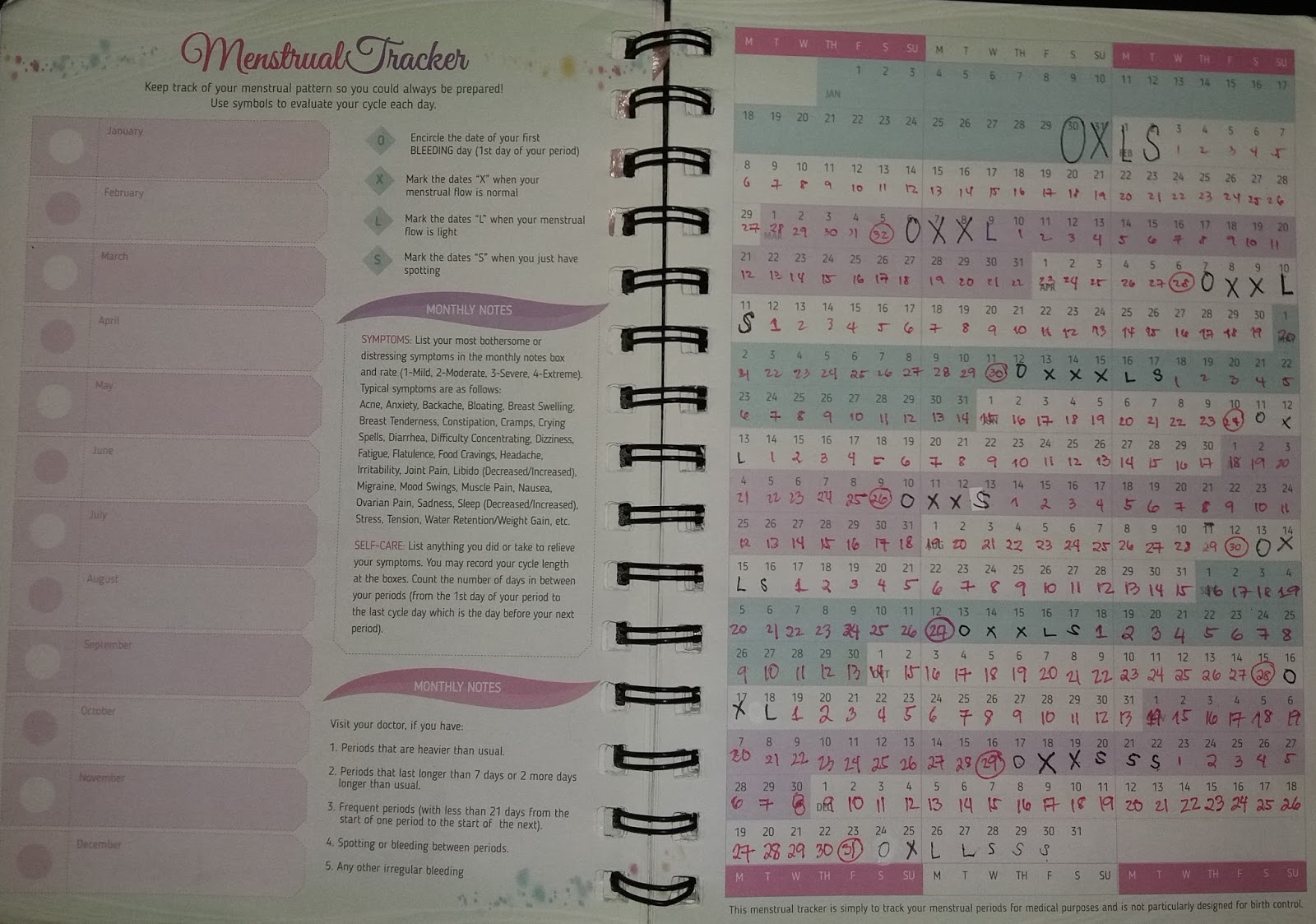 |
The planner is designed generally for girls. This is evident on the color themes and art included in the planner. Thus, it’s really useful that it includes a menstrual tracker where you could track when you had your period. It even has a system for recording which days you had normal flows, heavy flows, and spotting. This is extremely useful when it comes to preparing ahead and for future medical concerns that may arise. If there would be any problems that would occur where the doctor would need data on the frequency of your menstrual cycle, this would come handy.
Monthly View
Belle de Jour’s monthly view consists of the month’s calendar on one page and a space for writing random things on the other. What I liked about this was not only did it have a space for your drawing, reflections, etc., it also has short paragraphs of encouragement that you can reread when you’re stuck in a rut for that month. It also has a space for writing down the most important events for the month. Unfortunately, I was not able to use this because I did not know how to. On top of the monthly calendar was a space with the heading My Good Habit. The calendar had these little circles on each day that I did not know how to use. Apparently, you should write down a habit that you would like to develop that month (e.g., jogging for thirty minutes, reading, studying, etc.). And if you are able to successfully do that, you color in the circle as your reward. A colored dot may not be worth anything, but psychologically, seeing your progress that way can be a great motivation for continuing to strengthen the habit.
Weekly View
This is the heart of the planner and the one I got the most use out of. The planner is structured so that it shows all seven days in a spread. I love that it was designed this way because you get to see your whole week and could easily make adjustments for tasks that you want to push to another day. It looks really simple, but when you take a closer look, it actually has more features than you think. The first thing is the name of the month (pretty obvious and useful). Then on the right side, you see what week of the year it is. This is really helpful when you have projects that bleed through the year and you have subtasks that you need to finish on certain weeks. There is also a calendar snippet on top where you could see where the week is located on the monthly calendar along with a short sentence that you could use as your mantra for the week. These are positive statements whose main purpose is to encourage.
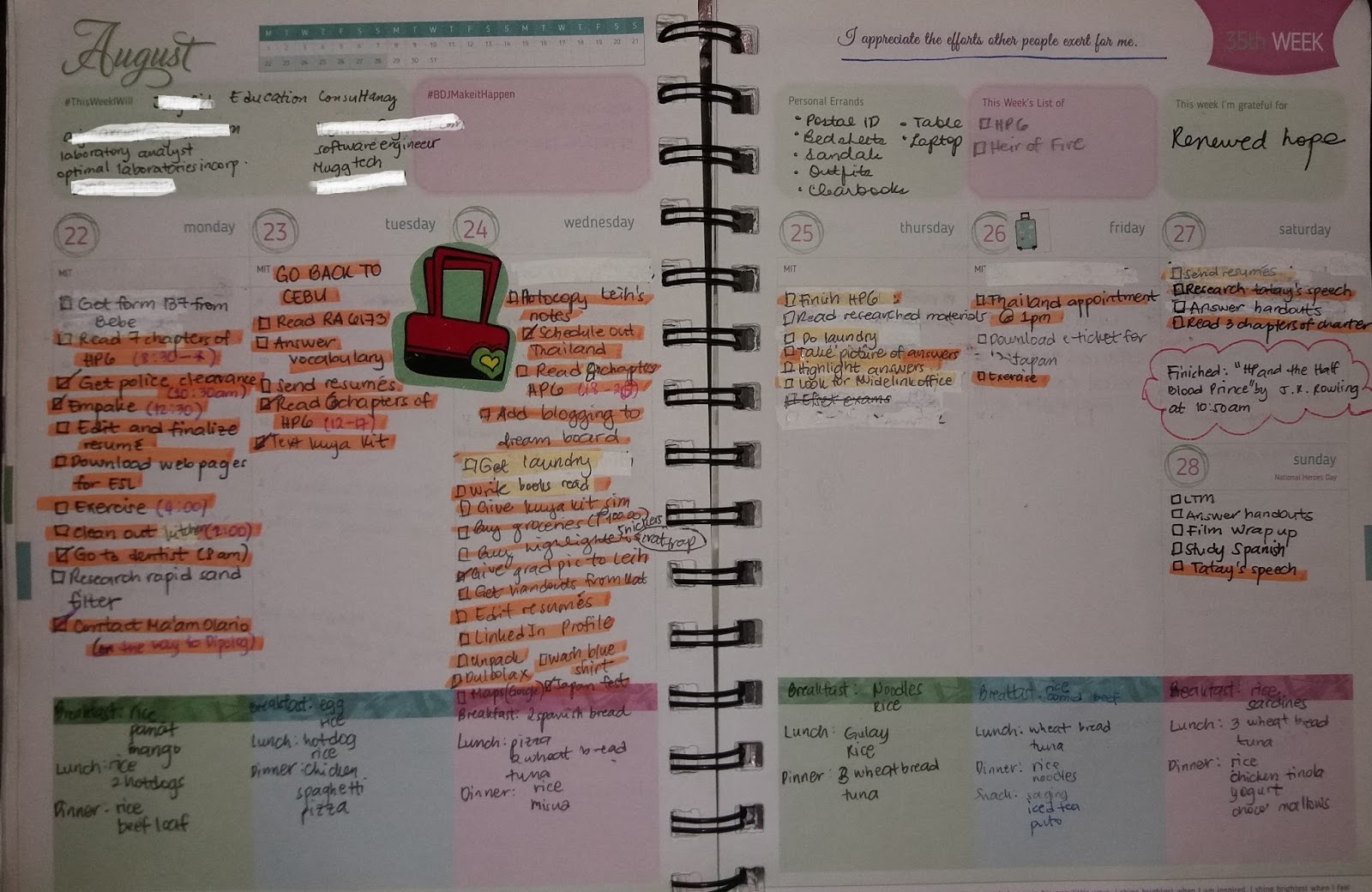
Below the calendar snippet are boxes that are unique to the planner (at least I haven’t found another planner with this feature yet). The boxes are useful to act as an overview for the whole week. They are as follows:
#This Week I Will – This space is for the most urgent things that you need to get done for the week.
#BDJMakeItHappen – This box is intended for your main goals for the week.
Personal Errands – This is for your random to-do list, especially for ones that you don’t necessarily need to get done on a particular day but needs to be done before the end of the week (at least that’s how I use it).
This Week’s List Of – The heading is incomplete for a reason. This box is for you to customize. I just usually add books to read because I read multiple books at once, and this is my way of keeping up with my readings.
This Week I’m Grateful For – The last box is filled in at the end of each week, and it has proven really helpful for me to stay grateful and keep track of the things that made me happy. No matter how bad the week may seem, this feature forces you to look back and look for at least one thing that you were thankful for. This way, you get to see the positive things in life no matter how small they may be.
Then we have the center of the specific days. On top of each day, there is the date and the name of the day. Each week would start on a Monday. It has a special portion for your MIT (Most Important Task) so you could prioritize that. In the larger area, there are time stamps for you to schedule out your day. What’s cool about this is that they are printed very lightly. This is to ensure that the planner caters to both kinds of people who like to use the time stamps and those who prefer an empty space. I used this part as a daily to-do list. I would then highlight the tasks that I already did.
Aside from to-do lists, I also use the daily pages to record the books that I have read. I write the title and author of the book as well as the time I finished reading it, and I enclose this information with clouds so that they stand out. This way, I could see if I haven’t been keeping up with my reading.
Finally, the last part of the weekly view is the colored boxes at the bottom. You could use this however you like. I used mine as food tracker. This way, I get to see what I’m putting inside my body, and it’s also a great motivation for staying healthy throughout the year. Another reason why I used it to record my food intake is so that whenever I get sick and have to go to the doctor, I wouldn’t have a hard time remembering what food I ate because they’re all recorded in the planner. Again, this is handy for medical reasons.
Monthly Covers
At the start of each month, you are greeted by the beautiful monthly spreads that feature beautiful art. The best thing about the Belle de Jour monthly spreads is that each month focuses on a different theme. It also has short paragraphs that discuss about the central theme. The articles are well-written and very encouraging, and it gets me so excited to start a new month so I could read them.
Back Pocket
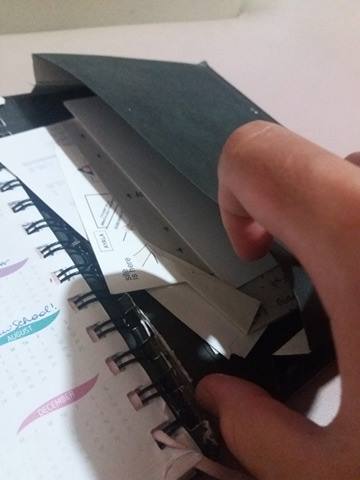
At the back of the planner, there’s a small flap that acts as an envelope for things you want to store. I used that to store my stickers and important receipts that I haven’t sorted out yet. It’s a useful feature, especially for people who don’t carry organizers around and keep on losing important notes.
Present Condition
Aside from the features, what you should generally look for in a planner is its durability. If the planner breaks in the middle of the year (pages falling off, cover getting torn), it would not be much use and may discourage further planning. Who wants to plan a beautiful day on an ugly planner anyway?
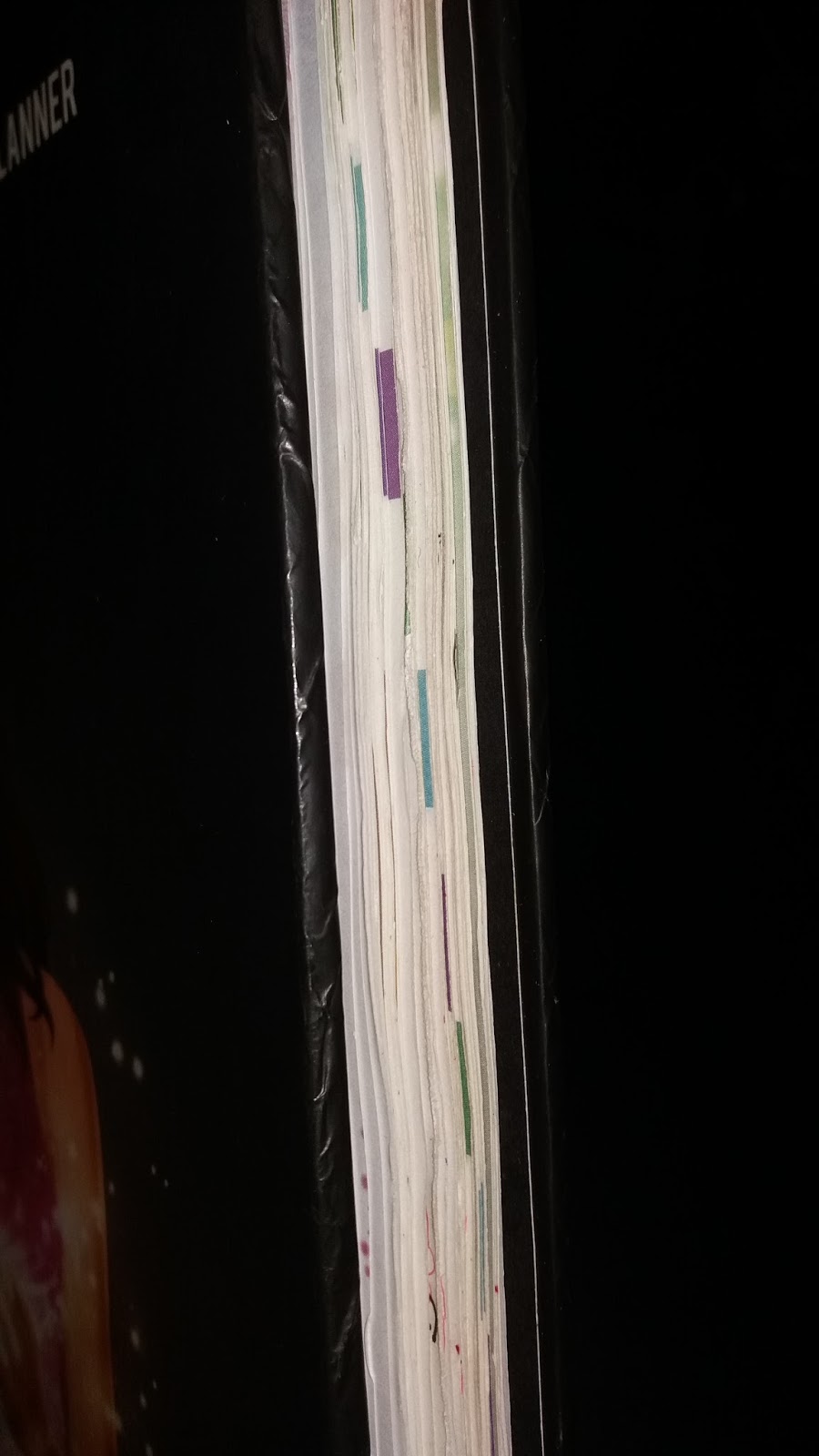
After a year of constant use, my Belle de Jour planner was starting to fall apart when it comes to the cover. As shown in the pictures, I had to use scotch tape on the spines because it was starting to tear. However, this could be credited to my neglect. I used to just stuff it in my bag and it would get bent and torn. With that considered, I’d still say it’s a pretty durable planner. The pages are all intact, and they are still in good condition.
What Was Lacking
I am very satisfied with this planner, although I have a couple things that I would suggest for future designs.
Bigger Weekend Spaces
I understand that it is common in a lot of planners to make the Saturday and Sunday spaces smaller. This may be because they want to optimize space, or planner makers might have assumed that people don’t do much on the weekends that need planning. But what about for those whose days are busiest during the weekends? I have struggles with this in the past because I tend to have a lot more activities during the weekend. I tend to schedule what I need to read and study and what chores I need to get done. I would like to see equal space allotment for each day of the week.
Notes
The Belle de Jour planner does not contain blank pages where you could write notes and random ideas. That’s why there is still a need for me to bring a small notebook. Sometimes, I would write random notes on random pages of the planner, which generally doesn’t bug me because I don’t mind having a messy planner. But for those people who would love to keep their planners pristine, blank note pages would be necessary.
The Verdict
Overall, I have loved using the Belle de Jour planner. The features are to my liking, and I have accomplished a lot of tasks because of it. It has been my guide through the busiest year of my life so far. For the value that I got from it, I would say it is worth the money. I actually got another one from the same brand this year. If you do want to purchase one, I would recommend pre-ordering because they sell out almost immediately in major bookstores—proof that it is highly in-demand.
 It's a Ping Thing