Tracking the Books I Bought in 2017


“I promise I’ll just look. I won’t buy anything.”

“Since I bought a lot of books already, I will ban myself from buying more for the rest of the year.”
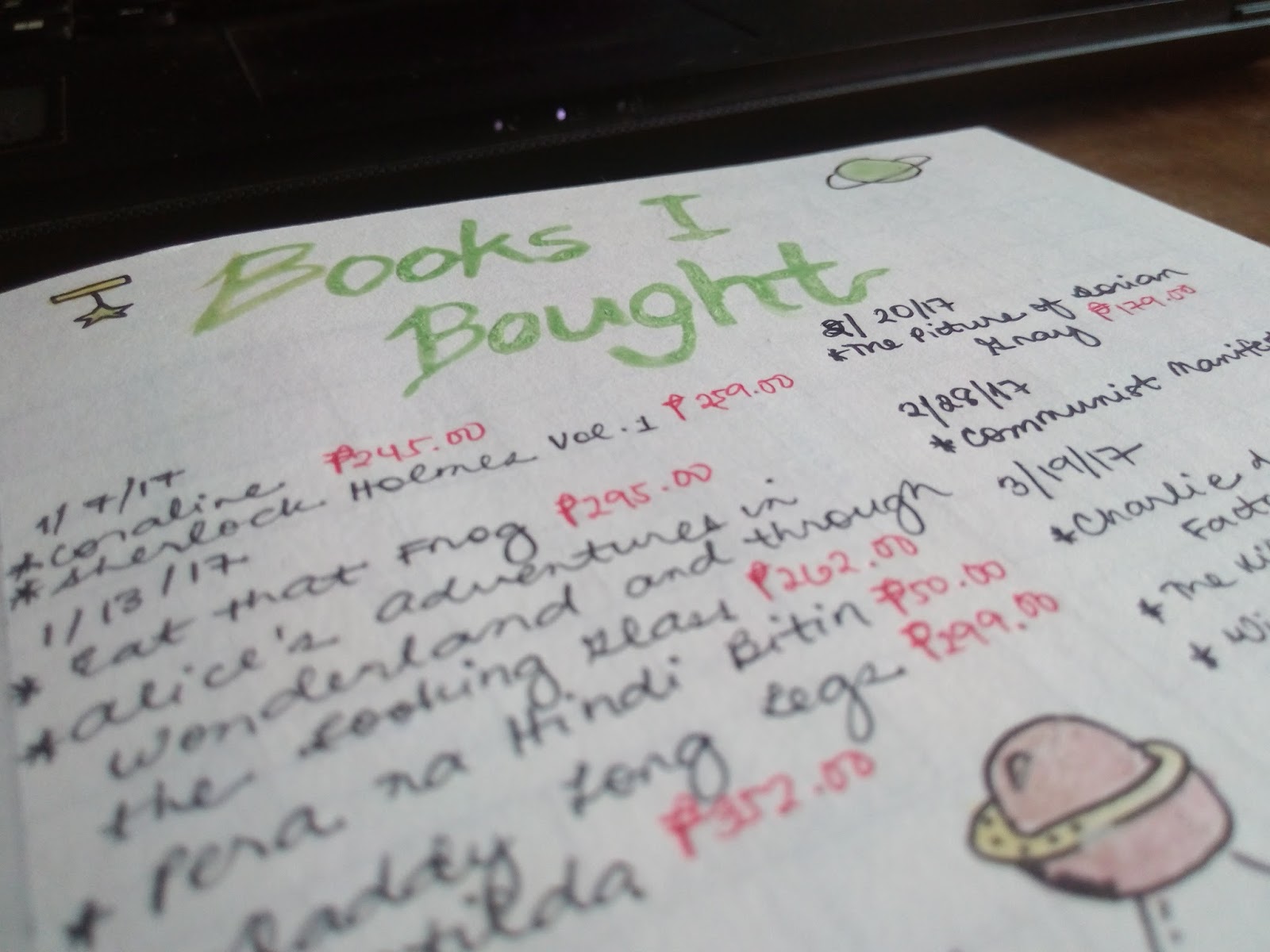
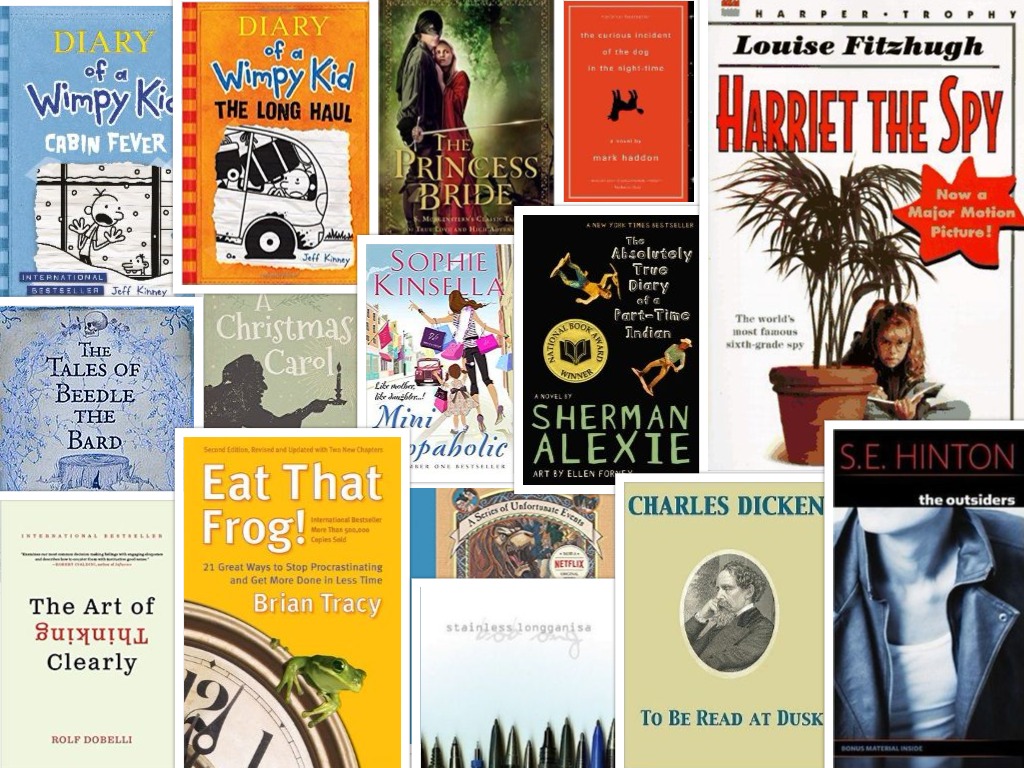
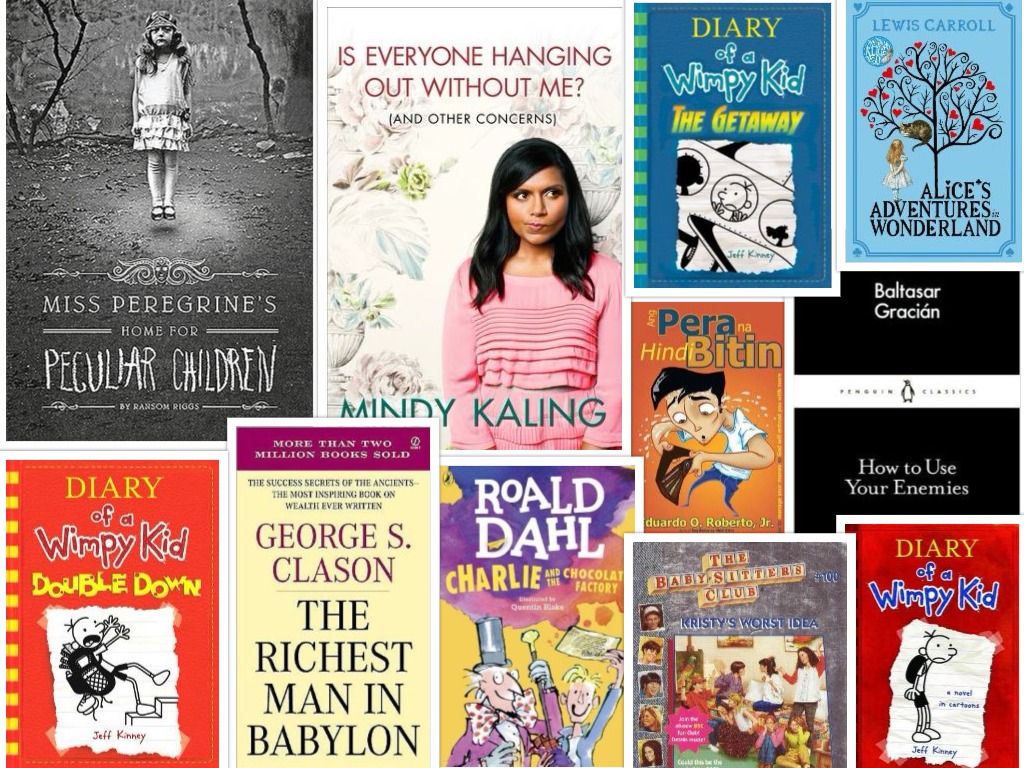
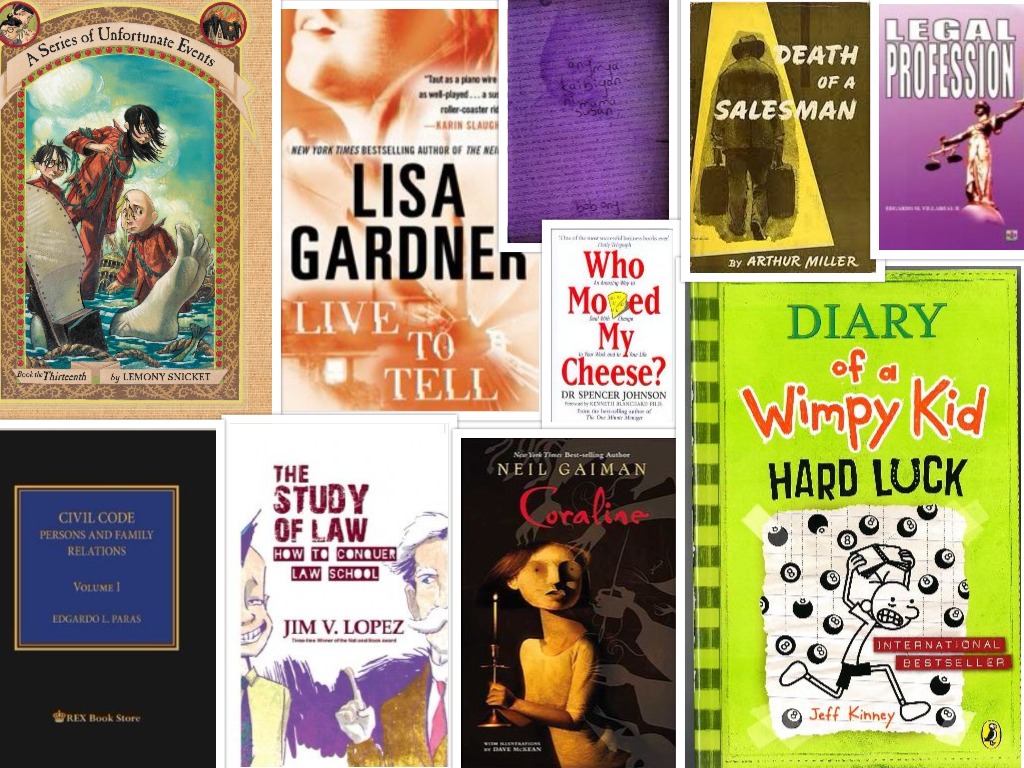
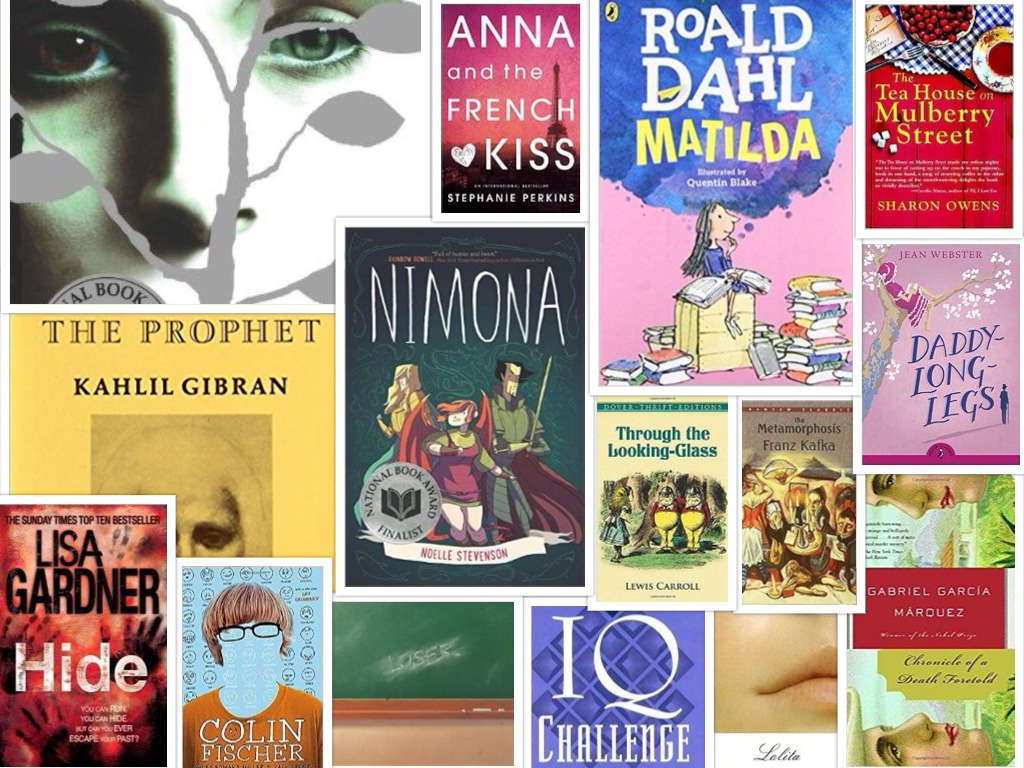
These are just some of the lies that book lovers tell themselves. Again and again, we promise not to buy more books, but we end up doing so anyway. Last year, I decided to track the books I bought and their respective prices. At the end of the year, I analyzed my book-buying habits, and here are the results.
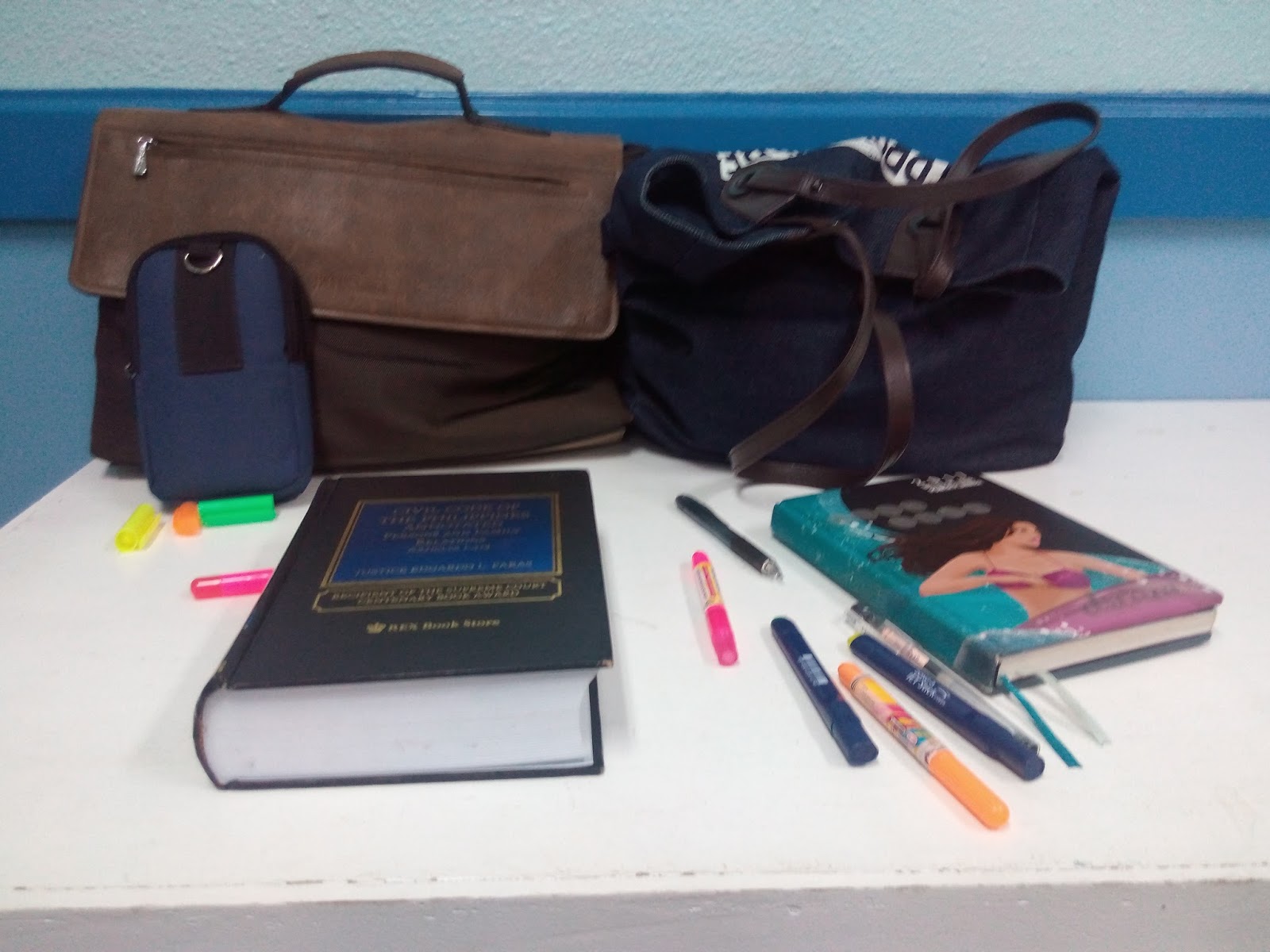
I bought a total of 60 books and spent a total of Php23,024.00. This is quite a huge amount for me to spend on books, but this includes 14 law books, which were not cheap. I bought my leisure books from National Bookstore, Fully Booked, and BOOKSALE while my law books were either from Rex Bookstore, CentralBooks, or Sebio. The cheapest book I bought was Php20 while the most expensive was Php2,168.
Kind
Quantity
Price
Leisure Books
46
Php7,462
Law Books
16
Php15,562
TOTAL
60
Php23,024
Buying books is one of the most relaxing moments for book lovers. We just love adding to our library and discovering new stories and learning new things. But sometimes, we take it too far and end up stocking more than we could read. I will continue tracking the books I will purchase in 2018, and hopefully, I’d do better this year.
What books did you buy in 2017? Share it in the comments section below.

I Can’t Rest My Case: My First Experience with Case Digests


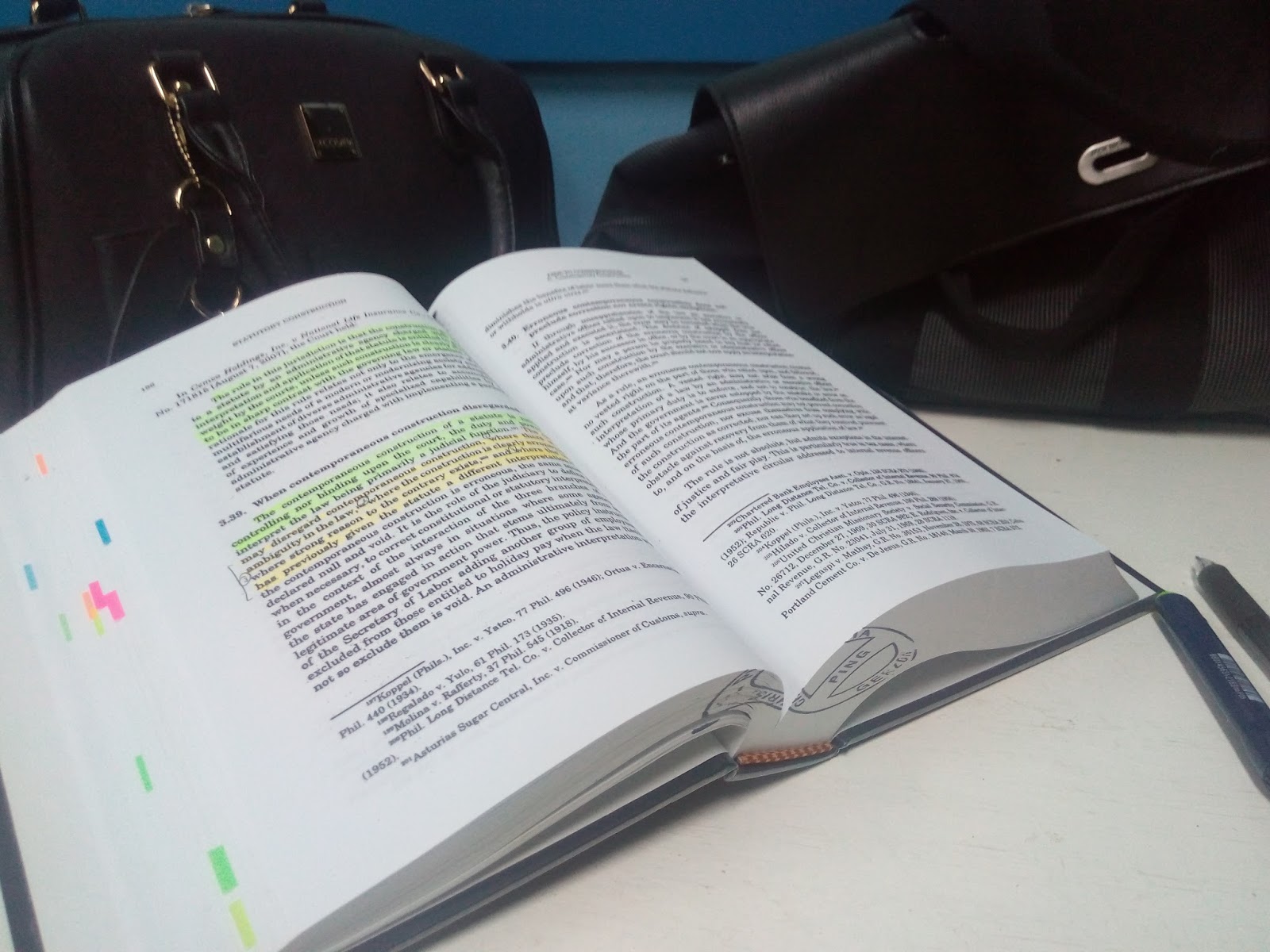
Aside from the codals and the thick textbooks that provide a good arm workout, law students also have to go through hundreds of cases per semester. This gives the would-be attorneys a chance to see the application of the statutes to real-life issues. It is standard for professors to ask students to not only read but also make summaries of the cases, called case digests.


A case digest consists of the summary of the facts, the issues, and the ruling of the Supreme Court. A case could be as short as two pages or as long as a hundred.

I made my first case digest before I enrolled in law school. My mentor asked me to pick any case and digest it. I looked up landmark cases online and decided to go with In Re: Florencio Mallare (AM No. 533, September 12, 1974). The case was just six pages long, excluding the footnotes. It took me three readings before I felt I was ready to take notes. I thought everything was important. I took notes of all the dates, the names of witnesses and their relation to the respondent, etc., which were not that important to the main issue.

I made four pages of notes on the six-page case, but I still didn’t know how to start the digest. Finally frustrated, I looked for a sample digest of the said case online. I was taken aback by its length. It was so short that I was ashamed of how long my notes were. It was then that I got the gist of how case digests should be.

During the first few weeks of law school, I learned that only the issues related to the topic you will be discussing should be included. This is because case digests are basically your guide during recitations, and the professor will be asking about the issues that will help you understand the topic more. I made the mistake of fussing over all the issues that had nothing to do with our lesson.

My case digests have improved since the first failed attempt, but the pressure and stress of making multiple digests in a week and familiarizing them hardly do. But these towers of readings, digesting, and recitations are what make law school more memorable.

Ping’s 2017 Reading Wrap-Up

The year 2017 is an interesting reading year for me. I’ve read a total of 51 books, which is a little less than my number for 2016. I read a lot, that’s for sure, but my readings consisted mostly of academic materials during the second half of the year after I enrolled in law school.

A lot of the leisure books I’ve read are fairly short and are easy to go through. The reading highlights of 2017 for me include the first time I’ve read a whole play and the first time I’ve finished a law book cover to cover.

My top 5 books are the following:
v  Alice’s Adventures in Wonderland and Through the Looking Glass by Lewis Carroll
I’ve watched the animated Disney movie of Alice’s Adventures in Wonderland as well as the live action with Mia Wasikowska, but honestly, I never liked the story. The 1951 Disney film gave me the willies. The fact that a little girl falls into a seemingly endless hole, swims in her own tears, and then talks to animals is disturbing to me. And don’t even get me started on the smoking caterpillar and the smiling cat. What made me pick up the two books is really just the pressure of not reading a very famous work of literature. It made my top 5 because it proved to be beautifully written. The word play that Carroll used in these books is entertaining. One of my favorite poems, Jabberwocky, is in the second book. I guess it was that much delightful for me to read because I went into it with very low expectations and ended up getting an “in your face” by the author’s genius.
v  The Outsiders by S. E. Hinton
This book hit me so hard I had to write a review about it. In just a few short pages, I was able to get engaged in the story, care about the characters, and sympathize with their miseries. This is a must-read for all teenagers especially those who are being bullied or better yet, for those who are bullies.
v  Eat That Frog by Brian Tracy
This one has an interesting title that goes way back during the time of Mark Twain. Actually, he was the one who started this. The famous author of The Prince and the Pauper once said “If it’s your job to eat a frog, it’s best to do it first thing in the morning. And if it’s your job to eat two frogs, it’s best to eat the biggest one first.”

This book talks about ways to be more productive and to prioritize the most important tasks. This was such a short and enjoyable read that I actually read it twice in 2017—while procrastinating for what I was actually meant to be doing.
v  Death of a Salesman by Arthur Miller
Fun fact. I’ve never read a Shakespeare play before. This is because I don’t understand plays. I’ve always thought that they were only for the cast and the director. But last year, I finally found one that I was able to appreciate. Arthur Miller’s Death of a Salesman is a poignant tale of a man who thought everything of himself and who kept on reliving his glory days in his head. Aside from being heartbreaking, it makes you think twice about your decisions in life and how willing you are to make the effort to prepare for the future. I think every twentysomething, especially those who are still trying to figure out what they’re going to do in life, should give this a go.
v  How to Use Your Enemies by Baltazar Gracian
This short book packs a lot of practical, direct-to-the-point tips about life in general. It offers advices on social conduct and climbing the corporate ladder. The title is a bit misleading, though. The content is generally about how to be successful in various environments while still keeping your friends and without losing self-respect.

Thesis Crazy: A Guide to Finishing That Final Paper

Thesis time is one of the most stressful times in university. Students are downing unhealthy amounts of coffee and energy drinks every day to stay awake for those all-nighters. They are at their wit’s end about how they’re going to finish their papers on time while still studying for exams. The diploma is almost within reach, but before you get that coveted piece of paper, you have to write a few hundred pages first.
And because these are hard times, here are some tips for you.
Before Starting
1. Choose the right people.
When you’re allowed or required to work in groups, it is best to assess the people you’ll be working with. Pick those who can be really valuable to the project and those who have the means to follow through with the process. I’m not saying that you choose your teammates based on their financial capabilities, but practicality is important.
I suggest you pick people you are not too close with. This is because your paper has a deadline and when you have your best friends on your team, those all-nighters might end up being a gossip session. Another reason for this is when emotions run high, your familiarity will not be advantageous because feelings take over logic. When you’re with people you’re not too familiar with, you’ll keep a business-like atmosphere, which is what you should be aiming for. I have witnessed friendships broken beyond repair because of this, so be careful.
2. Choose an interesting topic.
With the exception of those whose topics are chosen for them in advance, picking one that is genuinely interesting to you will make the project more tolerable. It will be easier to study and research a subject matter that you find important and you’re really curious about. It’s already a difficult task. Don’t make it more difficult by choosing to study a topic you don’t care about.
3. Plan.
It always pays to plan. Plan where you can get your resources. Universities usually have a paid platform for finding scientific journals. If you’re working in a group, assign specific chapters to each member. Plan how you will finance the project if it is not funded by the school or shouldered by an organization that makes use of the study. It is also good to find a good suit for the final defense because you know it’s coming. It won’t be a good feeling when you’re texting your friends if they can let you borrow their outfits just two nights before the big event. Making the final touches as well as preparing for the defense is stressful. If you don’t prepare your clothes in advance, you might end up looking sloppy and unprofessional. Power dressing adds to your confidence, and the panel will have the impression that you’re prepared and ready to do business when you’re dressed for the part.
4. Study in advance.
The most likely scenario is you’ll be expected to finish your thesis in the midst of finals. Having a buttload of exams is not an excuse for not finishing your thesis on time. Make use of the syllabus and read your lessons in advance so you won’t end up like a zombie during exam time and for you to actually pass. This will also keep stress levels
During the Writing
1. Consult your advisers regularly.
I have a friend who wasn’t able to finish his thesis because when he showed it to the adviser, the latter said it was far from what he instructed them to do. To avoid this, always meet with your adviser so you’ll understand what’s expected of you. Remember that if your adviser does not approve your work, you won’t even be allowed to defend it in front of the panel.
2. Buy or rent a printer.
Here’s what most students don’t think of when they’re about to finish their thesis: all the other graduating students in the university are doing the same. The defense day for other courses is scheduled close to yours or maybe even on the same day. The copying stations will be full of students lining up to have their papers printed. And each of them has hundreds of papers to print. And you know they’re not going to want just one copy. To avoid this hassle, either finish your thesis way ahead of time or get a printer. You can chip in with your groupmates or other students who are also doing their thesis. Believe me, you will wish you had a printer when you’re lining up at the printing station as you’re waiting for that biology student to finish five copies of his 200-page dissertation.
3. Make every chapter a separate document.
One of the biggest frustrations in writing a thesis, especially one with lots of tables and graphs, is that you have to keep on moving things around as you edit. To make this a little more bearable, separate the chapters from each other.
4. Decide how to name the files.
You’re editing your file and you’re putting the final touches when you realize you’re using the wrong version. You named the file chapter2final.doc when you should have used chapter2finalfinal. This kind of system for naming will only cause frustration and will waste your time. Decide on the naming system so you don’t have to wonder whether you should edit final.doc or thisisit.doc or even thisisreallythefinalone.doc. The general rule is you don’t name your file final when it’s not.
During the Defense
1. Prepare an extra copy of your paper.
The panel may be announced in advance, but you will never know who’s gonna turn up at the last minute. I’ve had this experience during our defense. An unexpected panel member showed up, and everyone had to print extra copies.
2. Be confident.
You know this. You’ve been daydreaming about this paper every day for the last five months. The panel members have just received your paper and would most likely be asking easy questions. However, if you forgot something or left something out, don’t panic. If you show the audience that you’re nervous, they will immediately conclude that you are underprepared. If you feign confidence, however, they’re likely to assume that you know the answer but forgot the exact numbers or names. If you are really struggling to find the answer, promise the panel members that you’re going to get back to them after the presentation.
The thesis is a necessary part of graduation, the final obstacle toward your goal. It is difficult and trying, but when it’s finally over, you’ll be glad for all the lessons you’ve learned. It is a test not only of your intellectual abilities but also of your resilience and ability to deal with trials. I hope you come out of it stronger and wiser. Good luck!

Las Alegrías y Luchas de Aprender Español: The Joys and Struggles of Learning Spanish


Spanish is fairly easy to learn for Filipinos because we were a colony of Spain for more than 300 years, from 1521 to 1898. When the Spaniards came, they introduced their culture as well as their language to our ancestors, which, as a result, influenced the evolution of the Philippines into what it is today. It is evident that Spanish has influenced the Filipino language. In fact, the common Filipino greeting “Kumusta?” is from the Spanish ¿Cómo está?. The names of the months in Tagalog—Enero, Pebrero, Marso, etc.—are similar to Spanish—enero, febrero, marzo, etc. Even the numbers are the same. Words like sibuyas (from cebollas) and pisara (from pizarra) are derived from Spanish. So in terms of vocabulary, Filipino learners are at an advantage.
When I started learning Spanish, I found that I was going through the lessons fast. I didn’t have a hard time with most of the words because they are used in both Cebuano and Tagalog. The sentence structure is similar to that of English, with a few exceptions like the placement of the negative noand the adjectives. The real struggle in Spanish is definitely with the verbs. My eyes widened when I first encountered the conjugations at Culture Alley Spanish. Unlike English where the verb conjugations are relatively few, in Spanish, there are different conjugations for different pronouns. And because Spanish is gender-sensitive, there are more pronouns. I sucked it up anyway and memorized them.
For the verb caminar (to walk):
Yo camino
Tú caminas
Él camina
Ella camina
Usted camina
Nosotros/Nosotras caminamos
Vosotros/Vosotras camináis
Ellos caminan
Ellas caminan
Ustedes caminan
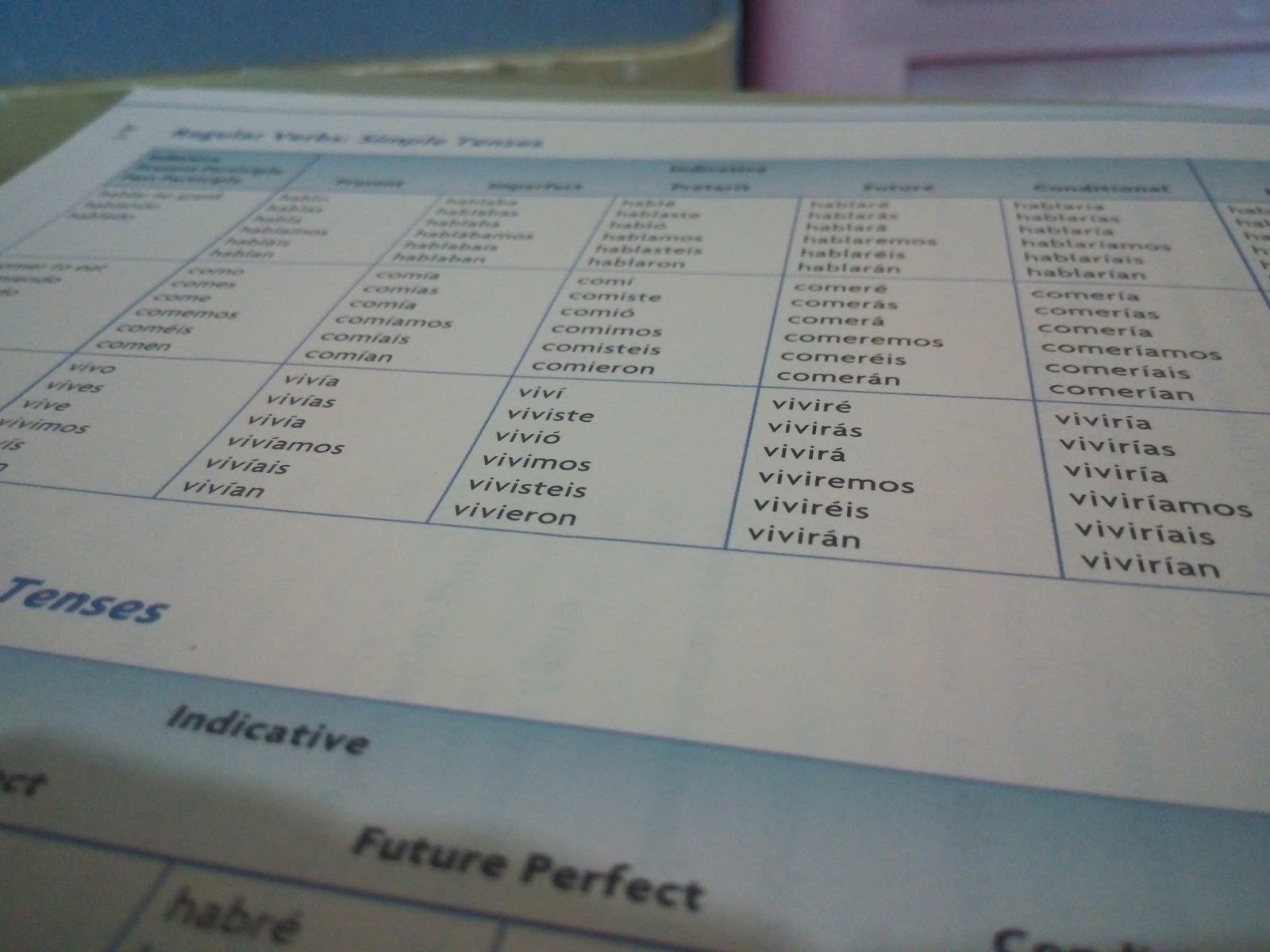
I was pretty proud of myself after I had memorized the above conjugation, and I thought I was good to go. However, later in the lesson, I found out that there are three main kinds of Spanish verbs—the -ar, ­-er­, and ­-ir­ forms. Examples include pensar(to think), comer (to eat), and vivir (to live). Not only that, there are also irregular verbs that conjugate differently, In addition, just like English, there are different tenses. In Spanish, the tenses include the present, preterite, future, perfect, imperfect, conditional, progressive, etc. This list of conjugations of caminar shows the different forms for one verb.


Another struggle I have with learning Spanish is understanding native speakers when they talk. I found that when I’m watching Spanish telenovelas, it is difficult for me to understand them just by listening, but with the Spanish subtitles on, I can follow the dialogue fairly easily. After a little research, I found out that languages have different speeds, called speech tempo. Unfortunately for Spanish learners, it is the fastest European language and the second fastest in the world, with a syllable-per-second velocity of 7.82 according to a study done by researchers at Université de Lyon. This is fast compared to English, which is only 6.19 syllables per second. The only language that is faster than Spanish is Nihongo, or Japanese, at 7.84 syllables per second.
Spanish is spoken in around twenty countries in the world, which is both an advantage and a disadvantage to learners. It is advantageous in the sense that you can understand the language of twenty more countries. The disadvantage is that some words in these countries are different. This video highlights the struggles of Spanish learners in terms of the different vocabulary in different Spanish-speaking countries.

Despite these difficulties, however, the joys of learning a new language is incomparable to the hardships of the learning process. It opens your eyes to a new culture and enables you to speak to millions more of people. In the end, fluency in a new tongue is worth the struggle.

First Impressions: The 2018 Belle de Jour Power Planner


It’s that time of the year again! We are once more looking forward to a new year and hopefully to a more productive one. Of course, that becomes easier to realize when you have a reliable planner that will remind you of important dates, appointments, and things to do. For the past two years, I’ve been using the Belle de Jour Power Planner, and because they have worked so well for me, I opted to do the same for 2018.

For the amazing (fingers crossed) year to come, BDJ celebrates the uniqueness of being you. It centers around the theme of individuality and has a few subtle but pleasant changes.
Let’s start with the basics. This is actually the first time that I had my planner personalized. You could do that by ordering through their website, ilovebdj.com. The personalization is free, and the planner costs Php580, plus the shipping fee, which varies from place to place. I chose the Smyth-sewn one just like my 2017 planner because it still is in great shape today after almost a year.
I have to say I was a little disappointed with the personalization because of the following reasons. First, because the name is not in the font and capitalization that I indicated. Second, I was expecting the name to be printed on the planner cover. It turned out to be thick reflective stickers. However, I didn’t mind so much. What I’m really after is the functionality, anyway.
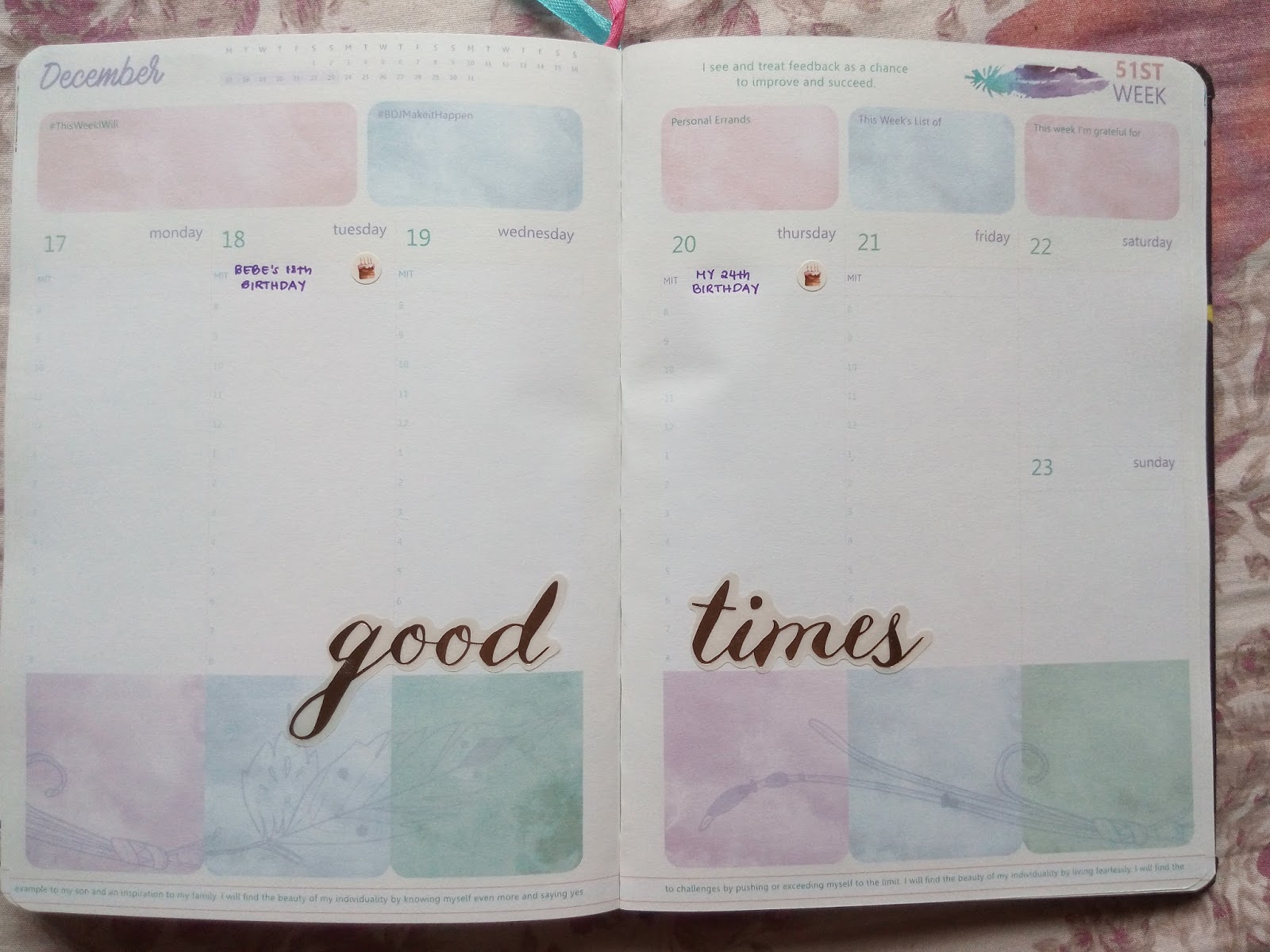
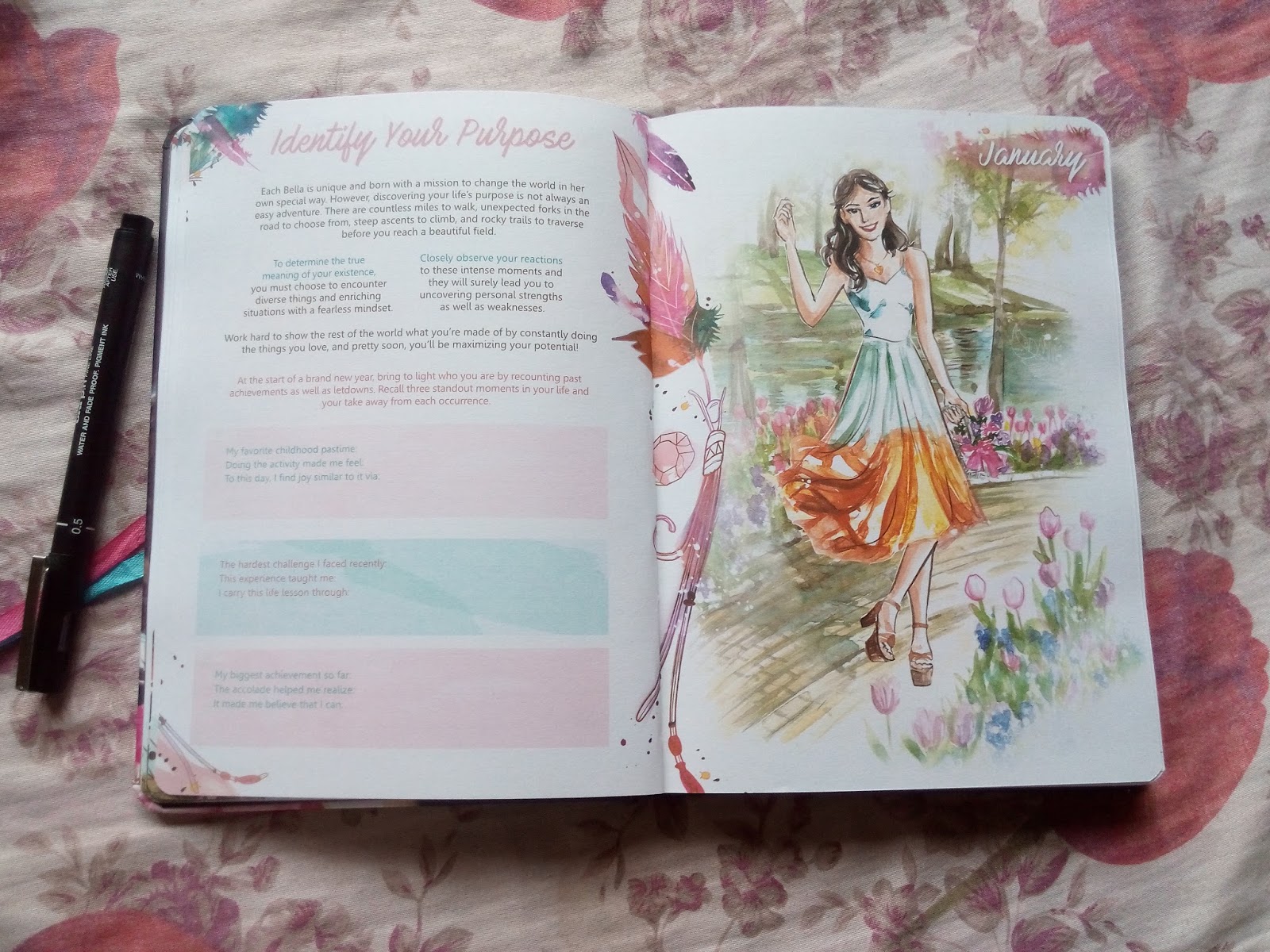
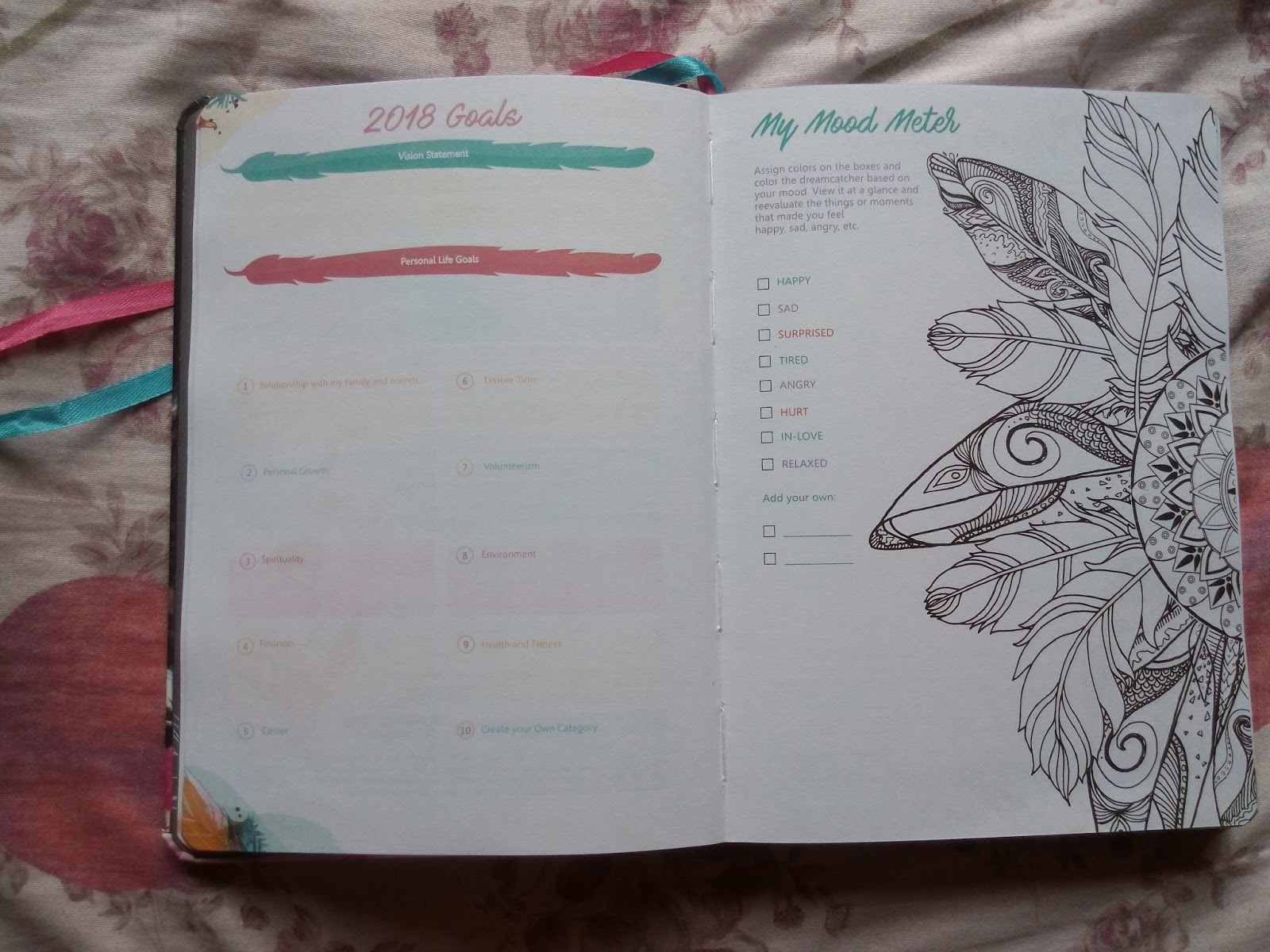
The main pages are pretty much the same. You have monthly covers that include little activities for reflection, the monthly views, and the weekly spreads. However, when it comes to style, I think the 2018 planner is better than its predecessor. I like the watercolor gradients more than the solid colors.


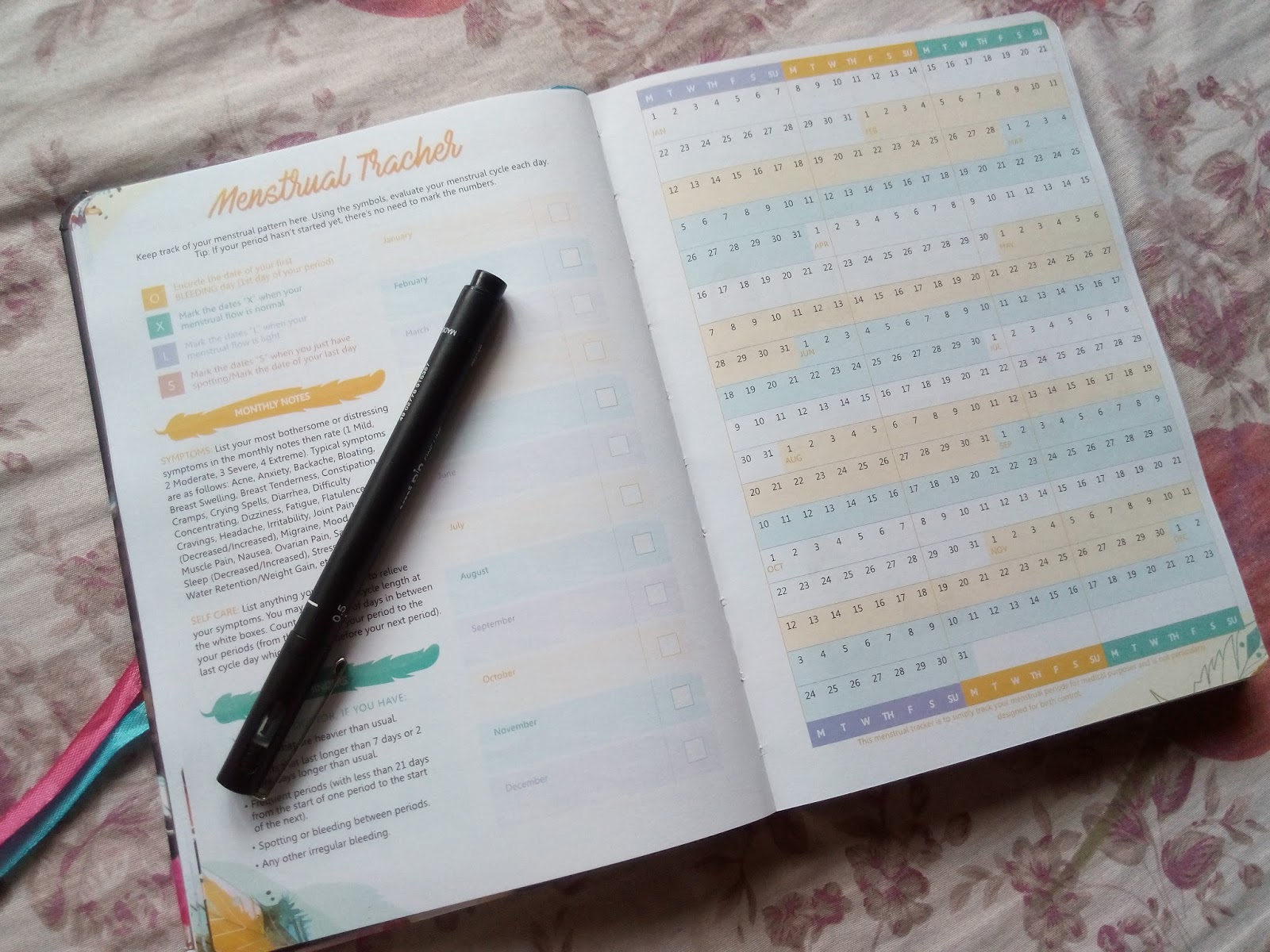
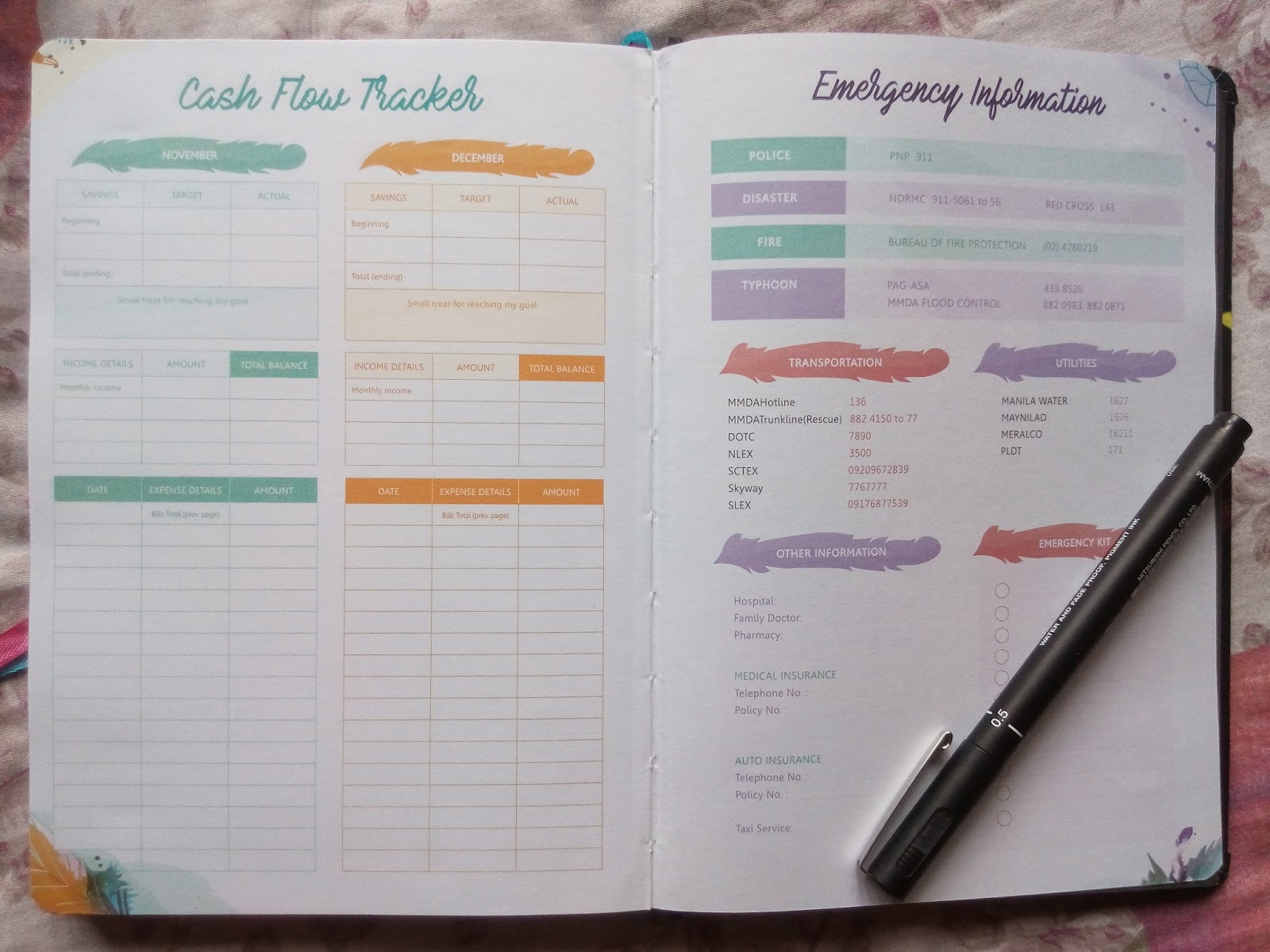
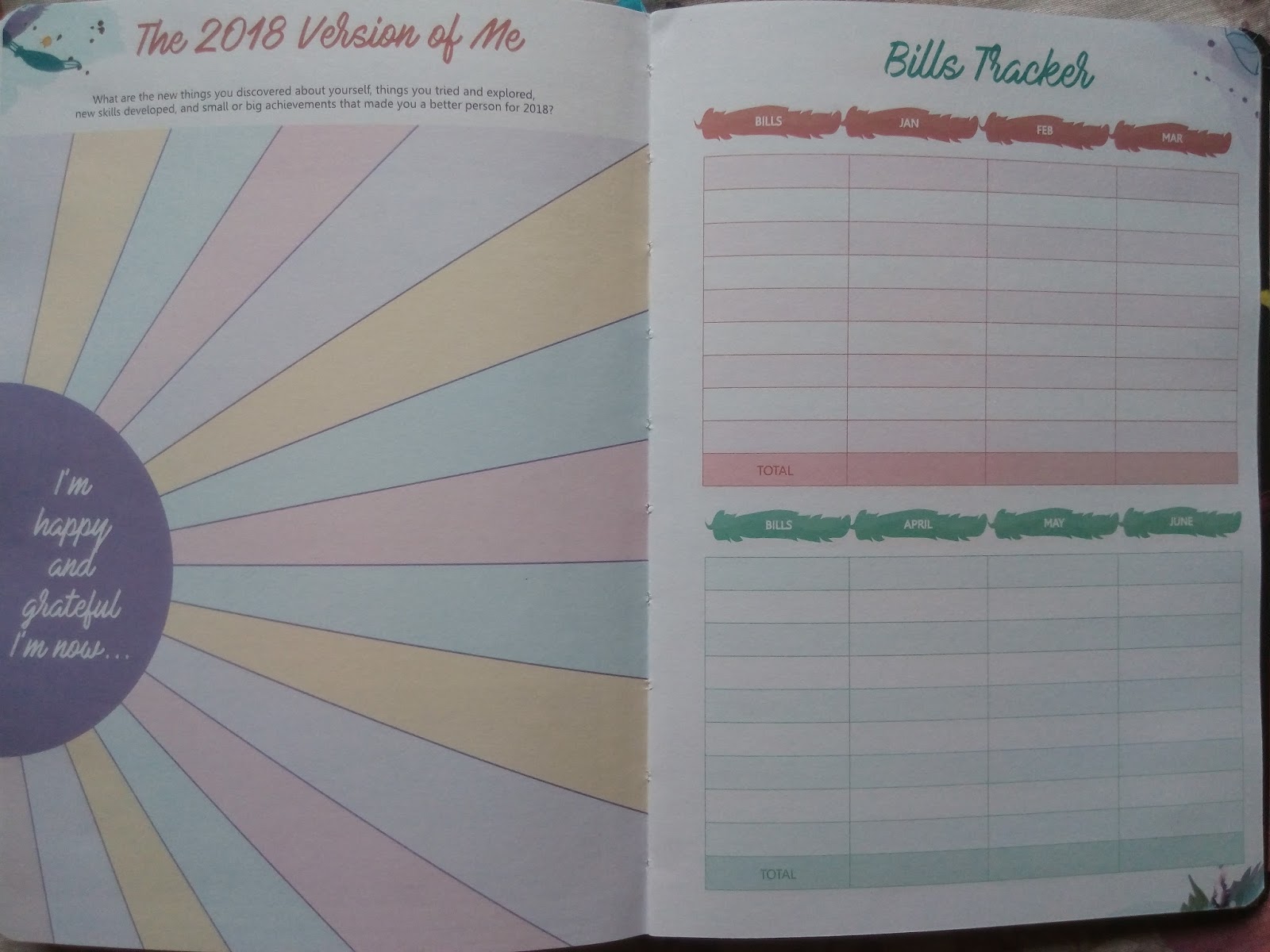
It also retained the essential features such as the menstrual tracker (my personal favorite) and the bills and cash flow tracker. The added new features include a mood meter, which you can color, and a page dedicated to reflecting on the improvements you’ve made during the year.


BDJ also made a wise choice with their stickers by making them round. They used to have these poorly-cut square stickers, which weren’t that attractive.
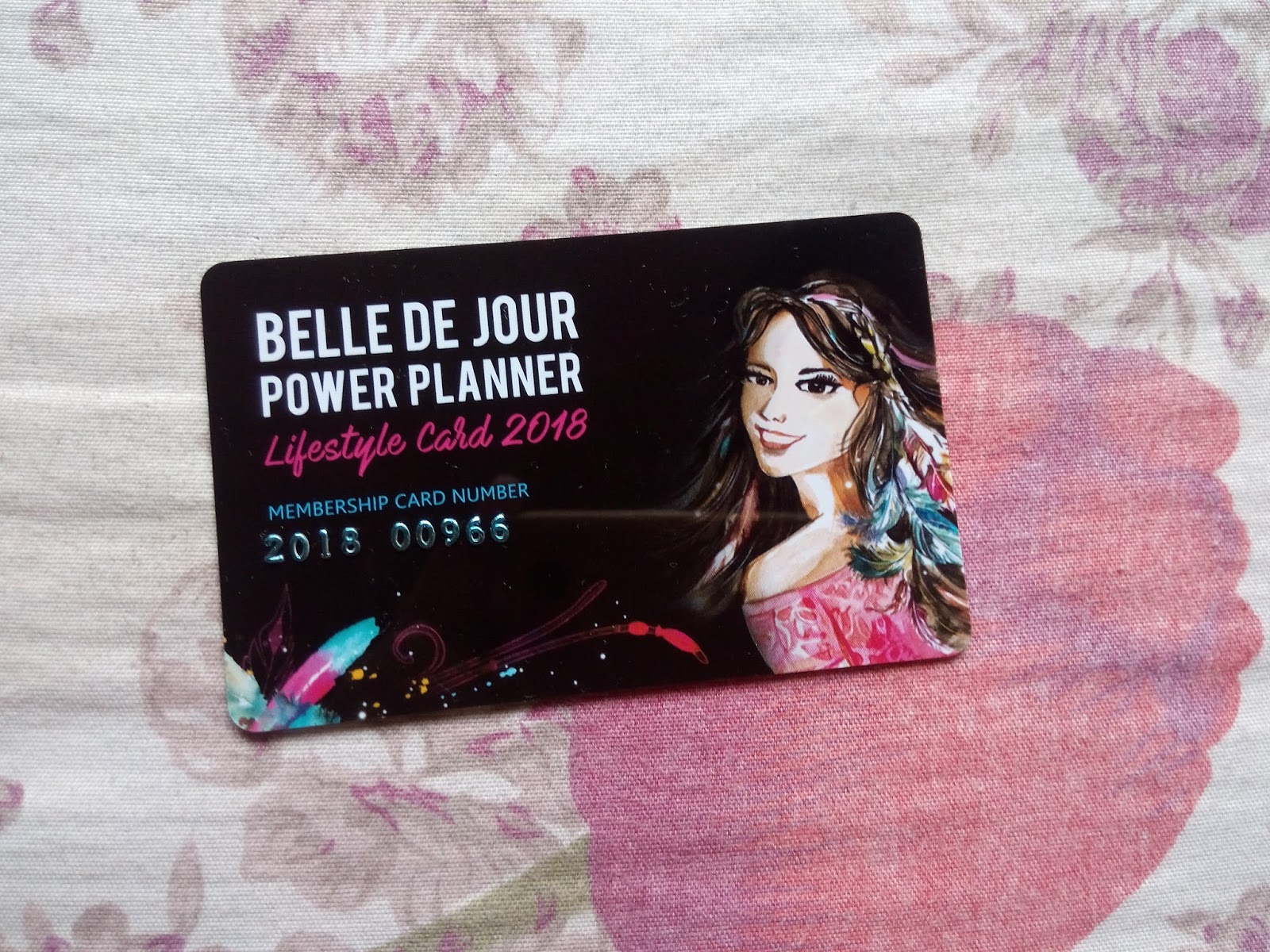
As usual, the planner came with the BDJ card as well as the notebook full of coupons for discounts to selected stores nationwide. If you use at least forty of these coupons by September 30, 2018, your next planner is free. Use fifty, and you get two planners for free!


Overall, I’m loving my new planner, and I’m looking forward to filling it in with my to-dos (that I hopefully really accomplish). If you’re looking for a good and affordable agenda, you may want to check their site out. They also have other designs that may just be the one you’re looking for.
Embrace the weird, clumsy, imperfect you with the 2018 Belle de Jour Power Planner!

Hit Play: My Favorite YouTube Channels

Remember when you had that seemingly impossible problem in calculus or when you struggled to grasp the idea behind that chemical reaction in class? How about that time when you were struggling to fix a computer glitch that was sucking away precious hours from your game time? Wasn’t there a time when you fell so down you just wanted to spend the day looking at funny videos online? In any of these instances, there is a big chance that you searched for YouTube videos for supplementary lessons, troubleshooting tutorials, and videos about weird cats (or babies).
Not only does it provide entertainment, it is also a big collection of ideas and solutions to various kinds of problems. There are thousands of YouTube channels out there, but they are not created equal. Here are some of the best, IMO.

Source: https://www.youtube.com
I’ve watched a lot of videos with study tips before, but this is one of those channels where the one offering the study tips is a guy. What I like about this channel is that the videos are short, to the point, and funny. I have nothing against other channels that offer study tips, but most of them offer the same or similar tips. Thomas Frank, on the other hand, has a lot more tricks up his sleeve. Being a big fan of life and motivation hacks since college, this guy offers a no-nonsense approach to studying. He does not have the usual cute notebooks and pens that other YouTubers have, but his methods are well-researched and advanced. He backs up his tips with scientific research and historical references. If you’re looking for hardcore study tips, this is the channel for you.
Source: http://www.thekitchn.com
If you’ve ever found yourself without money when you need it the most, check this channel out. Created by a former financial hot mess, The Financial Diet offers practical advices for people who are struggling with money and are having a hard time making ends meet. Their suggestions are mostly applicable to young adults, but the older audience could still benefit from them. They share their experiences and advice from how you could make college cheaper to how to invest when you’re still paying for loans. The videos are also really short, but packed with helpful information.
Source: https://www.youtube.com/watch?v=vGlMqtyIgo0
It is no secret that I love watching BookTube. I want to know what books everyone is talking about and what they are about. This channel, previously called HaileyHeartsNYC, is one of my favorites when it comes to this genre. Hailey talks about the books in such an engaging manner, and she always speaks her mind. When she doesn’t like a particular book, she makes sure to explain why. When it comes to young adult books and anything remotely related to Alice’s Adventures in Wonderland, she’s the BookTuber to watch.


Source: https://twitter.com/meredithfoster
My love for this channel is evident on the fact that Mer’s photo was my desktop background for two whole years. She’s also currently my phone wallpaper. I don’t know what it is about her videos, but it makes me more motivated to take care of myself, to be productive, and to enjoy life in general. I think I just strongly relate to her. I also admire how she was able to stand up against her bullies and was able to continue what she does best despite criticisms from people around her. She’s definitely more on the girly side, so if you’re into that, go check her channel out.
Source: https://www.marieforleo.com/marietv/
YouTube is not short of strong female personalities who are making their mark in the world, and Marie Forleo is one of them. This former barista tackles important issues and interviews influential celebrities in her channel. What I like about her is how eloquently she speaks and how high-spirited she is. The way she talks reflects her passion for what she does and her interest about the topic she’s discussing. She could be your next source of inspiration, so check her channel out.

Source: https://store.dftba.com/collections/crashcourse
As much as I like looking for tips, there really is no substitute for actual studying and learning. In Crash Course, brothers Hank and John Green (yep, the famous author of Paper Towns and The Fault in Our Stars) briefly discuss lessons regarding philosophy, literature, history, etc. This channel is perfect for those who want to learn more about these areas but have little time to actually read books. They tend to talk really fast, though, and you have to give them your undivided attention if you really want to learn. Because they offer crash courses, the lessons are already summarized, leaving only the most important details of the subject. If you have a major exam coming, you might find a summary of your lesson here.

Source: https://www.ted.com/
When you’re looking for speeches about relevant issues, TED is the place to go. This channel has a lot of sister channels that showcase independently organized TED talks, so you won’t run out of material to watch. It is worth checking out if you’re looking to improve your public speaking skills because they invite some of the best speakers in the world who are authorities in their respective fields. My personal favorite is “Inside the Mind of a Master Procrastinator” by Tim Urban. If you’re familiar with this channel already, tell me in the comments section below what your favorite TED talk is.
Source: https://www.youtube.com/watch?v=frQBWPg7tdk
Fearless broadcasting. That’s what Vice News embodies. I had been hearing stories about the terrifying circumstances in wars, but it was only when I discovered this channel that I was able to see high-quality videos of the actual encounters, bombings, and brutalities. I thought I wouldn’t be able to take the gore, but my heart aches more than my stomach weakens. I had seen Turkish soldiers captured and about to be beheaded, children swearing to protect the caliphate with their lives, and families losing loved ones because of stupid reasons. There are a lot of heavy contents in this channel, but it’s worth checking out.

How about you? What’s your favorite YouTube channel?

A Month into Law School: Health, Mood, and Sanity Check

It’s been more than a month since we were officially welcomed to “hell.” Since then, I discovered that what they say is true. Law school isn’t like undergrad. Even if you graduated from a difficult course like engineering and accountancy, the amount of work you must do in law school is worlds beyond what you did in college. I graduated with a bachelor’s degree in chemical engineering. It is one of the most difficult courses you could find in our university. I had spent hours of studying in other people’s houses, and I had taken tests without taking a bath and without a single minute of sleep multiple times. But only in law school was I compelled to spend a fifteen-hour study session not for a major exam, but for an ordinary class day. With so many books to read and cases to digest, I had to make use of every available time I have. I read in buses and in jeepneys while the drivers are still waiting for passengers. Sometimes, I’d read even when the vehicle is moving. It’s tough. I’m always hungry (but that’s just me). I don’t help around the house anymore. I can’t wash the dishes because I have to write a lot, and doing so would make my hands shake. Maybe this is just me being paranoid of not doing well, but as I’m still adjusting, the first few weeks, in my opinion, are very crucial. This is when you learn how to budget your time and energy to keep your sanity intact.


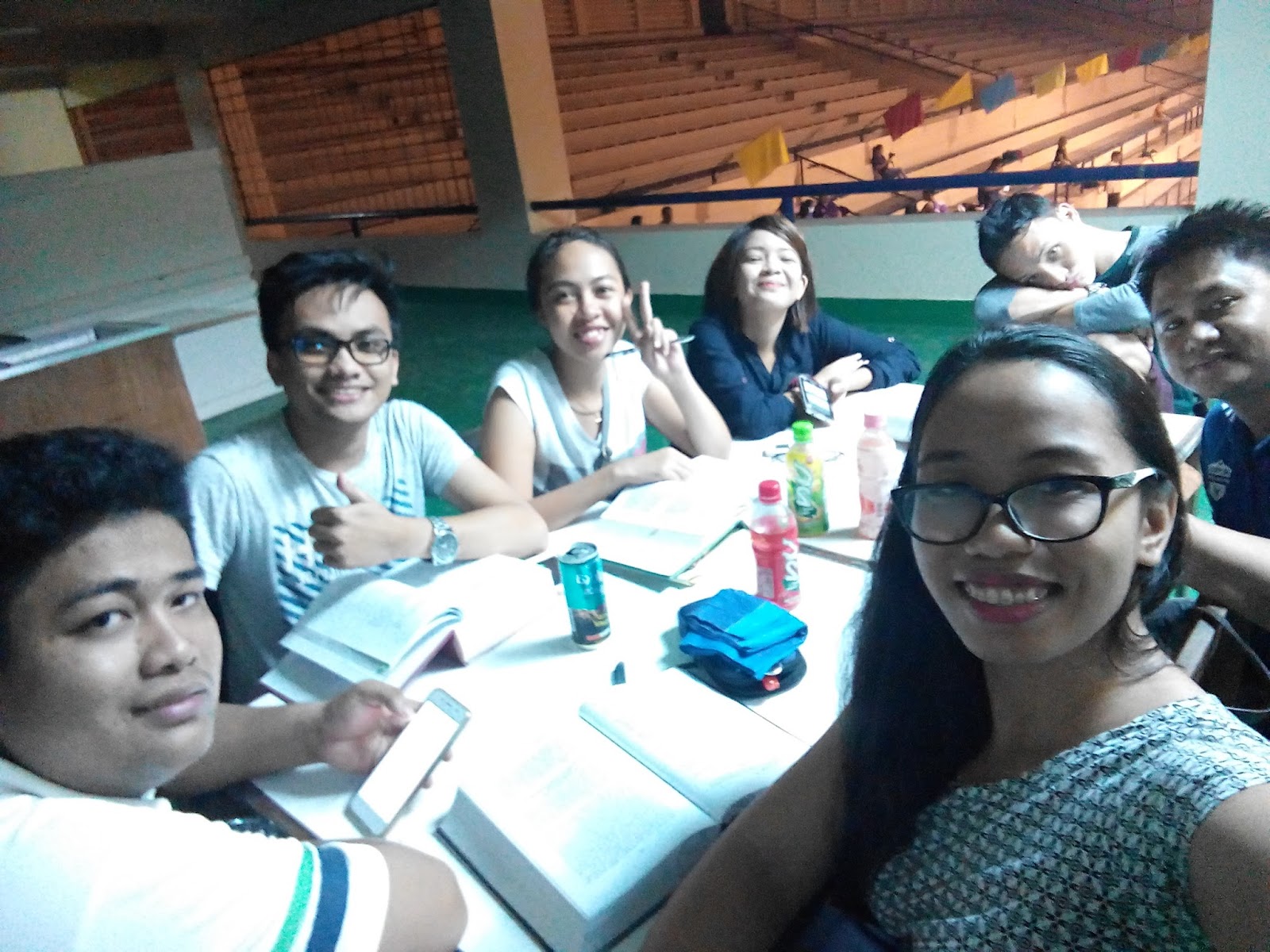
We were required to watch a basketball game, but seeing that we all brought our study materials with us, we ended up studying at the gym. We still cheered every now and then, though.


Before going to law school, I did a lot of research about what life will be like once I start. One of the tips I got was that you have to study every day. In my mind, I thought this would be just around two to four hours each day. However, during the first day, my professor particularly emphasized that we need to study six to eight hours a day to keep up with all the classes. He was not kidding. At least for me, I need that much time to prepare for classes and keep up. You could get by just by scanning the books and reading ready-made case digests sometimes, but you won’t really get the most out of the classes if you do this. Instead of strengthening well-established knowledge by reading the books and cases prior to class, you’ll end up writing everything the professor says and getting distracted and confused.
The books explain the material well, and the lectures are supposed to be there to reinforce the learning. But without reading prior to the lectures, everything will be new, and you’ll end up absorbing so much new information all at once. And that is very exhausting!
I admit I don’t always prepare for every class. Sometimes, the force of the bed is too strong, and my willpower becomes really weak. But I stand by what I’ve learned— reading before classes is important.
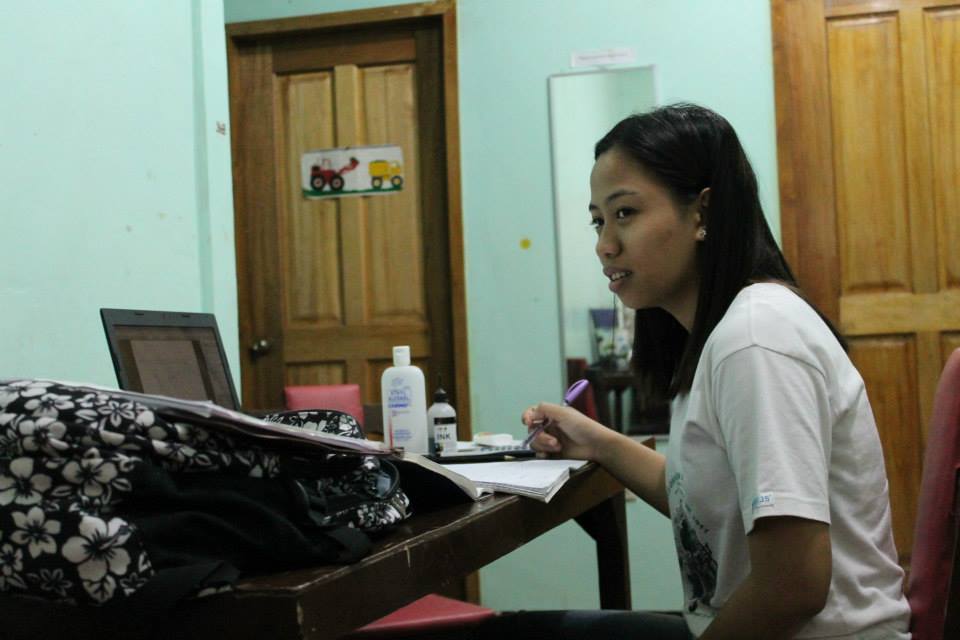
As for my health, I had learned the importance of exercise. When I’m studying, I would spend hours just sitting down. If I do this every day, I would be sedentary for the next four years. I was fairly active during college, exercising almost every day. But when I got to law school, I felt like spending even as short as thirty minutes for exercise would cost me a lot. But I had learned that it would cost more if I don’t take care of myself. I learned this the hard way. I was absent for my first Constitutional Law class because I got sick from being overly stressed, trying to prepare for class. We formed a study group, and we spent the whole day sitting down and eating unhealthy food while trying to cram every information in. Because of the stress, lack of rest, and lack of physical activity, I was bedridden for a whole day. Big price to pay for not taking care of myself.


The scene after our group study session


There’s also the issue with my eyes. Because I’m always reading (or watching funny videos on YouTube), my eyes could barely catch a break. That’s why since day 1, I had been drinking Eye Berry, this eye vitamin my friend recommended. I hope it really does help in the long run. I feel envious of law students who don’t wear glasses or contacts. I mean, how’d ya’ll do it? There are even times, especially during the first two weeks, when I would literally vomit because I was so dizzy from reading. My professor assured us that it was normal, but I was really worried. I really hope the vitamins work. Haha!
As for my mood, I have definitely become more irritable. I was not the most patient person before studying law, and it got worse now. I became more sensitive to noise and clutter. I can’t concentrate on studying if the conditions are not right. Law is not easy. It’s not as enjoyable as reading a novel, and some provisions of the law are quite hard to understand. I had to read some three times before I could say I really got it, only to find out later that my interpretation was wrong. Hard materials are meant to be studied well in the right setting, and with the right mind-set.
I would observe law students back in Iligan before, when I was still in college. They would spend the whole day in coffee shops, and if their friends or relatives would call them, they’d get so angry that the whole shop would know what their problems are. It’s better to irritate an inebriated person than one who just woke up, but it’s worse if you disturb a law student cramming for a major exam. That’s why I am learning more and more every day that it’s better to just voice out what you feel than keep it to yourself because there’s no room for drama when you’re studying law. Maybe that’s why lawyers are so straightforward. Instead of saying bad things about other people behind their backs, it’s better to tell them right then and there.
What’s good about this time is that I’m still not working after resigning from my previous job. I couldn’t imagine what life would be like if I’d have to deal with school and work. I will definitely be working again next year, but I need this whole semester to adjust accordingly. That’s why I salute all my classmates and all law students who have full-time jobs and are still able to make it through. Tell me your secrets, masters!
To summarize, I’m doing all right for now. It’s been a struggle adjusting, but I’m surviving. There are still lots to learn and lots of reading to be done, though. Exam weeks are coming, and I am bracing myself for the worst.

Are you in law school? How is the experience so far? Share it in the comments section below.

Tips for PhiLSAT Takers

In 2017, the legal education of the Philippines just got a little fancier with the addition of the Philippine Law Admission Test (PhiLSAT). The Legal Education Board decided to conduct the exam to screen future law students and to test their English and math skills. If you’re part of the thousands of Filipinos who aspire to become a lawyer and who are determined to do something about it, here are my tips on your first step toward that journey.
1. Know thy English
Three out of the four subtests in the exam deals heavily with your understanding and grasp of the English language. This is expected, of course, because a good command of the language is of prime importance in the study and practice of law. It is good to prepare by reviewing basic grammar rules and uses of punctuations. Here’s a breakdown of the first three sections:
Communications and Language Proficiency
This subtest is heavy on sentence technicalities and parallelism. Take note of the words used, and remember that commas are important. Every little detail of the sentence is taken into consideration. My job before as a copy editor definitely helped me with this, making this subtest my highest out of the four. If you need a reference, there are a lot of books out there, but I recommend Reader’s Digest’s How to Write and Speak Better and The Chicago Manual of Style. The latter is a very thick reference, but when it comes to technicalities, it’s a huge help.
Critical Thinking
They say that to be a good lawyer, you need three Ls—law, logic, and language. This subtest deals with the second element. It tests your analytical and logical skills. In my opinion, this is the most fun section, but could also easily become the most difficult. To prepare for this, I took IQ exams, prepping my mind to recognize trick questions and patterns for this kind of exam.


Verbal Reasoning
When I took the PhiLSAT, my biggest mistake was with this section. It’s basically reading comprehension. You have to read lengthy passages and answer a couple of questions afterward. What I forgot was that technique often stressed by elementary school teachers—read the questions first before reading the passage. Don’t make the same mistake.
2. Review basic math
The last subtest is quantitative reasoning. For those who have not solved math problems for a long time, especially those whose courses are not heavy on math, it is best to review your basic calculations. You will do a lot of solving here, and calculators are not allowed. Review the basics: long division, multiplication, and even basic addition and subtraction.
The first part of the exam contains a lot of series problems, i.e., you are asked to find the next number in the series. Practice doing this by acquainting yourselves with this kind of questions and recognizing patterns. A simple example is this: What comes next in the series?  36, 33, 30 __. Of course, it’s more complicated than that, but that’s basically what the first part of the fourth subtest looks like.
The second part is more on problem-solving and reading and analyzing graphs. Make use of available reviewers for this.
3. Don’t delay
The main problem you have to overcome with PhiLSAT is the time limit. There are two hundred questions and only three hours to finish them all. This means you only have 0.90 minutes or fifty-four seconds to answer a question. This leaves little time for doubt or reviewing. And taking into consideration the nature of the test where there are questions where you have to read long paragraphs, speed is definitely of importance. Take note that these fifty-four seconds should include the time it takes for you to shade your answers. PhiLSAT proctors will alert the examinees to pass the papers when time is up, and random shading is not allowed. It is best to practice speed reading and shading before taking the exam.
4. Skip ahead
There are no restrictions with the subtest you are answering. The only rule (as far as I know) is that you have to finish the exam in three hours. You can definitely skip ahead to another subtest if you wish. The proctors won’t be checking this. In my experience, the proctor will not be going around the room to check which subtest you are on. So if you think it will take you less time to answer the third or fourth subtest, go ahead and do that first. Unless, of course, if you are told to do otherwise.
5. Relax
This is my most important tip of all. I know you hear this all the time, but with a time-pressured exam like the PhiLSAT, you don’t have time to panic. Remember: 54 seconds, including shading. If you shake and worry in the process, it will cost you. Try taking the exam with a calm mind. This test is a big deal, but worrying about it won’t help you. Focus on the questions. Ignore the jitters.
For those who are going to take the PhiLSAT, I wish you well, and I wish you the best. My prayer is that we will all succeed in our chosen profession. See you on the other side someday!

Braving the Rapids: Canyoneering at Badian


After a few months of working, I am officially leaving the company in a few days. I wanted to spend more time with my friends before I left, so I impulsively told my workmate that we should go trekking. My trainer, who is a bit of an adventure junkie, suggested that we should go canyoneering instead. A few weeks after, we found ourselves waking up very early in the morning to go to Badian to experience Kawasan Falls. The overall experience was worth it although we had muscle pains for days afterward and we found it really hard to move around. My friend even texted me if I could help hook her bras because it was too painful to do it herself. We went there with no training or exercise, and we went home feeling drained but satisfied.


If you’re ever considering to do this activity yourself, I hope this article helps you to prepare for what’s coming.

Getting to South Bus Terminal


I was still groggy from just four hours of sleep when my alarm went off. I really wanted to go back to bed, but I still haven’t packed for the trip, and my friend was picking us up. I packed my towel, extra clothes, and my money. I grabbed whatever I could and thought I needed and headed to IT Park, where my friend’s dad picked us up. The ride to the bus terminal went smoothly. The traffic was not yet heavy, and the air was not yet saturated with poison. We arrived at the South Bus Terminal around fifteen minutes before six. We waited for our companions and boarded the bus at around six-thirty.


The Ride to Badian


The three-hour ride was not that pleasant for me. I felt dizzy because it’s been quite some time since I last rode on a bus, and I lacked sleep. We also didn’t have breakfast because we were trying to make it to the rendezvous before six. I just had a cup of noodles at the terminal. While looking out the window, I was reminded of my own city in Mindanao because the places we passed by looked more and more provincial as we approached Badian. It was nice to get away from the city for a while. The trip cost us Php160 each.

Preparations
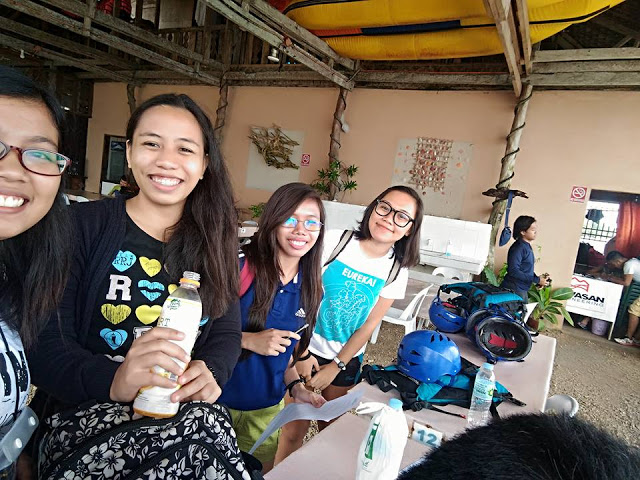


We have arrived, ready to sign the waiver that would clear the owners and staff of the resort of any liabilities should anything happen to us. See hoe happy we are?


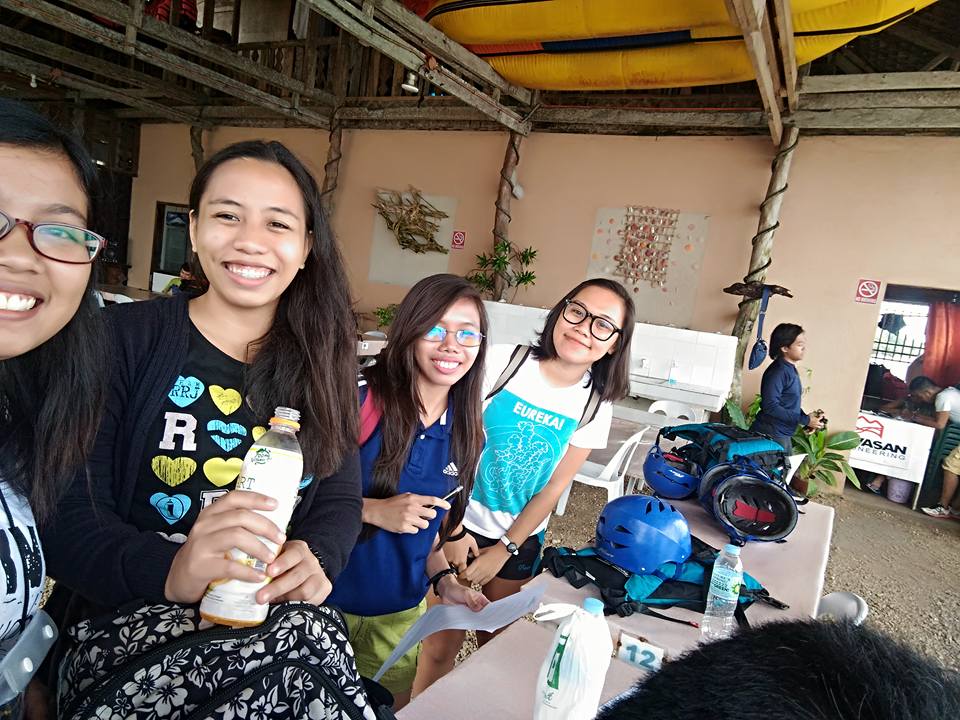
We arrived at Badian at half-past nine. I expected to see the falls right away, so I was surprised when we were led to a beach resort instead. It’s called Matutinao Beach Resort, and it was where we signed waivers and put on our gears. Here’s a note to all of you who are going to do this activity. Before you sign the waivers, make sure to read the entire document. It said there that the resort owner and the guides are not liable of any deaths and injuries, and you are also not allowed to take any legal action in case something bad happens. Basically, if waivers are likened to Pontius Pilate washing his hands in front of the people, this is just like that except that he washed his hands with soap twice and used sanitizer afterward.
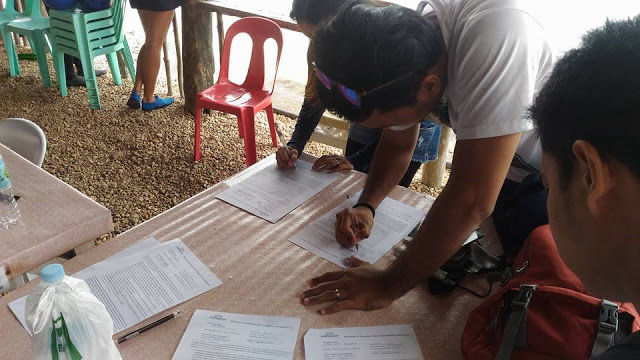


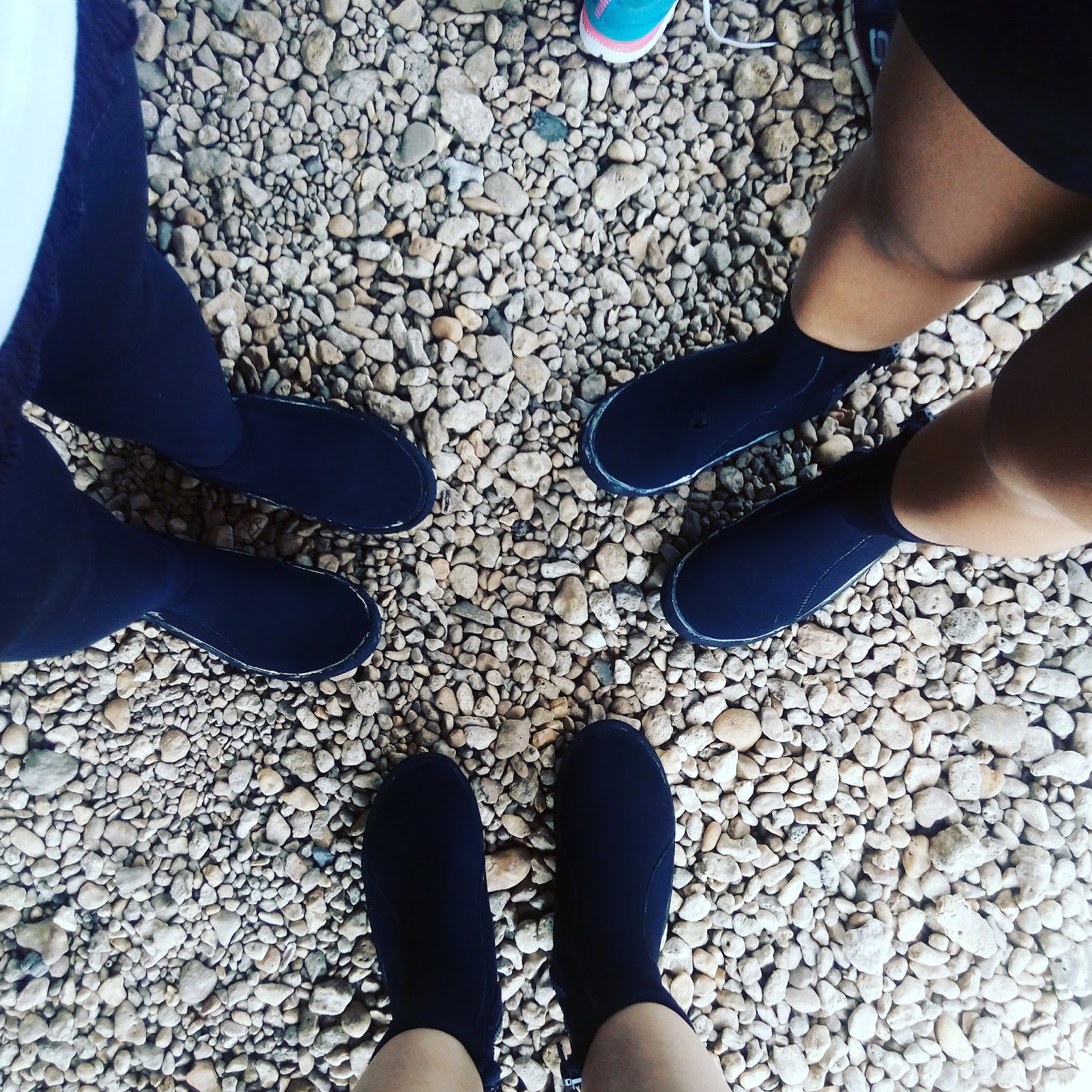
We paid Php1300 each for the experience.That includes the gears, the snack, and a meal after the trek. We had to pay an additional Php100 for the shoes, but you have the option to bring your own trekking shoes or sandals. The shoes they provided were these thin-soled ones that were tight so that not that much water can get it. They were so thin that you could actually feel the rocks while you’re walking. It takes some getting used to, but it’s really helpful and convenient along the way.


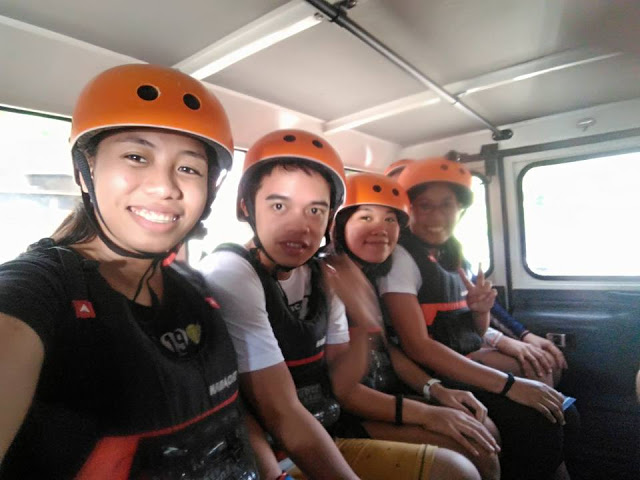
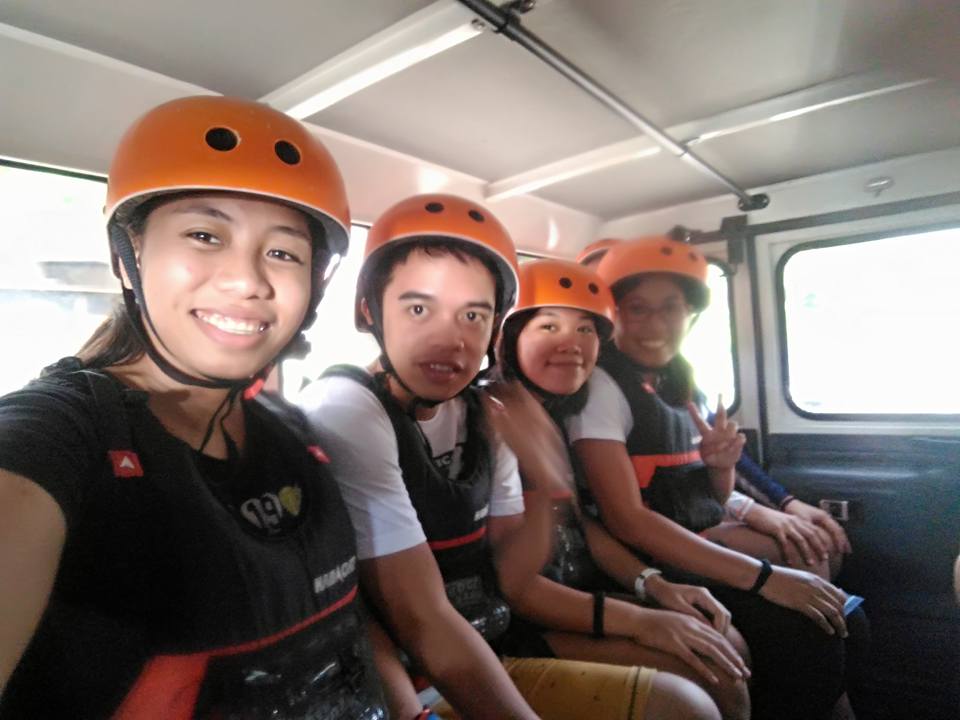
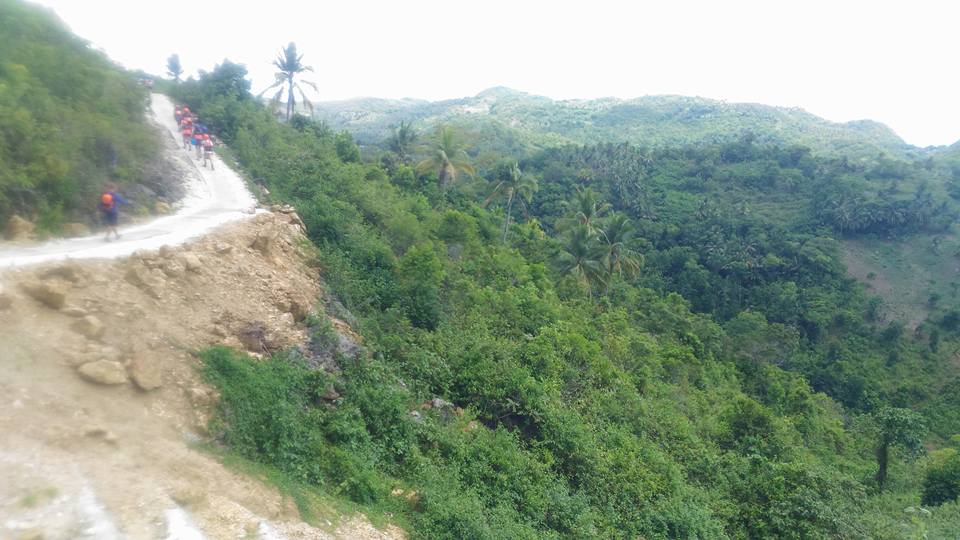
We were provided with life vests and helmets. Inside the vests were our snacks, which was a Fudgee bar and a bottle of water. When everything was in place and everyone had their gears on, we were led to a vehicle that took us to trails where we would start the trek. I don’t remember how long that ride was because I was still dizzy, and the humidity and bulky gear were not helping. The ride was also very nerve-racking at times because we were getting higher and higher, and there weren’t any rails on the road that could prevent our vehicle from falling over the cliff in case the driver makes a wrong turn. We were all thankful he knew what he was doing.
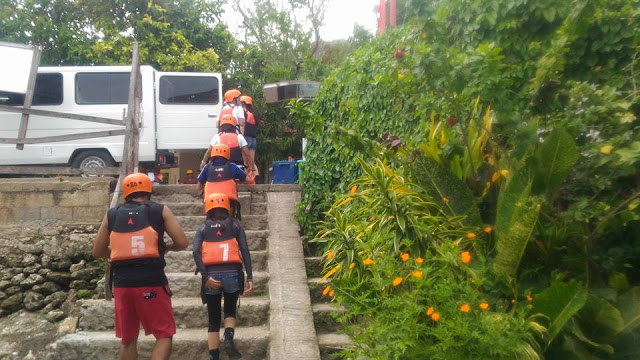


On our way to the vehicle that would take us to the trail


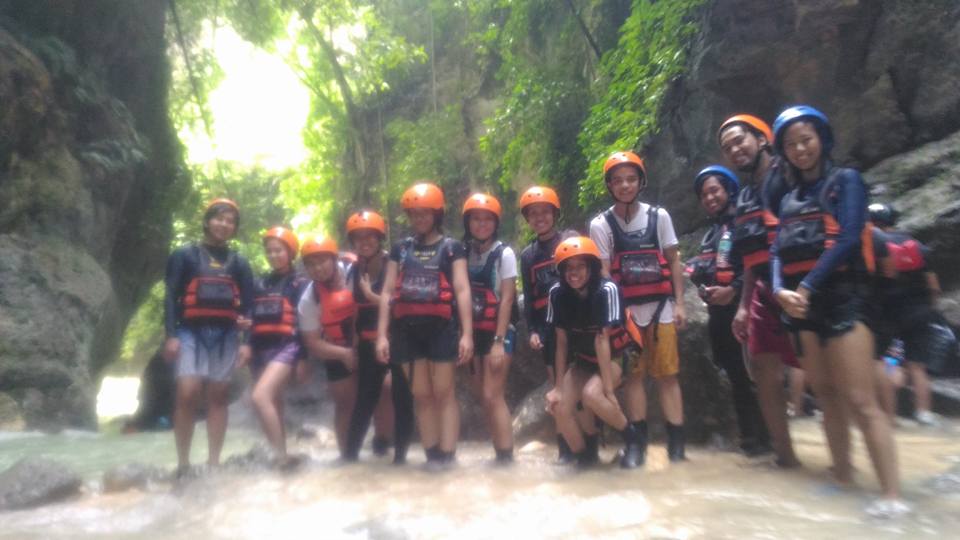
Here we are, trying to act cool while bathing in sweat.


The Trail


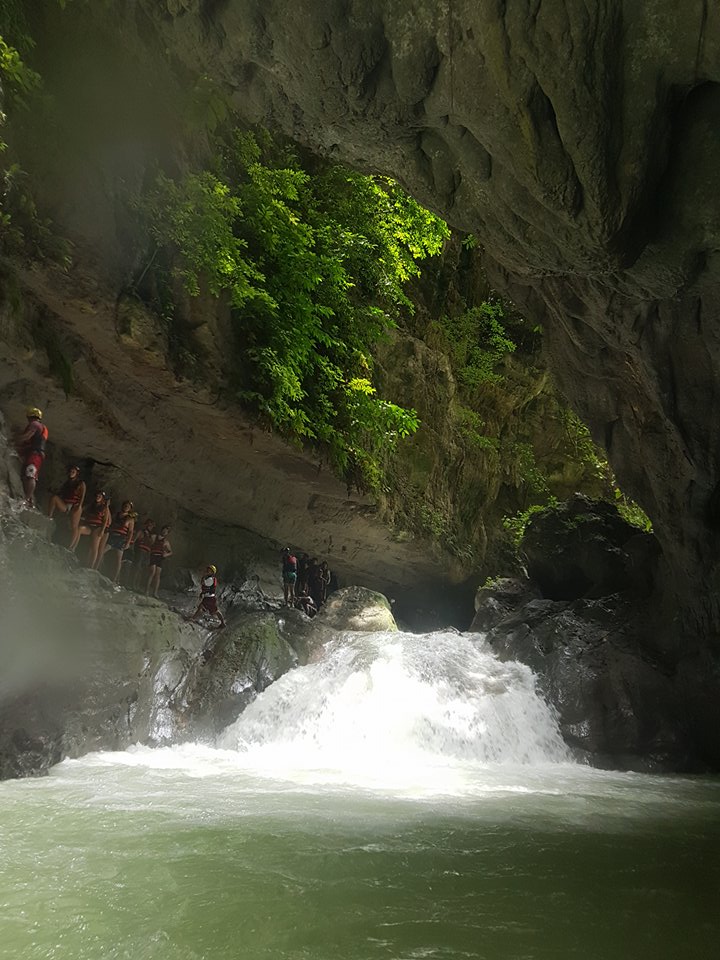
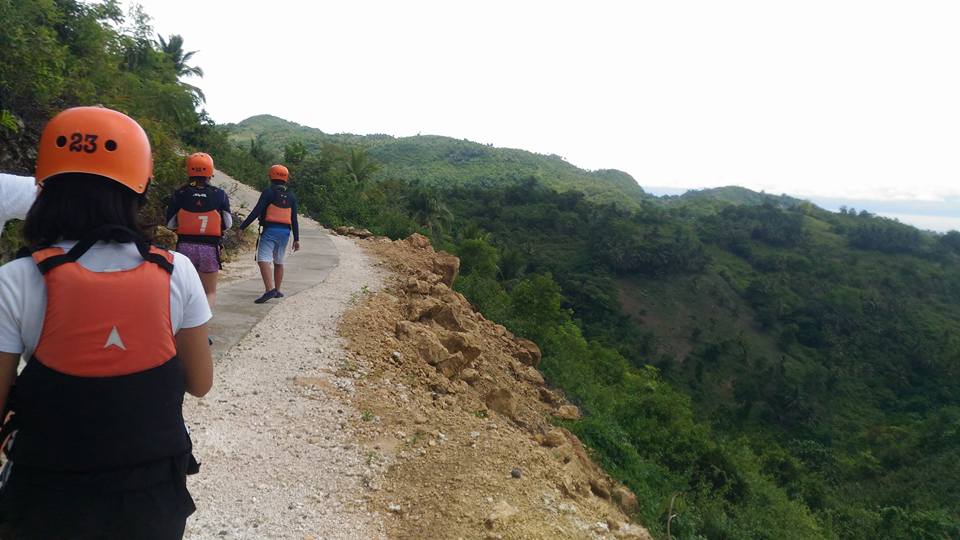
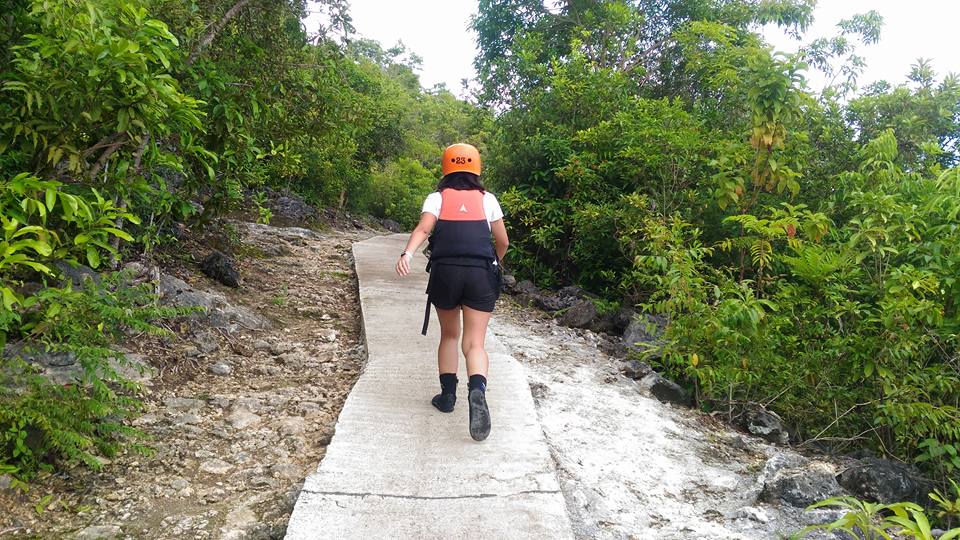
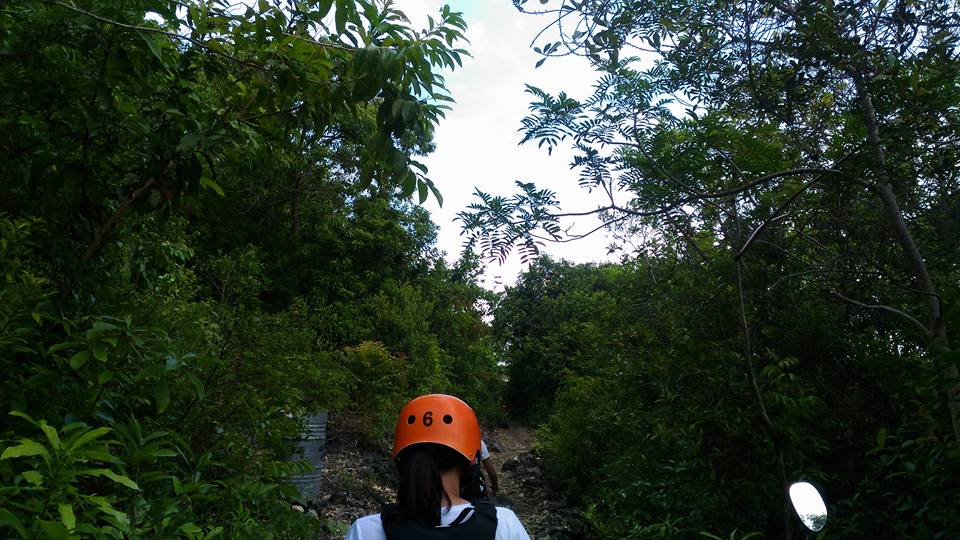
When we got to our destination, I was surprised to not see any bodies of water nearby. Instead, we were told to walk on a very long trail while we were still wearing our vests and helmets. The path was rocky, and some places were narrow (only those with pure hearts may pass). Aside from getting tripped by random rocks along the way, the view was magnificent. There were trees all over. Verdant beauty surrounded us while we sweat and occasionally pestered our guide by asking if we were there yet. We passed by a few houses and met some locals, but aside from a not-so-cheerful “good morning,” we didn’t interact with them.


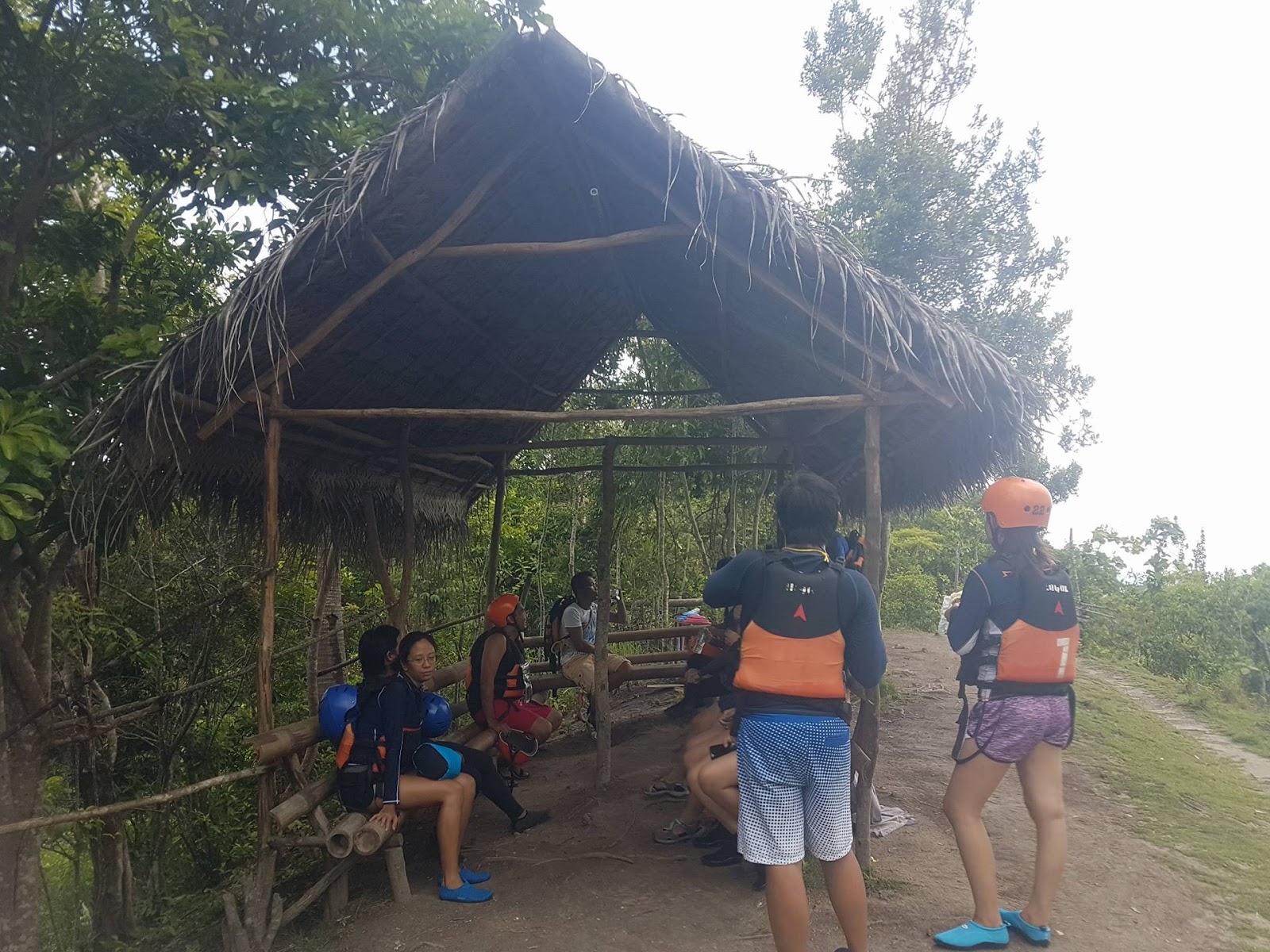
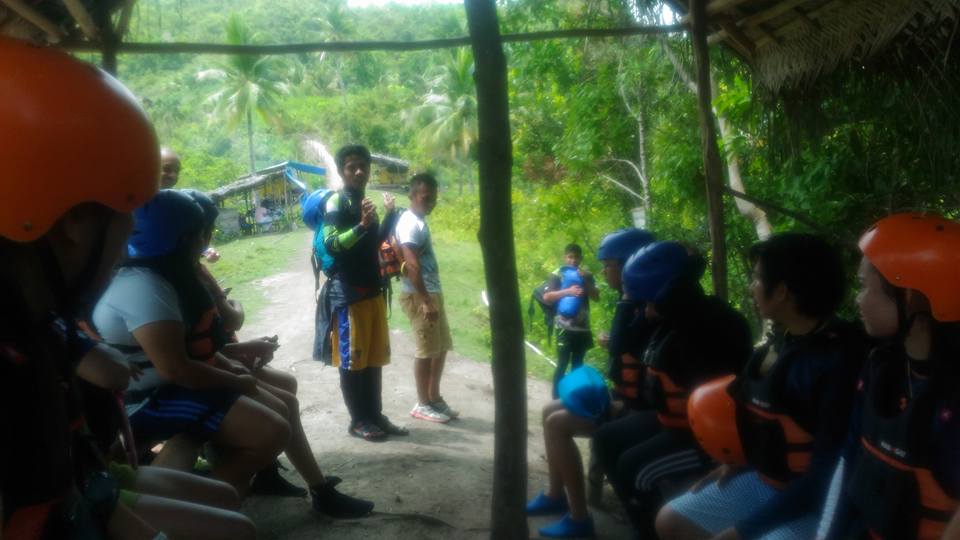
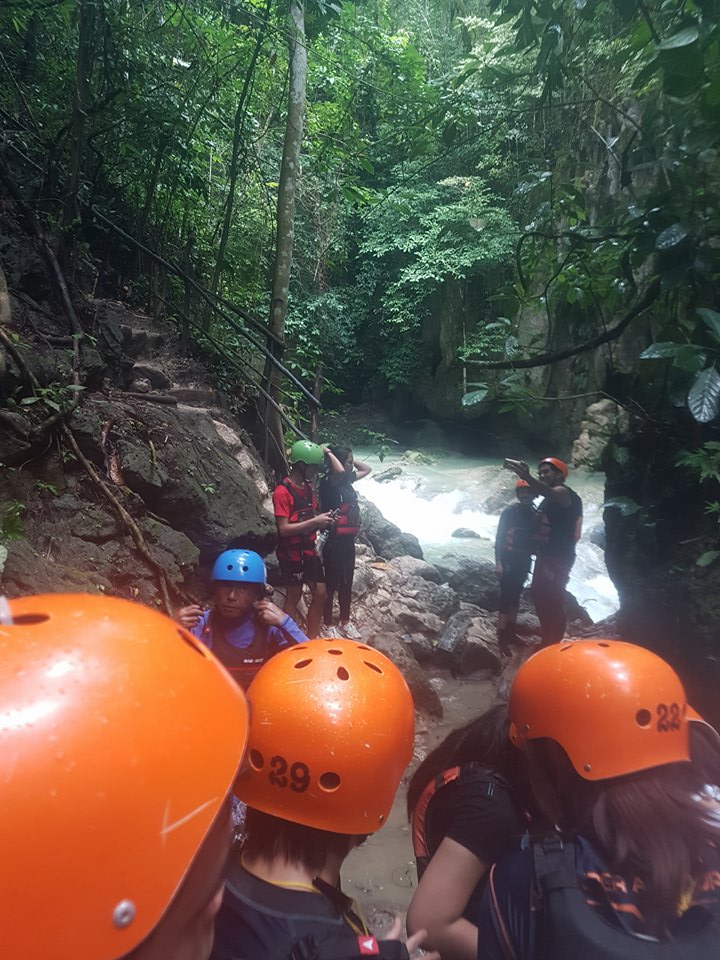
We were finally allowed to rest in a small shelter, where we were briefed for the trip. We were warned about the leaps we were going to take and the nature of the water and what we should and should not do. After a short prayer, we went on our way.
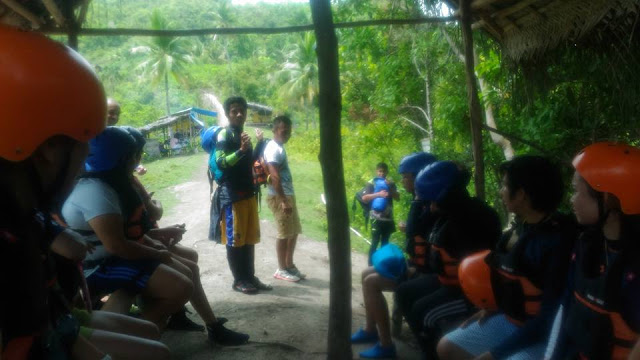


Our guides are briefing us about the dangers ahead.


We descended a very long and slippery trail that resembled a frustrated staircase. There were rails to hold on to, and I was basically using every limb to navigate the way. At some point, I was almost crawling, trying to hold on to any branch or rock nearby. Along the way, my workmates were starting to blame me for bringing them there. At that time, I thought of two things: (1) Don’t be afraid to get dirty. It’s better than being injured or dead and (2) I am neverbringing my siblings here.


We weren’t able to take many pictures of the trail because we only have two hands each, and both were needed for survival. We got to the point where we heard the distant screams of other brave souls who made the choice to risk their lives that day for a bit of fun. They were already making the first leap. A few moments after, it was our turn.

Our First Fall
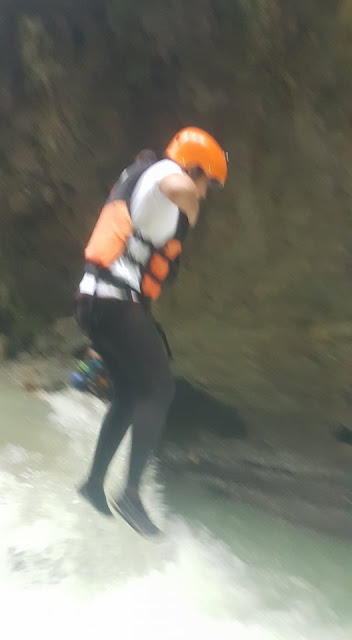


Talk about taking the leap


You know that feeling when you’ve been holding your breath for so long then you finally get to breathe freely again? We felt that for a while when we ascended into solid, not-so-slippery ground, but we had to hold our breaths again when we saw what we were going to do next.


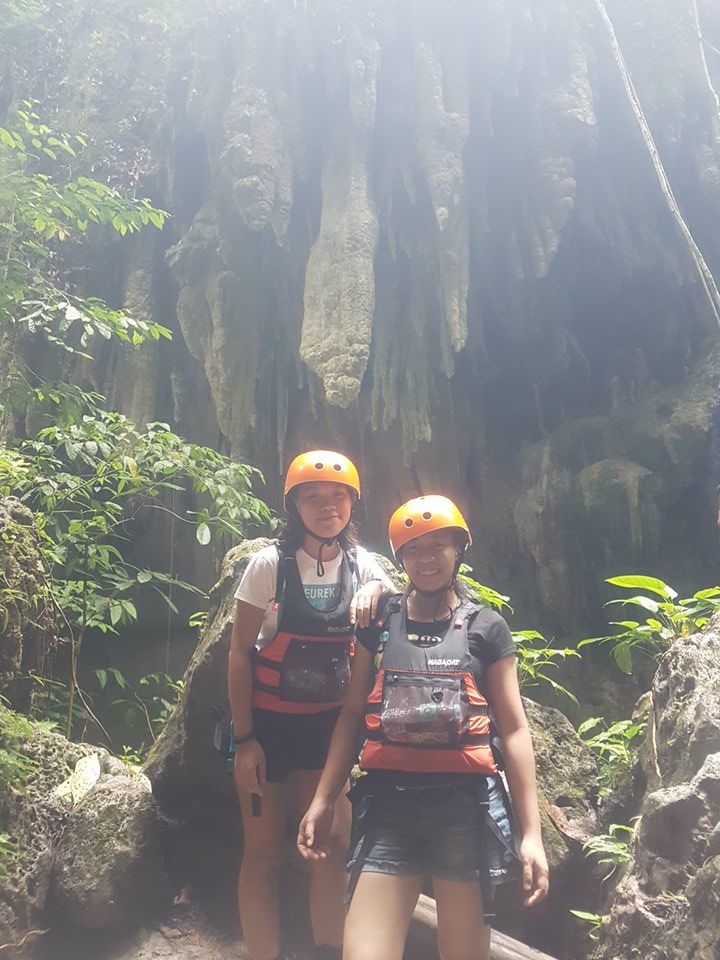
Before worrying about what’s to come, however, we took some pictures using the stalactites as background. We really had to because there was little to no chance of us coming back there voluntarily after walking and sliding down a mountain and bracing ourselves all the way. The sound of the water was like music to our ears, accompanied by the very loud beating of our frightened hearts. Together, they made the song that was to be part the OST of what we were about to accomplish.
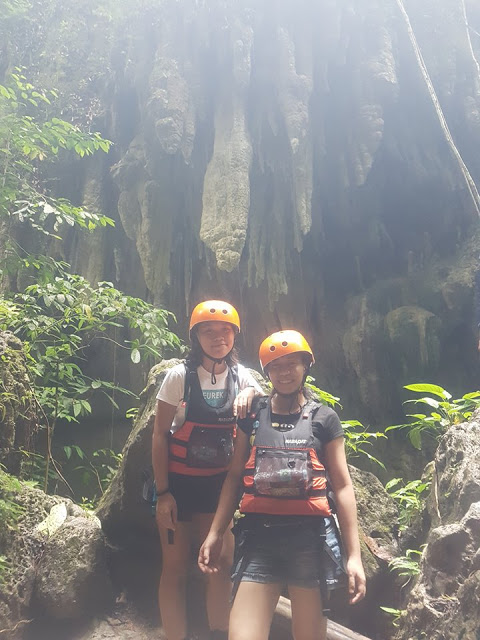


Background: Stalactites
Foreground: StalagMITES


We knew we were going to jump into the water. That was the only thing I was expecting that day, but still, I was not emotionally prepared. When I looked down and realized how high the jump was, I had second thoughts. There was a way to escape the jump—I could go back. But thinking about that wretched trail made me decide I’ll just do it.
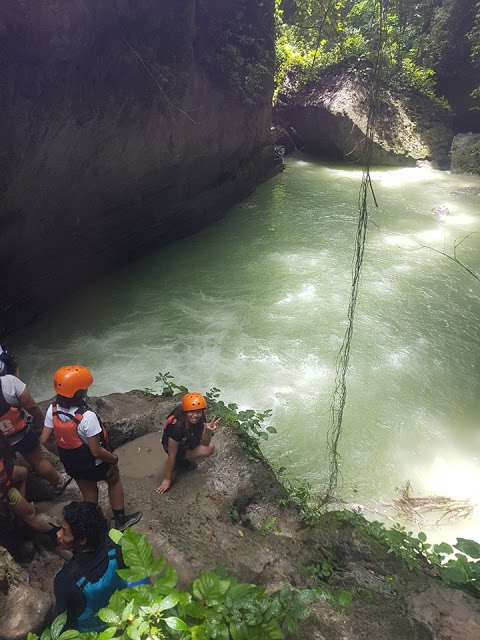


This is where we had to jump.


Smiling for the camera before jumping


We were egging each other on. Being afraid of heights, I took it as an opportunity to conquer my fear. I shouted encouragements to my friends only to find that there are not enough words to make me want to jump while it was my turn to stand on the edge. A lot of our companions were already on the big rock in the middle, waiting for us to join them. When it was finally my turn (It was my second, actually. I gave up on the first.), I held my nose and hoped for the best. When I finally jumped, I was so nervous because I kept on turning underwater. The life vest finally decided to take me to the top, and I was able to feel and appreciate the coolness of the water as well as the joy of having achieved such a feat. The next leaps after that were more fun. After you brave the first fall and discover that you could survive, you’ll be looking forward for the next challenge.
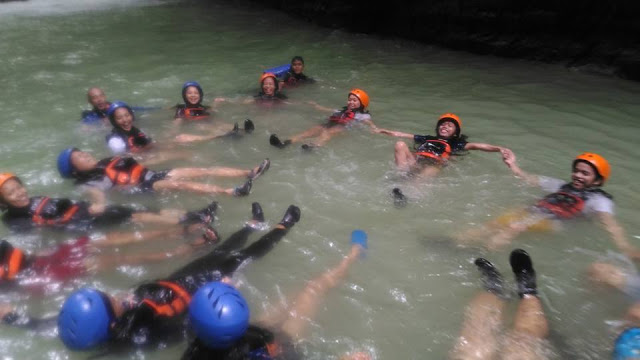


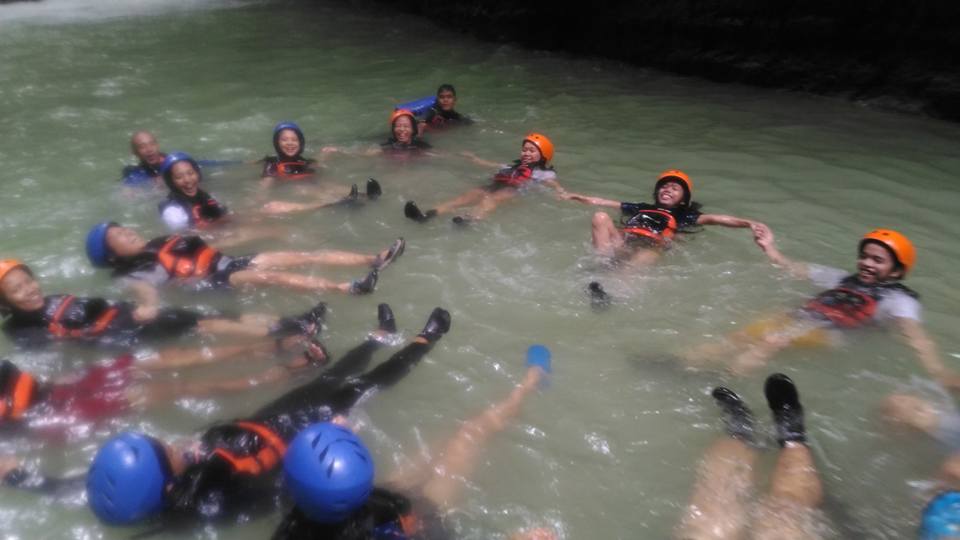
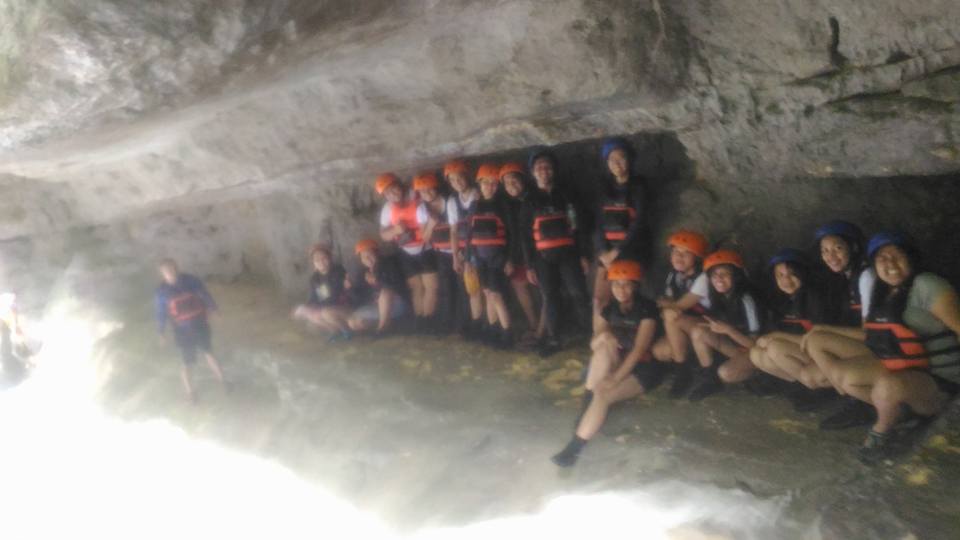
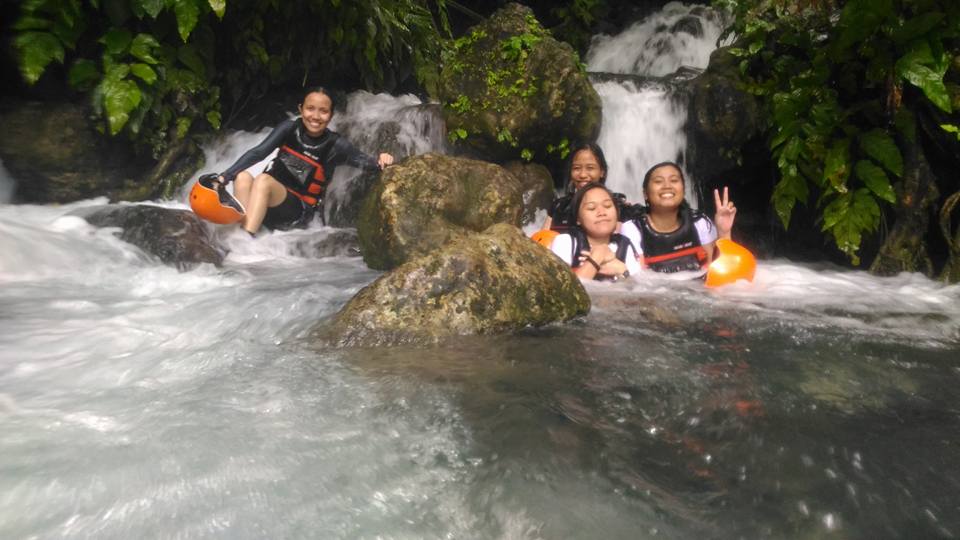
After jumping off, we tried to make a circle (you know, for social media), but we couldn’t manage because of the strong current.


More Beauty Along the Way


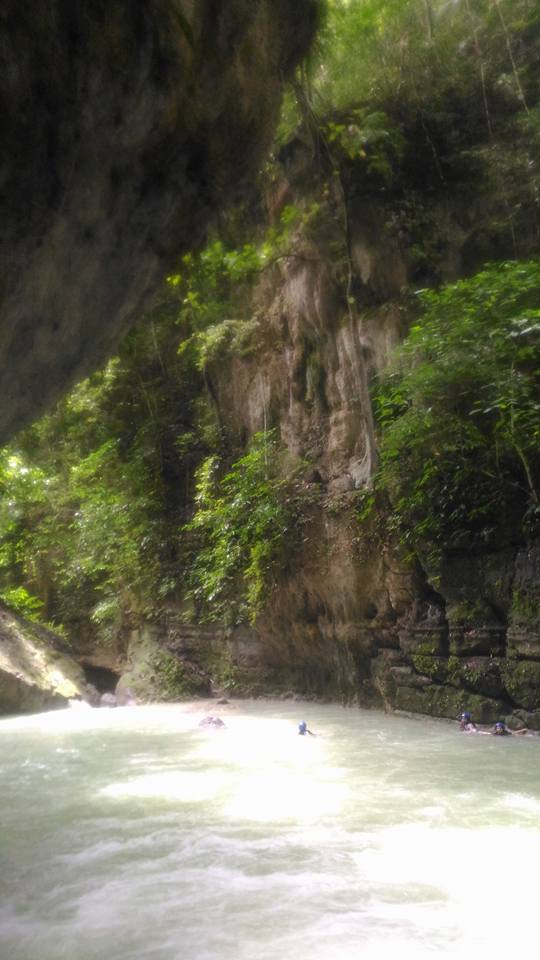
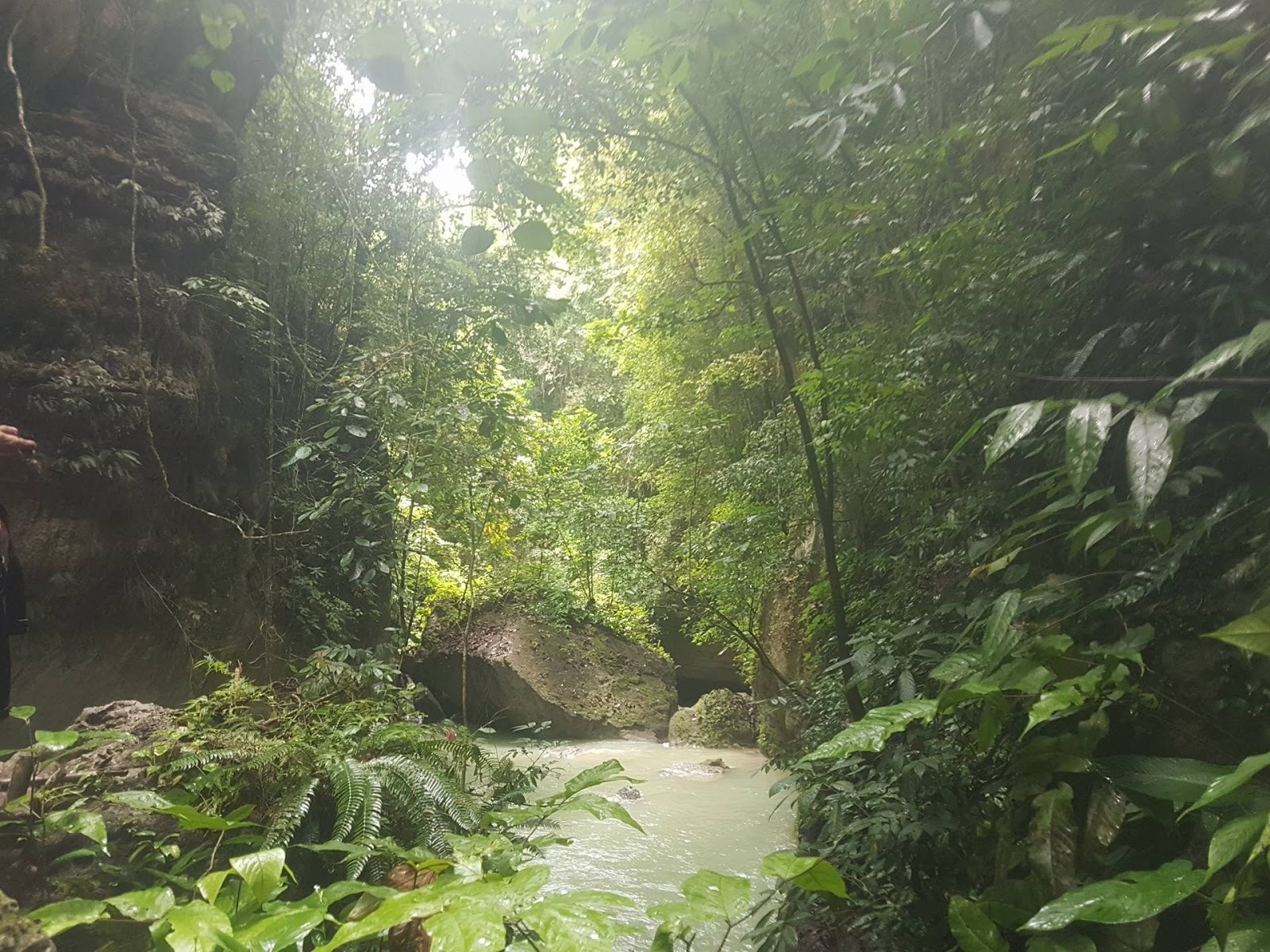
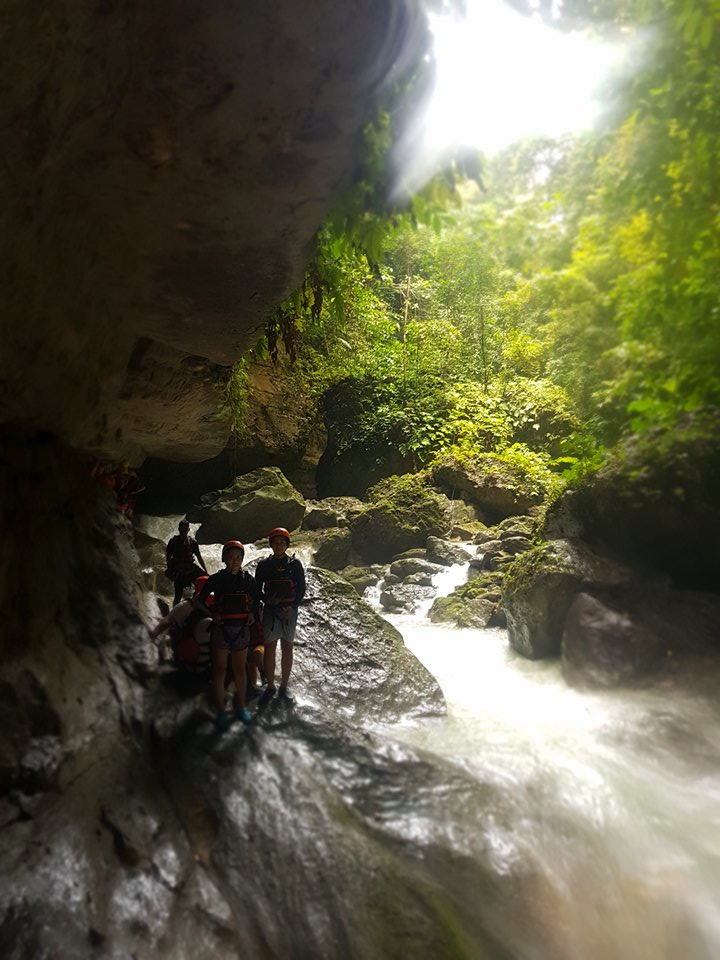
My favorite part of the activity was definitely the moments after every jump. You are asked to swim to certain areas while you’re on your back. The beauty that greeted me during those moments was mesmerizing. I could see the blue clouds amidst the foliage, and I was surrounded by rocks and was completely one with nature. That is until someone says “Picture!” then I’d stop thinking about nature and concentrate all my energy on my smile and pose. But seriously though. If you’re ever going on this trip, make sure to look up, and if possible, jump first so you could enjoy the view longer.
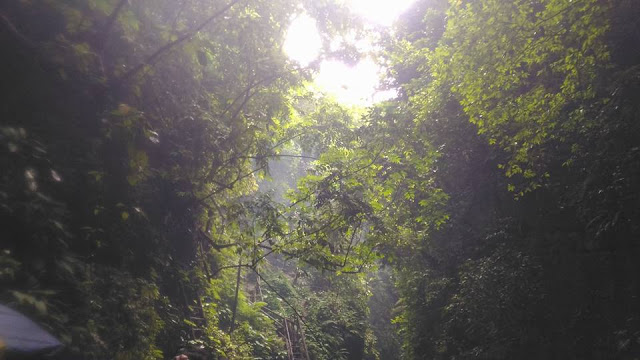
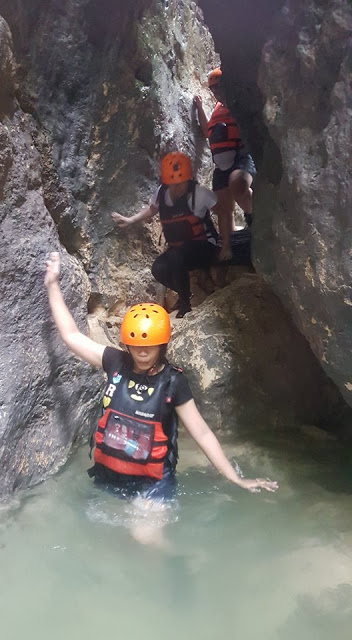
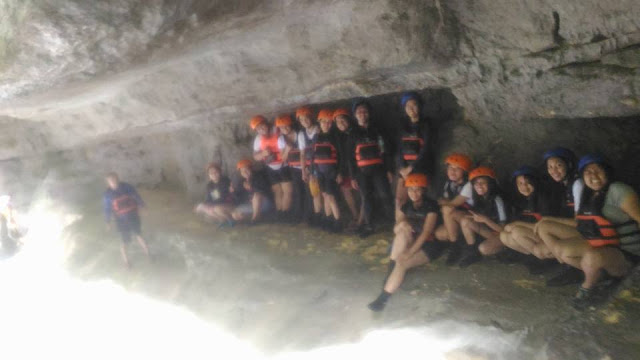


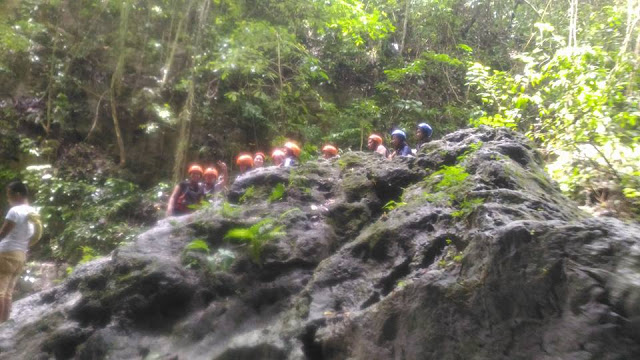
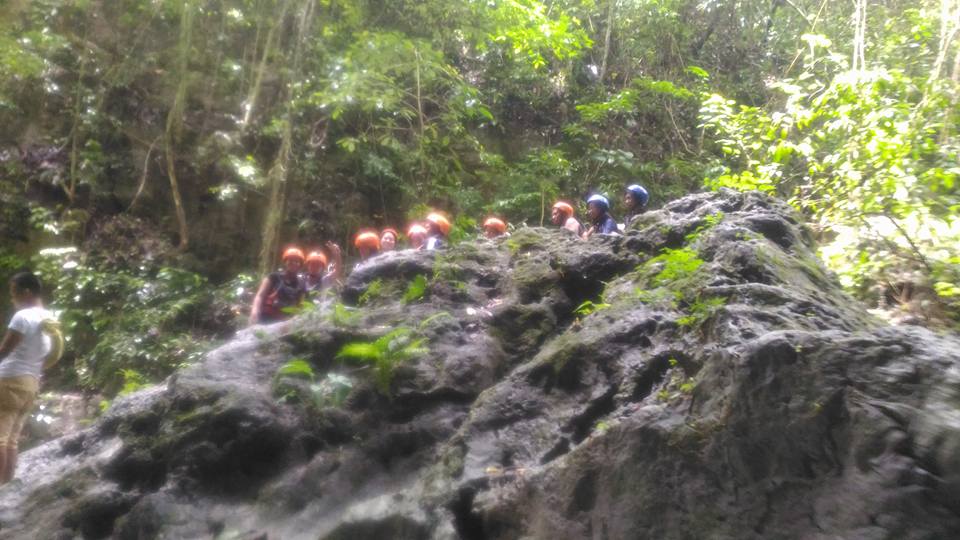
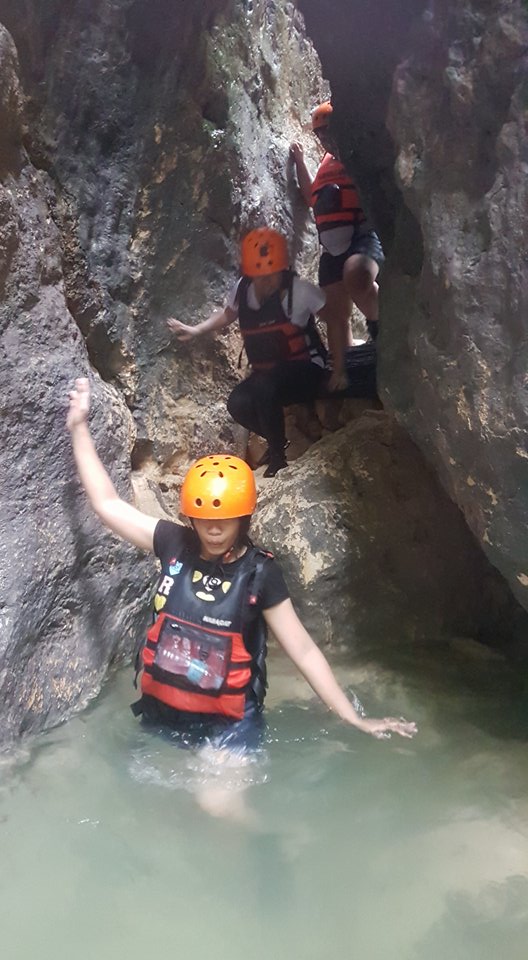
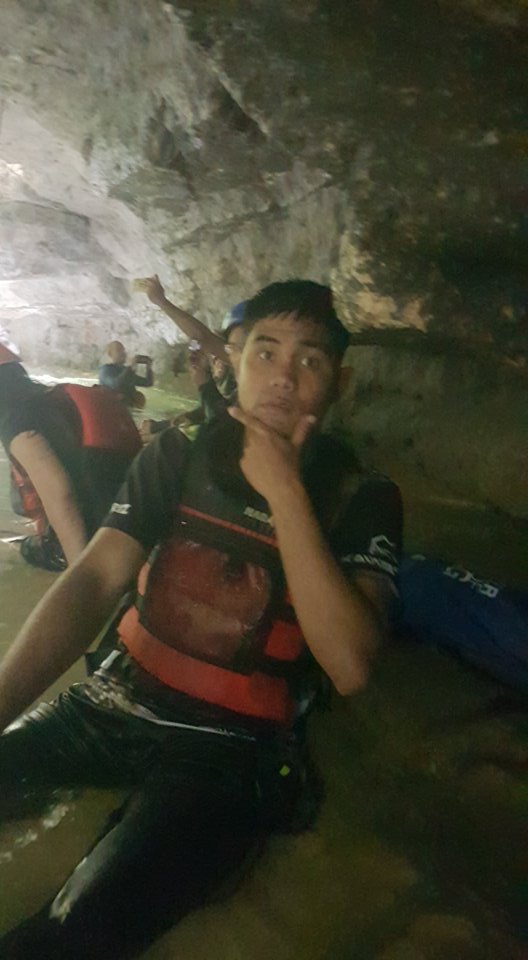
We went through a lot of interesting rock formations. We had to climb in some and crawl into others. There were moments when we had to step on the guides’ legs to get to the other side. We were lucky to have such amazing guides. They were very friendly and accommodating. They made lots of jokes and made sure to take lots of pictures and videos while we were crossing the obstacles. They were also very careful with us and made sure to make us feel safe. There were a couple of accidents along the way, but everything was fine in the end. We even had a guide who’s mute. I admired his spirit because he was so cheery, and he made lots of jokes through gestures.
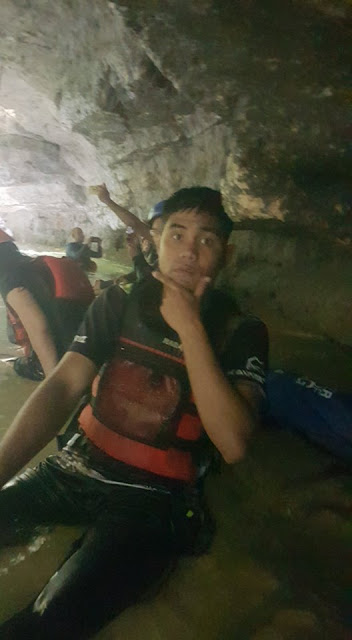


Hi, kuya!

BBQ


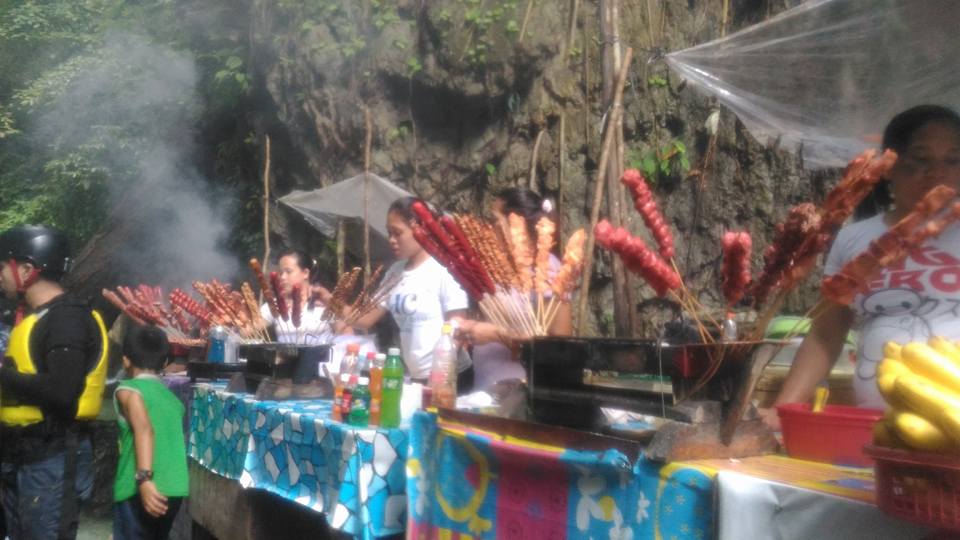
Believe it or not, in the middle of the trek, there were barbecue stalls on top of one of the rocks. I got the opportunity to eat a deliciously hot isaw(barbecued chicken intestines) while admiring the water below and the trees above. It was a nice break that enlivened us. We were ready and eager to continue the trail and were already talking about whether or not we should jump from the highest point of Kawasan Falls. That liveliness was instantly killed, however, when we were told we were only halfway through the trek. It was too late to go back. There was no other choice but to continue.

More Beauty Still


Throughout the journey, we had to occasionally use ropes to avoid being caught by the current. We also had to kneel on a makeshift bamboo bridge while crossing to the other side. Because there were no toilets along the way, I had to take bathroom breaks while in the water. *aherm*


It was all fun, but halfway through, we were all exhausted, and people rarely talked. We were going through the obstacles silently. We finally reached the point of the highest jump. There were people waiting for their turn. I wanted to do it, but the chicken inside me was screaming no. So what we did instead was enjoy the kiddie pool, a term here which means a small bounded part of a larger body of water where you could massage your back and pretend you’re in a Jacuzzi.
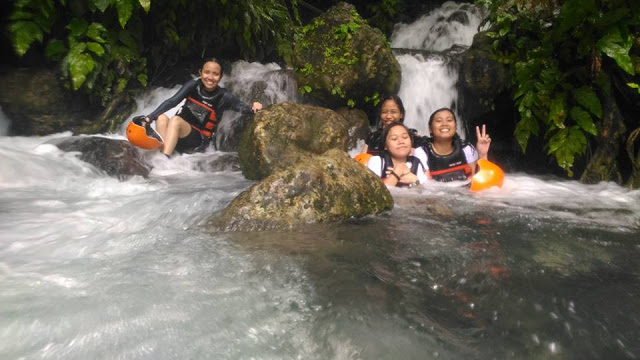


We children are having fun at the kiddie pool.


We crossed the other side to a part where they had a swing. Since seeing one of those from Grown Ups, I wanted to try it. I paid Php10 to use the swing for as much as I want, but I only went twice. It was rather embarrassing. Exhibit A, Your Honor, is shown below:


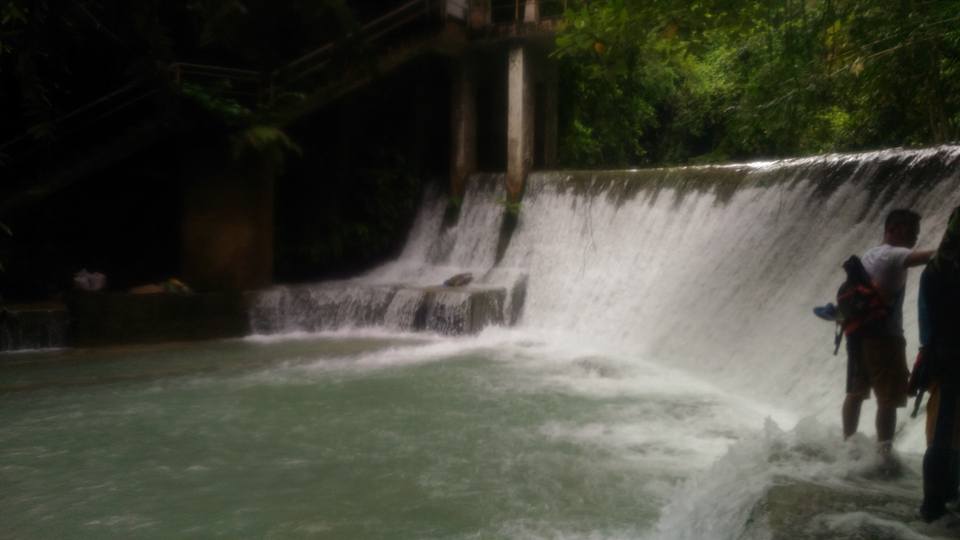
From there, we went to this dam-like portion, where I almost slipped into, and there was more walking. The pathway at this point was not that rocky anymore. We were slowly going back to civilization, and we passed a couple of resorts along the way. I felt like an alien walking amidst families having a good time while I was still in my gear.


We finally reached Kawasan Falls. It was my first time to be that close to really powerful water that has the potential to kill you. There were a lot of people there, including Miss Gay contestants having their photoshoot.


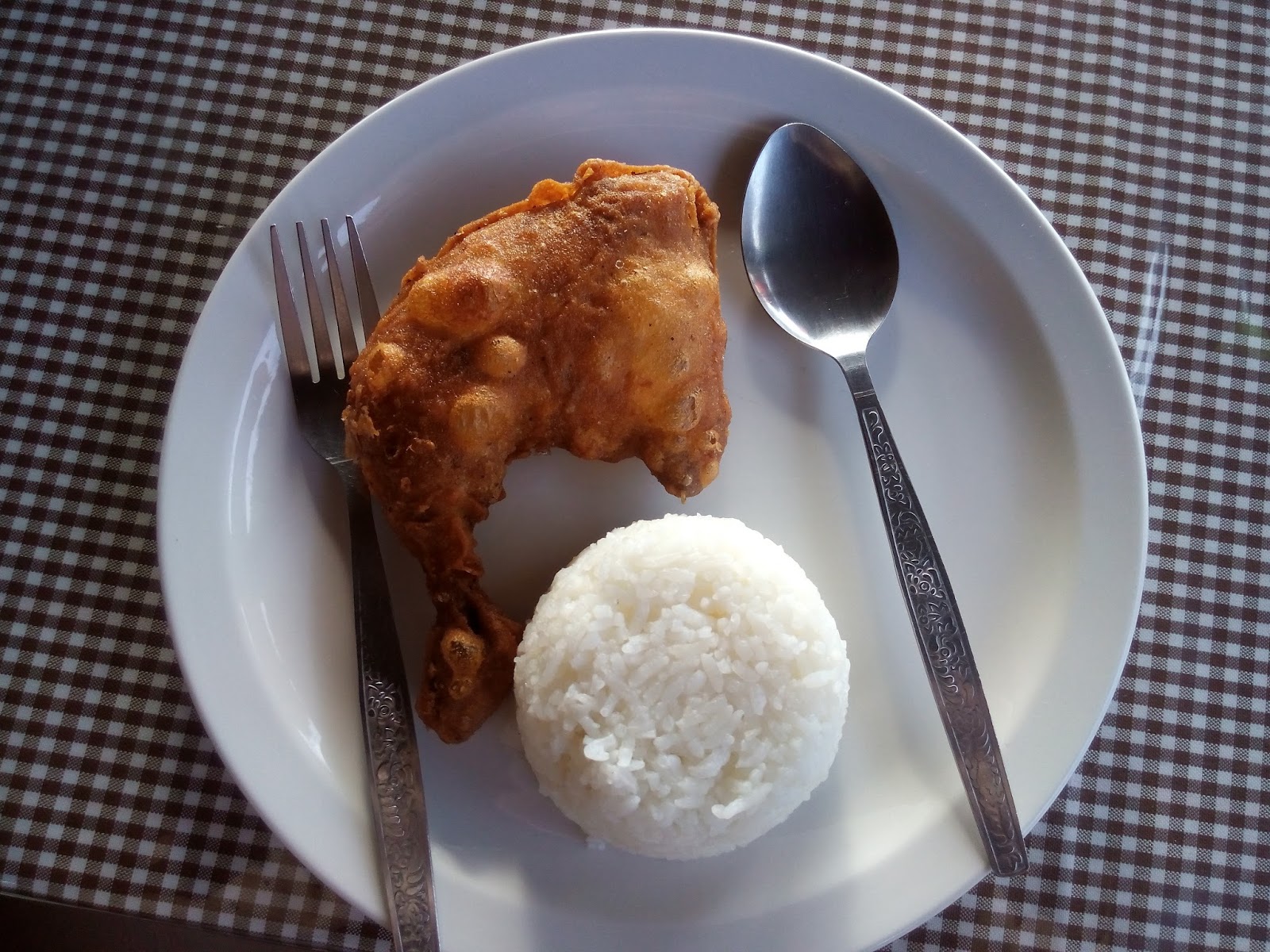
From there, we walked a little more until we reached the resort where we started from. We were so tired and were happy to finally taste food after so long. That cup of noodles wasn’t enough for the day’s activities, but I miraculously managed. We were served delicious chicken and pancit. It was one of the most delicious food I have ever tasted partly because the cook was amazing and partly because I was just really hungry.
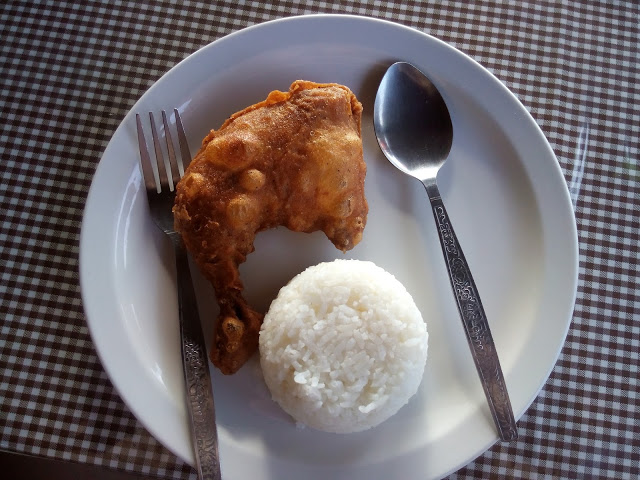


Food!


We took a dip at the beach after eating. (This is wrong. I know.) I then observed that the water was really salty. After spending a whole day in freshwater, you get used to the kind without flavor. While in the sea, our scratches from the trek were burning in the saltwater, but we tried to be cool about it.
We finally ended the activity when we got on that bus, away from the peace and fresh air and back to the more chaotic life in the city. We were very tired and had muscle pains all over, but it was worth the time and the money. I’m glad I went, and most importantly, I’m glad to find that the next day, I was still able to hook my bra.
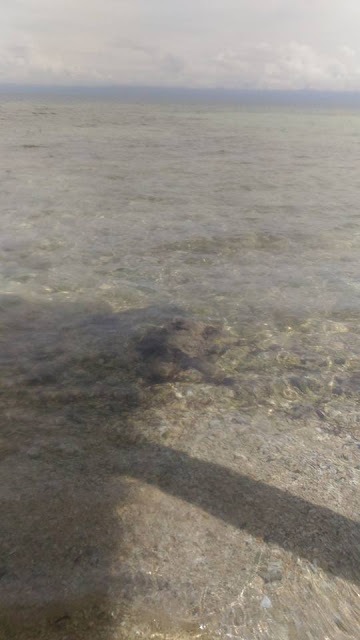

The sea was very clean . . . and salty.


Was this article helpful? If you’ve ever been to Kawasan, tell us your experiences in the comment section below.

Design a site like this with WordPress.com
Get started