
Active Realty v. Daroya Case Digest

ACTIVE REALTY & DEVELOPMENT CORPORATION, petitioner, 
vs.
NECITA G. DAROYA, represented by Attorney-In-Fact Shirley Daroya-Quinones, respondents.

Facts:

Active Realty & Development Corporation (Active) is the owner and developer of Town & Country Hills Executive Village in Rizal. On January 2, 1985, it entered into a contract to sell with Necita Daroya. They agreed on the price of P224,025.00.

However, it was also stipulated that Daroya should pay the initial amount of P53,766.00 upon execution of the contract and the balance of P170,259.00 in sixty (60) monthly installments of P4,893.35. This amounts to P346,367.00, which is clearly higher than the original price agreed upon.

By August 8, 1989, Daroya was in default of P15,282.85 representing 3 monthly amortizations. Active sent Daroya a notice of cancellation of the contract to sell to take effect 30 days after receipt of the letter.

Later on, Daroya offered to pay the balance, but was rejected by Active because the latter had sold the land to someone else.

By this time, Daroya had already paid the total sum of P314,816.76, which amount is P90,835.76 more than the total contract price of P224,025.00.

Issue:

Whether or not the petitioner can be compelled to refund to the respondent the value of the lot or to deliver a substitute lot at respondent’s option

Ruling:

Yes.

The contract to sell in the case at bar is governed by Republic Act No. 6552—“The Realty Installment Buyer Protection Act,” or more popularly known as the Maceda Law—which came into effect in September 1972. Its declared public policy is to protect buyers of real estate on installment basis against onerous and oppressive conditions.

To help especially the low income lot buyers, the legislature enacted R.A. No. 6552 delineating the rights and remedies of lot buyers and protect them from one-sided and pernicious contract stipulations.

Section 3 of RA 6552 provides for the rights of the buyers:

  1. To pay, without additional interest, the unpaid installments due within the total grace period earned by him, which is hereby fixed at the rate of one month grace period for every one year of installment payments made
  2. If the contract is cancelled, the seller shall refund to the buyer the cash surrender value of the payments on the property equivalent to fifty per cent of the total payments made; provided, that the actual cancellation of the contract shall take place after thirty days from receipt by the buyer of the notice of cancellation or the demand for rescission of the contract by a notarial act and upon full payment of the cash surrender value to the buyer

In the case at bar, Daroya had already paid 4 years equivalent od the contract price.

However, the records clearly show that the petitioner failed to comply with the mandatory twin requirements for a valid and effective cancellation under the law,19 i.e., he failed to send a notarized notice of cancellation and refund the cash surrender value.

It was only during the preliminary hearing of the case before the HLURB arbiter when petitioner offered to pay the cash surrender value.

The Court found it illegal and iniquitous that petitioner, without complying with the mandatory legal requirements for canceling the contract, forfeited both respondent’s land and hard-earned money after she has paid for, not just the contract price, but more than the consideration stated in the contract to sell.

Thus, for failure to cancel the contract in accordance with the procedure provided by law, the Court held that the contract to sell between the parties remains valid and subsisting. Following Section 3(a) of R.A. No. 6552, respondent has the right to offer to pay for the balance of the purchase price, without interest, which she did in this case.
Jesus Velasquez v. Spouses Paterno Cruz and Rosario Cruz Case Digest

Jesus Velasquez v. Spouses Paterno Cruz and Rosario Cruz

GR No. 191479

September 21, 2015

TOPIC: AGRICULTURAL LEASEHOLD

Facts:

Spouses Paterno and Rosario Cruz owned a parcel of land in Brgy. Santa Monica. Bernabe Navarro was a tenant of the said land until April 6, 1985, when he relinquished his tenancy rights by virtue of a Sinumpaang Salaysay. No other person was installed as tenant of the farmland.

Navarro’s son-in-law—petitioner Jesus Velasquez—entered the farmland without the spouses’ knowledge and consent. From 1985 up to the time of filing of complaint, Velasquez did not pay any rent. He also converted the farmland into a fishpond.

The spouses Cruz leased the farmland to Godofredo Tosco in 1995, but Velasquez refused to leave the property. Thus, the spouses filed a complaint for recovery of possession with damages at the RTC. Velasquez contended that the RTC did not have jurisdiction because it should be the Department of Agrarian Reform Adjudication Board (DARAB) because the instant controversy is an agrarian dispute.

Issue:

Who has the jurisdiction of this case—DARAB or RTC?

Ruling:

The RTC has jurisdiction.

For DARAB to have jurisdiction over the case, there must be a tenancy relationship between the parties. Tenancy relationship is a juridical tie which arises between a landowner and a tenant once they agree, expressly or impliedly, to undertake jointly the cultivation of a land belonging to the landowner, as a result of which relationship the tenant acquires the right to continue working on and cultivating the land. Its existence could not be assumed.

There are 6 requirements for a tenancy agreement to arise:

  1. the parties are the landowner and the tenant or agricultural lessee
  2. the subject matter of the relationship is an agricultural land
  3. there is consent between the parties to the relationship
  4. the purpose of the relationship is to bring about agricultural production
  5. there is personal cultivation on the part of the tenant or agricultural lessee
  6. the harvest is shared between the landowner and the tenant or agricultural lessee

The element of consent and sharing of harvests are clearly lacking.

Robles v. Lizarraga Hermanos Case Digest

Robles v. Lizarraga Hermanos

GR No. L-26173

July 13, 1927

Facts:

Hacienda Nahalinan was originally owned by Zacarias Robles, Sr. and Anastacia de la Rama, the plaintiff’s parents. When Robles Sr. died, de la Rama became the administatrix and leased the hacienda to her son, Zacarias Robles. The lease was to run from May 1915 to May 1920. It was stipulated that any permanent improvements necessary for the cultivation and exploitation to the hacienda should be made at the expense of the lessee without right to indemnity at the end of the term.

Three years before the lease was to expire, de la Rama dies, leaving as heirs Zacarias, Jose, Evarista, Magdalena, and Felix. Jose and Evarista acquired by purchase the shares of their coheirs in the entire inheritance.

Lizarraga Hermanos, a mercantile partnership, proposed to buy all other properties belonging to the Robles estate. It was also proposed that Zacarias would surrender the lst two years of his lease and permit Lizarraga to take possession as purchases in June 1918. In consideration of shortening the lease term, Lizarraga agreed to pay Zacarias the value of all betterments that he had made on the hacienda and to purchase from him all that belonged to him personally on the hacienda.

No reference in the conveyance was made as to the surrender of Zacarias’ rights as lessee except in fixing the date when the lease would end. Zacarias pointed out upon reading the instrument that it was declared that the lease will subsist only up to June 30, 1918 instead of May 1920 and at the same time, there was nothing in the instrument about the promise of Lizarraga to compensate him for the improvements and to purchase the existing crops.

When Zacarias pointed this out, Lizarraga’s representative said that it was unnecessary to do so because of the confidence existing between the parties.

Zacarias did not contract any plans for his sugarcane because he relied on the defendant’s promise to buy the crops from him. Lizarraga later on said that they would not be buying the crops, which caused the plaintiff to lose money by virtue of the delay. During the trial, Lizarraga contended that they had not come into an agreement regarding the crops.

Issues:

Can the contract be proved by oral evidence?

Is the sale enforceable?

Ruling:

1. Yes. While it is true that the execution of a contract in writing is deemed to superseded all oral negotiations or stipulations concerning its terms and the subject-matter which preceded the execution of the instrument, in the absence of accident fraud, or mistake of fact, this rule should be taken with proper qualifications.

It is agreed that proof is admissible of any collateral, parol agreement that is not inconsistent with the terms of the written contract, though it may relate to the same subject-matter.

It has accordingly been held that in case of a written contract of elase, the lessee may prove an independent verbal agreement of the part of the landlord to put the leased premises in a safe condition and a vendor of realty may show by parol evidence that crops growing on the land were reserved, though no such reservation was made in the deed of conveyance.

The verbal contract which the plaintiff has established in this case is therefore clearly independent of the main contract of conveyance and evidence of such verbal contract is admissible under the doctrine above stated.

2. Yes. The defendant invoked Article 335 of the Code of Civil Procedure, which states that a contract for the sale of goods, chattels, or things in action at a price not less than P100, shall be unenforceable unless the contract shall be in writing and subscribed by the parties charged or by his agent. But the Court notes that the section contains a qualification, which is thus stated: “unless the buyer accepts and receives part of such goods and chattels.

It was found by the trial court that the personal property such as farming implements, were ued by Lizarraga in the cultivation of the hacienda.

Mindanao Bus Company v. City Assessor (Case Digest)

GR No. L-17870

Sep 29, 1962

TOPIC: INTRODUCTION AND PRELIMINARY CONSIDERATIONS

Facts:

The City Assessor of Cagayan de Oro City subjected Mindanao Bus Company’s maintenance and repair equipment to realty tax. The company is in the business of transporting passengers and cargoes by motor trucks over its authorized lines in the Island of Mindanao.

The machineries subjected to realty tax included a

  • welder machine
  • storm boring machine
  • lathe machine
  • decker grinder
  • hydraulic press
  • battery charger

The company owns the land where it maintains and operates a garage for its motor trucks, a repair shop, blacksmith and carpentry shops, and with these machineries which are placed therein, its trucks are made.

These machineries have never been or were never used as industrial equipment to produce finished products for sale, nor to repair machineries, parts and the like offered to the general public indiscriminately for business or commercial purposes for which petitioner has never engaged in.

Issue:

Are the machineries movable or immovable properties?

Ruling:

They are personal property.

These machines are not essential for the industry that the bus company was engaged in. They were merely accidental. The company’s business is transporting people or cargo from place to place, and these machines are not essential for that.

Article 415(5) of the Civil Code states that machineries are immovable if they “tend directly to meet the needs of the said industry or works.” This is not so in this case. In addition, the machineries were also mounted on platforms and can be moved around the repair shop.

More importantly, the provision also requires that the industry must be carried on in a building or on a piece of land. The machineries, therefore, cannot be deemed real properties.

Jesus Velasquez v. Spouses Paterno Cruz and Rosario Cruz (Case Digest)

GR No. 191479

September 21, 2015

TOPIC: AGRICULTURAL LEASEHOLD

Facts:

Spouses Paterno and Rosario Cruz owned a parcel of land in Brgy. Santa Monica. Bernabe Navarro was a tenant of the said land until April 6, 1985, when he relinquished his tenancy rights by virtue of a Sinumpaang Salaysay. No other person was installed as tenant of the farmland.

Navarro’s son-in-law—petitioner Jesus Velasquez—entered the farmland without the spouses’ knowledge and consent. From 1985 up to the time of filing of complaint, Velasquez did not pay any rent. He also converted the farmland into a fishpond.

The spouses Cruz leased the farmland to Godofredo Tosco in 1995, but Velasquez refused to leave the property. Thus, the spouses filed a complaint for recovery of possession with damages at the RTC. Velasquez contended that the RTC did not have jurisdiction because it should be the Department of Agrarian Reform Adjudication Board (DARAB) because the instant controversy is an agrarian dispute.

Issue:

Who has the jurisdiction of this case—DARAB or RTC?

Ruling:

The RTC has jurisdiction.

For DARAB to have jurisdiction over the case, there must be a tenancy relationship between the parties. Tenancy relationship is a juridical tie which arises between a landowner and a tenant once they agree, expressly or impliedly, to undertake jointly the cultivation of a land belonging to the landowner, as a result of which relationship the tenant acquires the right to continue working on and cultivating the land. Its existence could not be assumed.

There are 6 requirements for a tenancy agreement to arise:

  1. the parties are the landowner and the tenant or agricultural lessee
  2. the subject matter of the relationship is an agricultural land
  3. there is consent between the parties to the relationship
  4. the purpose of the relationship is to bring about agricultural production
  5. there is personal cultivation on the part of the tenant or agricultural lessee
  6. the harvest is shared between the landowner and the tenant or agricultural lessee

The element of consent and sharing of harvests are clearly lacking.

Looking Back on My First Year in Law School

I had the [wonderful, rare, tragic] opportunity to experience the first day of law school as a freshman twice. I was previously enrolled in a state university in our province in Mindanao, and I stayed there for three months before my father decided to transfer me to another island. He has reasons for doing so, but I think the turning point was when he realized he had to fetch me from school every night for the next four years if I stayed in my hometown. I never thought he’d agree to enroll me in a private university because the cost is about a hundred times more especially since I would be living away from home. But here I am in arguably the best law school in the Philippines today, still unsure if it’s all gonna be worth it in the end.

I had graduated from 1L without failing grades or, as we say in USC, way samad [no wounds]. If not for the grace of God, I wouldn’t have been able to do so. I entered the University of San Carlos not really prepared for what’s to come. Sure I had read most of the required readings for class, and reading cases was not new to me. But there’s still a certain scare that you get from knowing that a bigger challenge is ahead of you and that this is your second shot at finding your place in the world. (Engineering was not it for me. Told yah, dad!)

I was looking for a place called Gansewinkel Hall, which I thought was a really fancy name. I was used to rooms designated only by numbers. As I entered the hall (that turned out to be the AVR), there were still a couple of seats that I could choose from so I wouldn’t have to engage in small talk with anyone. I looked around and saw that almost all of the students came in pairs or in groups. Everybody looked like they knew they deserved to be there. Meanwhile, I was busy looking at the ceiling, contemplating my choices in life, wondering if I would ever fit in. The demographics at the new school is very different from my previous one. In the latter, most students had jobs and were significantly older, whereas in the new school, a lot of the students are fresh from college, diving head first into graduate school. This was a more idealistic group.

The orientation started, and I saw Dean Largo for the first time in person. She is someone I look up to, and prior to entering USC, I had watched some of her videos online. It was like meeting a superstar. She told us that we were the biggest batch of freshmen so far. It was the first time that they had to conduct two separate classes for intro to law. I didn’t know how to feel about that. San Carlos was gaining popularity because of its performance in the bar exams. Its graduates had dominated the coveted top places, earning the school a good reputation. This can easily mean that the administration is going to decrease the mesh size of the strainer some more to retain only the best students in the program.

We were promised that we had the most dedicated faculty. We were promised with enthusiastic teachers who were passionate about what they did. So far, that promise has been kept well. To be completely honest, I had been absent more times compared to my professors. To be fair, I was sick a lot during the first semester. (I have no excuses for the second semester, though. Does watching Ipaglaban Mo recaps on Youtube count?)

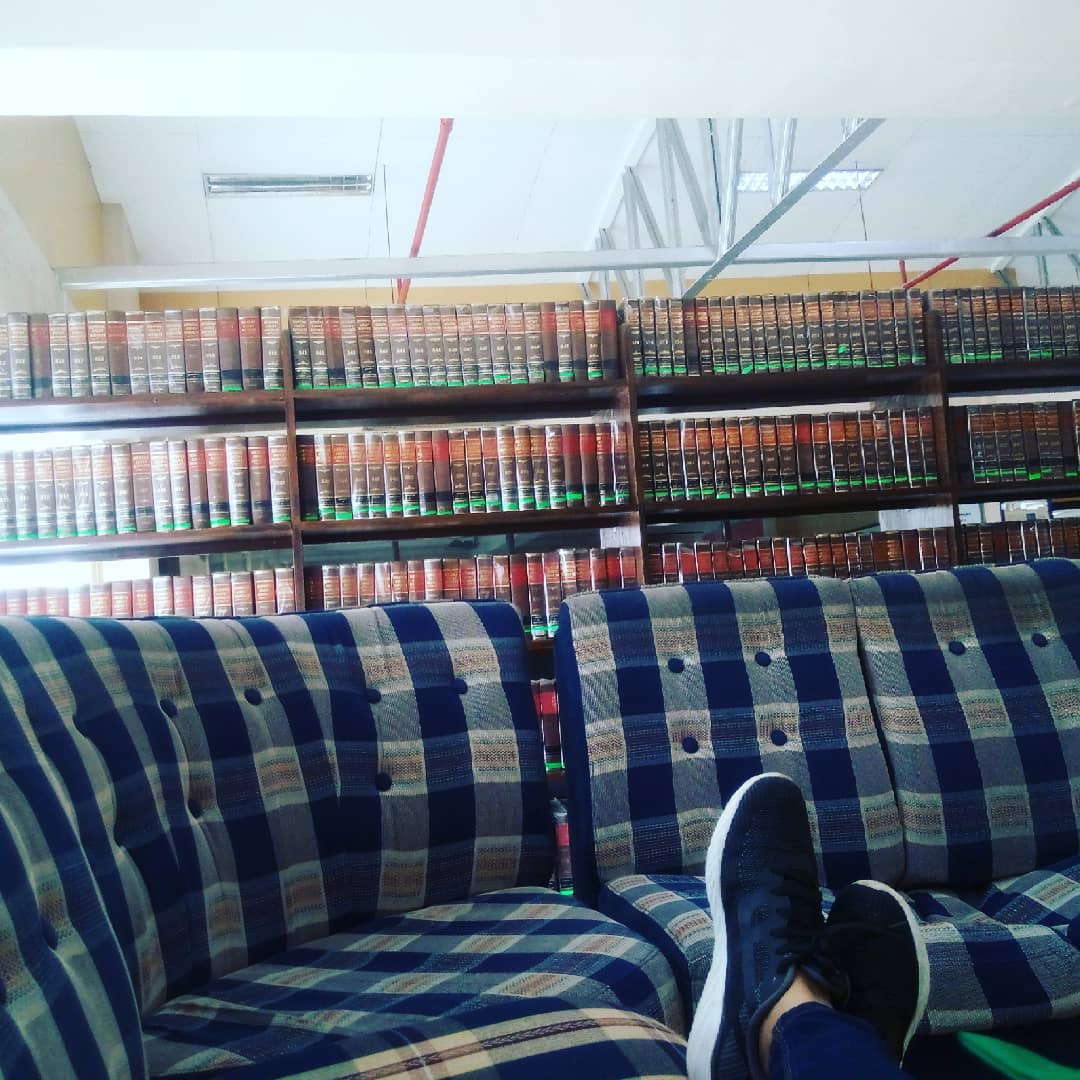
Recitations are my biggest enemies in law school. I can write decently, and I have no problem with written exams because I’m confident when I’m writing. But with recitations, you have to memorize a lot, and looking at your notes is a big no-no for most professors. In Criminal Law I, for example, we had to stand in front of the teacher without bringing anything with us. The recitations made up 20 percent of the grade, and you’ll be called only once during the whole semester. So if you mess it up, you’ll have to work your butt off to get really high marks in the written exams. That thought was enough to make me vomit every time we had a class for that subject. I thought it wasn’t that bad at first, but one afternoon, as I was preparing for class, I suddenly vomited right there at my table. (Praise the Lord that I wasn’t in the library that day!) The reaction came out of nowhere. That was when I realized that no matter how much I tell myself I’m okay, my body knows that I’m not.

The semester came and went in a blur. I had learned a lot, and I enjoyed the journey so much, but everything was just happening so fast. Frankly, I was mostly just surviving each day, curling up on my bed for a while, then preparing for the next battle. I wasn’t like most of my classmates who go on a study frenzy when they panic about their grades. Whenever I feel overwhelmed about law school, I clean. The level of anxiety can be quantified by how clean my room was. If all I did was tidy up a bit, that means I’m confident I’ll survive the day. If I did all the laundry in one go, that means I’m really anxious. But when I move the furniture around, that’s bordering on the I-can’t-do-this-I-wanna-go-home level. There are scuff marks on the floor because of how often I repositioned my bed.

During the second semester, I decided that I wanted to be nearer the teacher so I could concentrate more. Boy, was that the wrong move to take! I was seated so close to the teacher’s table that I was practically my teachers’ seatmate except that they were facing me. This was a nightmare for recitations because I could hardly dare sneak glances at my notes because that would be too obvious. I could practically see the wrinkles on my teachers’ oh so beautiful but really intimidating faces. To alleviate the problem, I talked to the board most of the time. This torture went on for a whole semester. Also, the university was not holding back on the expenses for electricity because I think they were trying to freeze us all in our classrooms. Back that up with scary questions and you’ve got a law student who’s shaking externally as much as internally.

Aside from the dreaded recitations, the task of checking grades was another source of anxiety for us poor beings. Looking at grades is an activity not meant for the weak at heart. The good thing about USC is that they give out midterm grades halfway through the semester, which makes it easier to see where you stand in class. Failure makes you work harder, and a passing mark makes you breathe easier.

Now that I think about it, it’s interesting to note the hand positions of law students whenever they’re checking their grades. Most of the time, we’d grab our chests. It is also common to hold on to a classmate’s arm after opening the exam booklet. We need the support. We’re literally holding on to someone and bracing ourselves.

Throughout the academic year, I did question my abilities a lot. Because of the difficulty of the materials and the standards set by the university, it’s easy to feel small and incapable. There were quite a few students who already left law school during the first few months. Those who stayed had to constantly remind themselves of the reason why they took this path in the first place.

I have yet to face the biggest challenges in the university, though. Our upperclassmen say that the first year is really the easiest one. If this were true, good luck and God bless to us hopefuls!

I Tried to be a Paperless Law Student, and Here’s What Happened

Most of my friends were shocked when I advertised that I was selling my law books online. They know how much I love hoarding books, and it’s so unlike me to get rid of them just like that, especially because the first semester has not ended yet. It had always been my dream to own a huge library someday, but there came a point in my life when I became so stressed out about seeing my law books occupying so much space in my shelves.

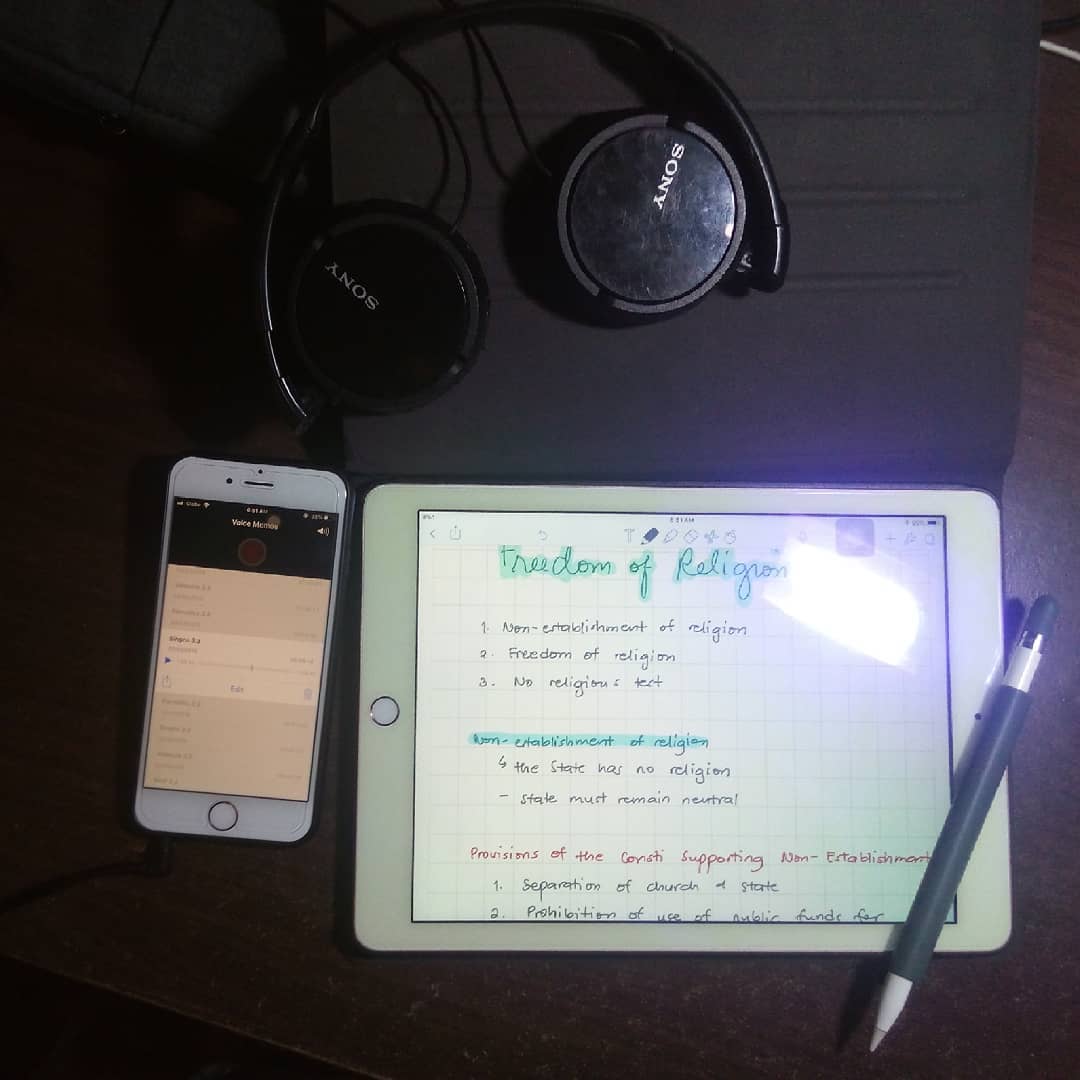
The obsession with going paperless started with a couple of chance encounters with the 2018 iPad on Youtube. A lot of student vloggers were using their iPads to take notes in class and to annotate books. After a few weeks of research, I finally decided that I wanted one. I convinced my dad to buy me the iPad and then sold my books the minute I got it. I was ecstatic. I only had to carry a small bag to school, and it was so easy to study with such a small device. The iPad made it easy to turn books into pdf and collate reading materials. Everything was there, my shelves took a breather, and I was happy. I ended the first semester using only my gadgets to make it through.

When the second semester started, I did the same thing. I was making notes using my laptop and reading books through my iPad. That system got me through pre-midterms, midterms, and pre-finals. Then my dilemma came when we approached finals week. I realized that I couldn’t understand criminal law that well when I’m not able to easily flip back to the pages to compare certain crimes as I was learning new ones. My digital notes were also becoming a problem when it came to recitations. When I was called for my first recitation in criminal law, I was asked about a particular crime and to provide its elements. I was able to do so because those were in my notes. Then our professor asked me to discuss two cases cited in the book and to compare them. Now that information was not in my notes because those cases were only examples and I didn’t deem them to be so important. I frantically flipped through my iPad to search for them, which was not an easy task because I had to go through the pages one by one to check if the information was there. Luckily, my seatmate saved me by shoving her book in my direction with the page opened on the cases I had to discuss. Ethel, if you’re reading this, a million thanks to you for saving my sorry ass.

I finally caved and decided that law school would not be as easy without having hard copies of the books to study. What the paperless system lacked is the ability to easily flip through multiple pages. Even if you had bookmarked them, it would still be hard to access those bookmarks quickly because you might have to scroll to get to there.

So I purchased the books for the second semester and repurchased the books for the first semester. Stupid move selling them in the first place, I know. But I guess I just had to experience that to find the balance and to discover the study mediums that work for me best. I still use my iPad, especially for cases because those are usually too many to print out. I still consider it a smart purchase because it provides me with the convenience of having a big enough screen to annotate files I have to read and don’t have the time to print out.

In summary, my journey to becoming a paperless student was a failure. Try as I may, there are just some things you learn better with good old actual paper.

People v. Dansico Case Digest (GR No. 178060)

People v. Dansico
GR No. 178060
February 23, 2011
Facts:
The appellants Romeo Dansico and Augusto Cuadra were charged with violation of Section 4, Article II of RA 6425 (The Dangerous Drugs Act of 1972) for the illegal sale of marijuana. They were arrested during a buy-bust operation conducted on September 7, 1998.
During the operation, the poseur-buyers informed the appellants that they wanted to buy Php5,000 worth of marijuana. They handed the buy-bust money to the appellants who left in a motorcycle to get the drugs. After about three hours, the appellants returned with a brick, allegedly the marijuana, wrapped in a newspaper. It was then that the police arrested the appellants. The team then proceeded to the NARGROUP Office where an officer prepared a booking sheet and the arrest report. The confiscated marijuana was placed in a plastic bag, which was then initialed by Inspectors Vargas and Paz.
On the other hand, the appellants contend that they were victims of frame-up and police extortion. According to them, Danisco had a farm where Cuadra worked. On the afternoon of September 7, 1998, Cuadra was on his way back to the farm when he was accosted by Inpector Vargas, who poked a gun at him. Then the latter struck the former’s head with a gun.
The RTC found Danisco and Cuadra guilty of the illegal sale of marijuana. The CA, on appeal, affirmed the decision.
The appelants contend that the two elements of the crime, namely (1) the sale and delivery of marijuana and (2) the knowledge of the sale of marijuana were not established. Furthermore, they contend that the evidence failed to establish the existence of the buy-bust operation.
Issue:
Were the RTC and CA correct in convicting the appellants?
Ruling:
Yes. To convict an accused of the illegal sale of marijuana, the prosecution must establish the following elements:
1. The identity of the buyer and the seller, the object of the sale, and the consideration and
2. The delivery of the thing sold and the payment
All these elements were duly proven during the trial. The fact that there was indeed a buy-bust operation was supported not only by the testimonies of Inspectors Vargas and Paz but also by the documentary evidence consisting of photocopies of the serial numbers of the marked money, a blotter showing the arrest of the appellants, the booking sheet and arrest report, and the joint affidavit of arrest of Inspector Vargas and a civilian volunteer.
The defenses of denial, frame-up, and police extortion only become weighty when inconsistencies and improbabilities cast doubt on the credibility of the prosecution evidence.

Social Justice Society v. Dangerous Drugs Board Case Digest (GR Nos. 157870, 158633, 161658)

Social Justice Society v. Dangerous Drugs Board
GR Nos. 157870, 158633, 161658
November 3, 2008
Facts:
Petitioners question the constitutionality of Section 36 of RA 9165, a.k.a. the Comprehensive Drugs Act of 2002. Section 36 requires mandatory drug testing of candidates for public office, students of secondary and tertiary schools, officers and employees of public and private offices, and persons charged before the prosecutor’s office with certain offenses, particularly those who are charged with offenses punishable by a penalty of not less than 6 years and 1 day of imprisonment.
On December 23, 2003, COMELEC issued Resolution 6486, which provides the rules on the mandatory drugs testing of candidates for public office. It requires the COMELEC offices and employees concerned to submit two separate lists of candidates: one for those who complied with the mandatory drug testing and the other of those who failed to comply.
It was Aquilino Pimentel, Jr. who opposed such resolution, contending that it was unconstitutional as it imposes an additional qualification for senators.
Issues:
1. Do Section 36(g) of RA 9165 and COMELEC Resolution 6468 impose an additional qualification for candidates for senator?
2. Is RA 9165 unconstitutional?
Ruling:
1. Yes. The COMELEC cannot, in the guise of enforcing and administering election laws or promulgating rules and regulations to implement Section 36, validly impose qualifications on candidates for senator in addition to what the Constitution provides. The COMELEC resolution effectively enlarges that qualification requirements for senator, enumerated under Section 3, Article VI of the Constitution.
2. The provision of RA 9165 requiring mandatory drug testing for students (Section 36[b]) are constitutional as long as they are random and suspicionless. This is because schools and their administrators stand in loco parentis with respect to their students, and schools have the right to impose conditions on applicants for admission that are fair and non-discriminatory.
The provision requiring mandatory drug testing for officers and employees of public and private offices (Section 36[d])  are also justifiable. The privacy expectation in a regulated office environment is reduced. A degree of impingement upon such privacy has been upheld. To the Court, the need for drug testing to at least minimize illegal drug use is substantial enough to override the individual’s privacy interest under the premises.
On the other hand, the Court finds no justification in the mandatory drug testing of those prosecuted for crimes punishable by imprisonment of more than 6 years and 1 day (Section 36[f]). The operative concepts in the mandatory drug testing are randomness and suspicionless. In this case, it cannot be said that the drug testing is random. To impose mandatory drug testing on the accused is a blatant attempt to harness a medical test as a tool for criminal prosecution, contrary to the stated objectives of RA 9165.
In sum, Section 36(c) and (d) are constitutional, but 36(f) is not.

People v. De Jesus Case Digest (GR No. 134815)

People v. De Jesus
GR No. 134815
May 27, 2004
Facts:
SPO3 Eugenio Ybasco was a policeman who worked for a money changer after his tour of duty. He delivered money for his employer every afternoon and uses a bicycle for the job. Sometime in February 1994, Dante Manansala, Eduardo de Jesus, and Crispin Del Rosario agreed to stage a robbery on March 7, 1994. Their financier was Christopher Nash, a British national.
They performed the robbery using a car owned by Nash. They confronted Ybasco and told him that he had a warrant of arrest. They grabbed Ybasco, handcuffed him, and dragged him to the car. Roberto Acosta, a roving security guard, saw the incident and pulled out his gun. As Del Rosario managed to wrest possession of the gun from Acosta, Manansala ordered Del Rosario to shoot, and the latter obeyed. Acosta expired.
The accused drove to Cabuyao, Laguna. They took the plastic bag containing the money, but instead of the $250,000 they expected, it contained only Php5,000. They then transported Ybasco to a sugar farm and told him he would be freed. Believeing that Ybasco would be freed, Del Rosario took Php80 from Ybasco’s wallet but returned Php50 for the latter’s fare. However, De Jesus suddenly shot Ybasco on the head.
De Jesus denied involvement in the robbery because he said he was not in the area as he was working as a tricycle driver at that time. The only reason why he was indicted was because Del Rosario, who was his brother-in-law, had held grudges against him. De Jesus said he only fled when he found out that there was a warrant of arrest against him because he was told that the other accused were physically tortured by the police.
The event was witnessed by Yolanda Dela Rapa, who knew the victim Ybasco because she sold cigarettes to him regularly.
Issue:
Is De Jesus guilty of robbery with homicide?
Ruling:
Yes. His alibi are intrinsically weak defenses and cannot prevail over the positive and straightforward identification made by Del Rosario. Alibi is easy to concoct and hard to disprove. His flight from justice works against him. According to the Supreme Court, flight is an indication of guilt. His reason that he feared for his life has no basis.
The Supreme Court also discussed the nature of robbery with homicide. In such crime, the original design of the malefactor is to commit robbery, with homicide perpetrated on the occasion or by reason of the robbery. The intent to commit robbery must precede the taking of human life. Homicide is said to have been committed by reason or on the occasion of robbery if, for instance, it was committed to (a) facilitate the robbery or the escape of the culprit; (b) to preserve the possession by the culprit of the loot; (c) to prevent discovery of the commission of the robbery; or, (d) to eliminate witnesses in the commission of the crime. As long as there is a nexus between the robbery and the homicide, the latter crime may be committed in a place other than the situs of the robbery.


Design a site like this with WordPress.com
Get started